
A Primer on Schools, Splits, and What Shaped Them
Buddhism is not one thing wearing different costumes in different countries. It’s closer to a river that split almost immediately after its source, then split again, and again, picking up sediment from every culture it passed through. What you see in a Ladakhi monastery, a Kyoto Zen garden, or a Bangkok wat are not regional flavors of the same product. They’re the accumulated result of two and a half thousand years of doctrine, politics, translation, and collision with older belief systems that refused to disappear.
This is a walk through that river, source to delta.
The Source: What the Buddha Left Behind
Siddhartha Gautama died, by most traditional reckonings, sometime in the 5th or 4th century BCE, without leaving a single written text. For roughly a hundred years, his teaching survived as oral transmission, monks reciting and cross-checking each other’s memory of what he’d said. There was no schism yet, only a Sangha, the monastic community, working from shared memory.
That didn’t last.
The First Crack: Sthavira and Mahasanghika
About a century after the Buddha’s death, at what’s traditionally called the Second Buddhist Council, the community split for the first time. The immediate trigger, according to most textual sources, wasn’t grand philosophy. It was a dispute over Vinaya, the monastic rule book, specifically over a proposal by a group of reform-minded elders to tighten or alter existing rules. The larger body rejected the changes. The reformers split off and became the Sthavira Nikaya, the “Sect of the Elders.” The majority who stayed became the Mahasanghika, the “Great Community.”
This undercuts a common assumption: the first fracture in Buddhism wasn’t about whether there’s a self, or what enlightenment means, or how many Buddhas there are. It was an argument about discipline and organization. Doctrine came later, riding on top of an already-divided institution.
The Mahasanghika’s more expansive, almost devotional view of the Buddha’s nature, treating him as something closer to transcendent and cosmic rather than simply an awakened teacher, is now generally seen by scholars as an early seed of what would become Mahayana centuries later.
The Eighteen Schools
From those two initial camps, the Sangha kept fracturing, mostly along doctrinal and geographic lines, over the following few centuries. Tradition settled on the number eighteen for how many schools eventually existed, though the actual historical count and the specific names vary wildly depending on which ancient source you’re reading. Different chronicles list different eighteen. Some scholars think “eighteen” became more of a formula than a literal headcount.
A few of these schools matter enough to name specifically, because their fingerprints are still visible in Buddhism today:
Sarvastivada (“the doctrine that all exists”) became hugely influential in northwest India and Kashmir. Its Abhidharma, the highly systematic philosophical analysis of mind and phenomena, fed directly into later Mahayana philosophy. A subgroup called Sautrantika broke off, rejecting the Sarvastivadin Abhidharma and insisting only the actual sutras carried authority.
Pudgalavada, also called Vatsiputriya, took the controversial position that there’s a “person” (pudgala) that’s real in some limited sense, neither identical to nor fully separate from the five aggregates that make up a being. This was their attempt to explain how karma and rebirth work without smuggling in a permanent soul, and it made them the most argued-with school in Buddhist history; virtually everyone else considered this dangerously close to violating the core teaching of no-self.
Sammitiya, a Pudgalavada offshoot, was for a long stretch of Indian history the single largest Buddhist group by number of followers, larger than every other school combined, something that surprises most people who’ve only heard of Theravada and Mahayana.
Dharmaguptaka spread through Gandhara and Central Asia along the Silk Road, and its Vinaya, its ordination lineage, became the one that took root in China, and from there in Korea and Vietnam. If a monk in East Asia today traces their ordination lineage back far enough, it likely runs through this school, not through the Theravada line at all.
Vibhajyavada (“the analysts”) is the broad lineage that Theravada itself claims descent from, via a further sub-branch based in Sri Lanka.
Of all eighteen, only one still exists as a living, continuous tradition.
Theravada: The One That Survived Intact
Theravada, “the Teaching of the Elders,” is the only early school still practiced today essentially unbroken. It reached Sri Lanka via the monk Mahinda, traditionally said to be the son of Emperor Ashoka, and there the scriptures were eventually written down in Pali, giving us the Pali Canon, the most complete surviving record of any early Buddhist school’s teachings.
Interestingly, the term “Theravada” itself wasn’t in common use until roughly the 4th century CE, centuries after the school’s actual roots. The Sri Lankan Mahavihara monastery tradition worked hard, starting with a chronicle called the Dipavamsa, to identify itself as the sole true continuation of the original Sthavira lineage. Historically that claim is more asserted than proven, but it stuck, and it worked: Theravada spread from Sri Lanka into Myanmar, Thailand, Cambodia, and Laos, and remains the dominant form of Buddhism across mainland Southeast Asia.
Core Theravada emphasis: individual liberation through your own sustained effort, becoming an arhat, someone who has personally extinguished craving and won’t be reborn. The path runs through ethical conduct, meditation, and wisdom, laid out most famously in the Noble Eightfold Path. There’s no expanded pantheon of celestial bodhisattvas here, no tantric ritual technology. It’s comparatively austere, and it thinks of itself as the closest living approximation to what the historical Buddha actually taught and practiced.
The Second Great Split: Mahayana Emerges
Somewhere between the 1st century BCE and 1st century CE, a new self-description starts appearing in the textual record: Mahayana, “the Great Vehicle.” Crucially, and this surprises people, Mahayana was never an organized separate sect the way Theravada was. It didn’t have its own ordination lineage or its own Vinaya. A Mahayana monk in medieval India was still ordained into one of the eighteen early schools, most often Dharmaguptaka or Mulasarvastivada, and layered Mahayana philosophy and practice on top of that existing monastic identity. Mahayana was less a competing institution and more a movement, a set of new texts, ideals, and metaphysical claims that spread through existing structures.
The animating idea: don’t just aim to liberate yourself. Vow to liberate all beings first, delaying your own final release out of compassion. This is the bodhisattva ideal, and it’s the single clearest dividing line, philosophically, between Mahayana and everything that came before it.
Mahayana also dramatically expanded the cast of characters and the canon. New scriptures, the Prajnaparamita literature, the Lotus Sutra, the Heart Sutra, the Avatamsaka (Flower Garland) Sutra, introduced a universe crowded with celestial bodhisattvas (Avalokiteshvara/Chenrezig, Manjushri, Tara), multiple Buddhas existing simultaneously across countless world-systems, and philosophical concepts like emptiness (shunyata) worked out with far more elaborate logical machinery than earlier Abhidharma had attempted.
Mahayana spread north and east out of India, into Central Asia, then China, and from China into Korea, Japan, and Vietnam, along with a separate current into Tibet. Southeast Asia, by contrast, stayed largely Theravada.
Vajrayana: Mahayana’s Tantric Turn
Vajrayana, “the Diamond Vehicle” or “Thunderbolt Vehicle,” isn’t a third separate branch alongside Theravada and Mahayana, despite how casually people group the three side by side. It’s a tantric development within Mahayana, built directly on the bodhisattva foundation but adding an accelerated, ritually dense method on top: mantra recitation, mandala visualization, deity yoga (visualizing yourself as an already-awakened being rather than praying to one as separate from you), and initiation from a qualified teacher as a formal prerequisite for many practices.
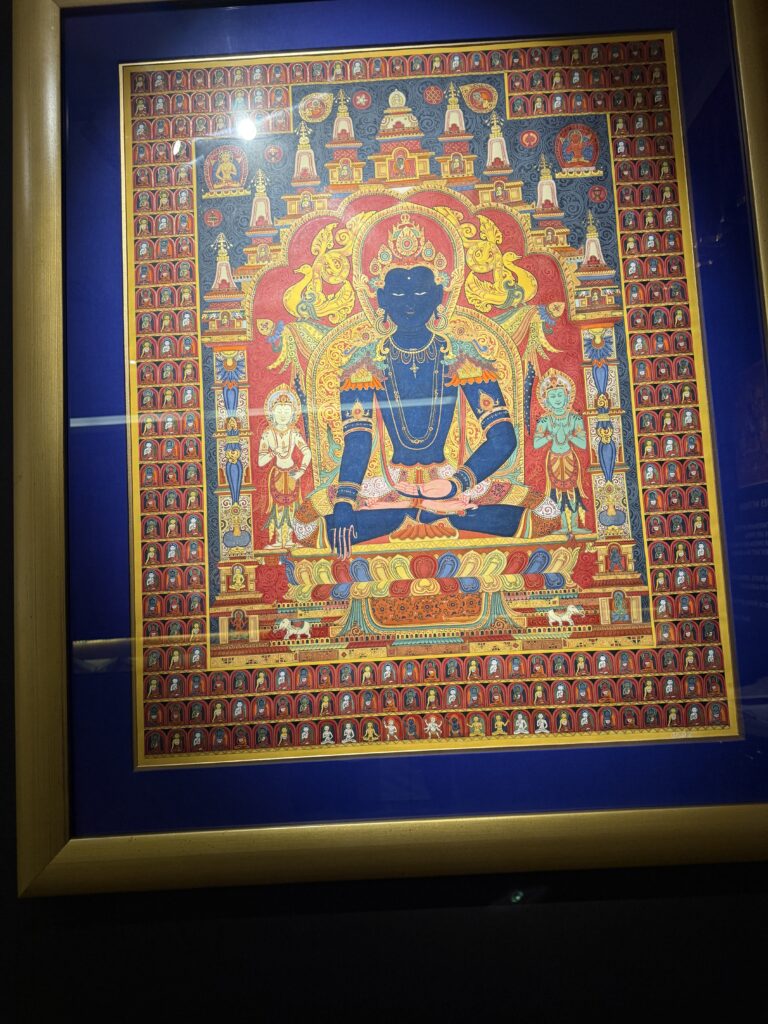
The core Vajrayana claim is speed. Standard Mahayana generally frames full Buddhahood as a project spanning countless lifetimes of accumulated merit and wisdom. Tantra claims a practitioner can traverse that same distance within a single lifetime, by working directly with body, breath, and subtle energy rather than only through gradual ethical accumulation.
Esoteric Buddhism reached China during the Tang dynasty and had real influence there for a period, and it also crossed into Japan, where it survives today as Shingon. But it’s in Tibet that Vajrayana became the dominant, defining form of the entire religious culture, not one current among several but essentially the whole architecture of practice.
Tibet’s Four Schools
Buddhism reached Tibet starting around the 7th and 8th centuries CE, and it didn’t arrive into a religious vacuum. It arrived into a landscape already populated by Bon, an indigenous Tibetan tradition built around animism, shamanic ritual, nature spirits, and a priestly class mediating between the human and spirit worlds. Rather than erasing Bon, Tibetan Buddhism absorbed enormous amounts of it. The protector deities, the wrathful imagery, the mountain and lake spirits still propitiated at monasteries today, the entire visual and ritual texture that makes Tibetan Buddhism look so different from Theravada, is substantially built on this Bon substrate. Bon itself survived as a distinct tradition too, and today looks so structurally similar to Tibetan Buddhism, with its own monasteries, its own canon, its own version of the four schools, that separating “what’s Buddhist” from “what’s Bon” in Tibetan religious culture is genuinely difficult even for specialists.
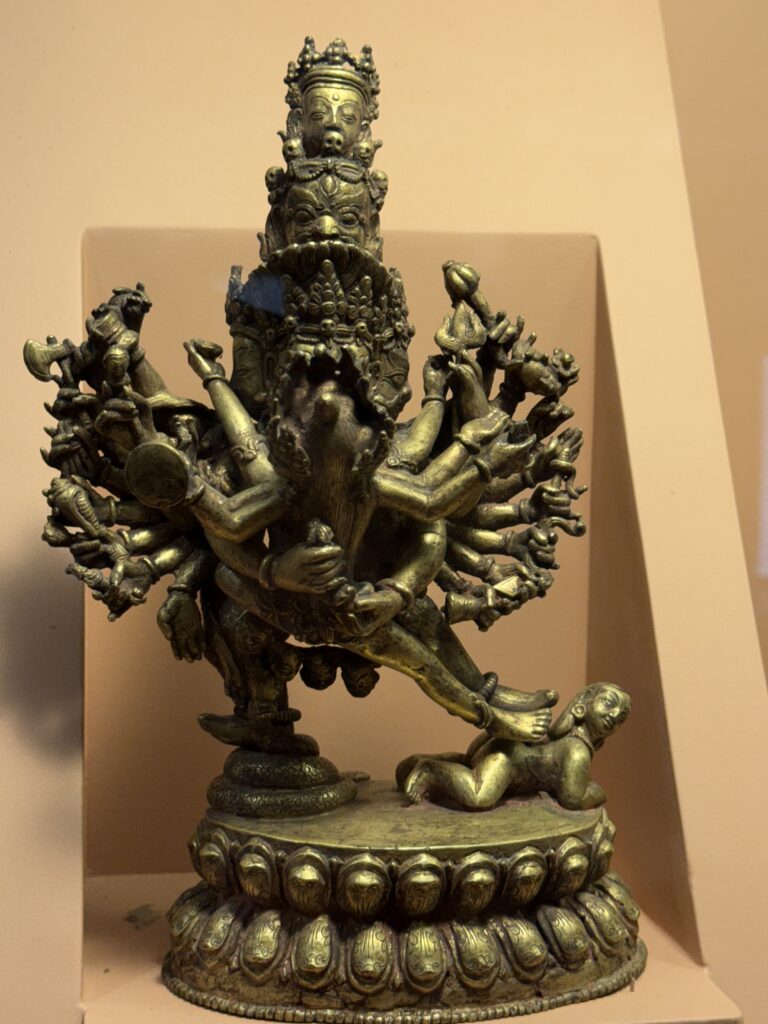
Out of that fusion, four principal schools of Tibetan Buddhism developed:
Nyingma (“the ancient ones”) is the oldest, tracing its founding transmission to the 8th-century tantric master Padmasambhava, Guru Rinpoche, who is central to Ladakhi and broader Himalayan devotion. Nyingma preserves the earliest wave of tantric teachings brought into Tibet and places heavy emphasis on Dzogchen, the “Great Perfection,” a set of teachings on directly recognizing the nature of mind.
Kagyu (“oral lineage”) emphasizes direct, meditation-focused transmission from teacher to student, historically favoring intensive retreat practice over pure scholasticism. It’s the lineage headed by the Karmapa, and it’s the lineage of the monastery you visited in Choglamsar. Kagyu produced Milarepa, probably the most famous yogi-poet in Tibetan history, and its Karma Kagyu sub-branch was historically among the most politically influential of the four schools before the rise of the Gelug.
Sakya takes its name from the monastery where it was founded in the 11th century, and historically produced some of Tibetan Buddhism’s most rigorous scholastic and philosophical work. Sakya lamas briefly held political rule over Tibet in the 13th century under Mongol patronage, a precedent that mattered later.
Gelug (“virtuous ones”), the newest of the four, founded in the early 15th century as a reform movement emphasizing monastic discipline and structured philosophical study. This is the school of the Dalai Lama, and it’s the “Yellow Hat” school, named for the distinctive ceremonial headwear. Gelug eventually became the politically dominant school in Tibet, a position cemented once the Dalai Lama lineage gained both religious and temporal authority.
All four schools share the same basic Vajrayana toolkit, tantra, mandala, deity practice, and all sit on the same Bon-influenced cultural foundation, but differ in which specific tantric lineages they emphasize, how much weight they give scholastic study versus meditative retreat, and their historical relationships to political power.
Buddhism Meets China: A Different Kind of Collision
Buddhism entered China around the 1st century CE, probably carried by traders along the Silk Road, and it walked into a civilization that already had two deeply entrenched intellectual and spiritual systems: Confucianism and Daoism.
Confucianism is fundamentally this-worldly: social order, filial duty, correct relationships, the cultivation of virtue within family and state. It had essentially no interest in rebirth, karma, or liberation from suffering, and in fact found the Buddhist monastic ideal, men leaving their families and abandoning social obligation to become celibate renunciants, actively offensive to Confucian values. This tension produced real hostility across Chinese history, including periodic state persecutions of Buddhism, the worst being the Great Anti-Buddhist Persecution of 845 CE, in which, by traditional accounts, thousands of temples were destroyed and hundreds of thousands of monks and nuns were forced back into lay life.
Taoism, by contrast, shared enough surface vocabulary with Buddhism, the ineffable, the return to a natural or original state, non-action, that early Chinese translators actually borrowed Taoist terms to render Buddhist concepts, which shaped how the Chinese understood Buddhist ideas from the very beginning. Taoist alchemical and meditative practice also blended into later Chinese Buddhist practice in ways that are hard to fully untangle.
Out of this friction and fusion, distinct Chinese schools formed, most of them centered on organizing the entire, sprawling, sometimes contradictory mass of imported Indian scripture into one coherent system:
Tiantai, founded by the monk Zhiyi in the 6th century, took the Lotus Sutra as supreme and built an elaborate system for ranking and reconciling all of the Buddha’s other teachings underneath it.
Huayan, emerging slightly later, built its entire worldview on the Avatamsaka Sutra and its vision of total interpenetration, every phenomenon in the universe reflecting and containing every other phenomenon simultaneously. This is some of the most philosophically ambitious material in the entire Buddhist tradition.
Pure Land, associated with monks like Tanluan, Daochuo, and Shandao, offered something radically simpler: faithful devotion to Amitabha Buddha and sincere recitation of his name, with the promise of rebirth in his Pure Land, a far more accessible practice than years of monastic discipline or philosophical study. This simplicity is exactly why Pure Land became, and remains, one of the most widely practiced forms of Buddhism across East Asia at the popular level.
Chan, the school that would eventually become Zen in Japan, traced its lineage back to the semi-legendary Indian monk Bodhidharma and developed a self-image built on “transmission outside the scriptures,” direct mind-to-mind pointing toward awakening rather than textual study. Chan absorbed real Daoist sensibility, its love of paradox, spontaneity, and suspicion of over-conceptualizing.
Of these schools, Chan and Pure Land proved the most durable, largely because they were rooted in practice and devotion rather than large institutional libraries and scholarly infrastructure, which meant they survived the 845 persecution in far better shape than the more academically dependent Tiantai and Huayan. A well-known saying captures how Chinese Buddhism eventually settled into rough functional harmony rather than rigid sectarian warfare: doctrine belongs to Tiantai and Huayan, practice belongs to Chan and Pure Land.
Buddhism Reaches Korea
Buddhism arrived in Korea from China in the 4th century CE, into a peninsula whose indigenous religious life centered on shamanism, spirit mediums, ancestor veneration, and nature worship, and Korean Buddhism absorbed elements of that shamanic backdrop the way Tibetan Buddhism absorbed Bon.
The monk Wonhyo, in the 7th century, became one of Korean Buddhism’s most important figures by explicitly trying to harmonize competing doctrinal schools rather than pick a winner, an approach called tong bulgyo, “interpenetrated Buddhism.” His contemporary and friend Uisang studied Huayan directly in China and brought it back, establishing Hwaeom (the Korean pronunciation of Huayan) as the dominant doctrinal current in Korea for centuries.
Chan Buddhism reached Korea via students who traveled to study with Chinese masters and returned to found what became known as the Nine Mountain Schools of Seon, Seon being the Korean word for Chan/Zen, all of them tracing lineage back to the Chinese Chan patriarch Huineng. These nine schools eventually reorganized under the name Jogye, after the mountain in China where Huineng resided, becoming what is today the Jogye Order, still the largest Buddhist institution in Korea.
Korean Buddhism went through its own severe persecution during the Joseon dynasty, which adopted neo-Confucianism as state orthodoxy and pushed Buddhism to the social margins, driving monks out of the cities and into the mountains for roughly five hundred years. Modern Korean Buddhism still bears the mark of that exile; its mountain-monastery culture is partly a direct legacy of Confucian-era suppression rather than pure religious preference.
Buddhism Reaches Japan: Layered on Top of Shinto
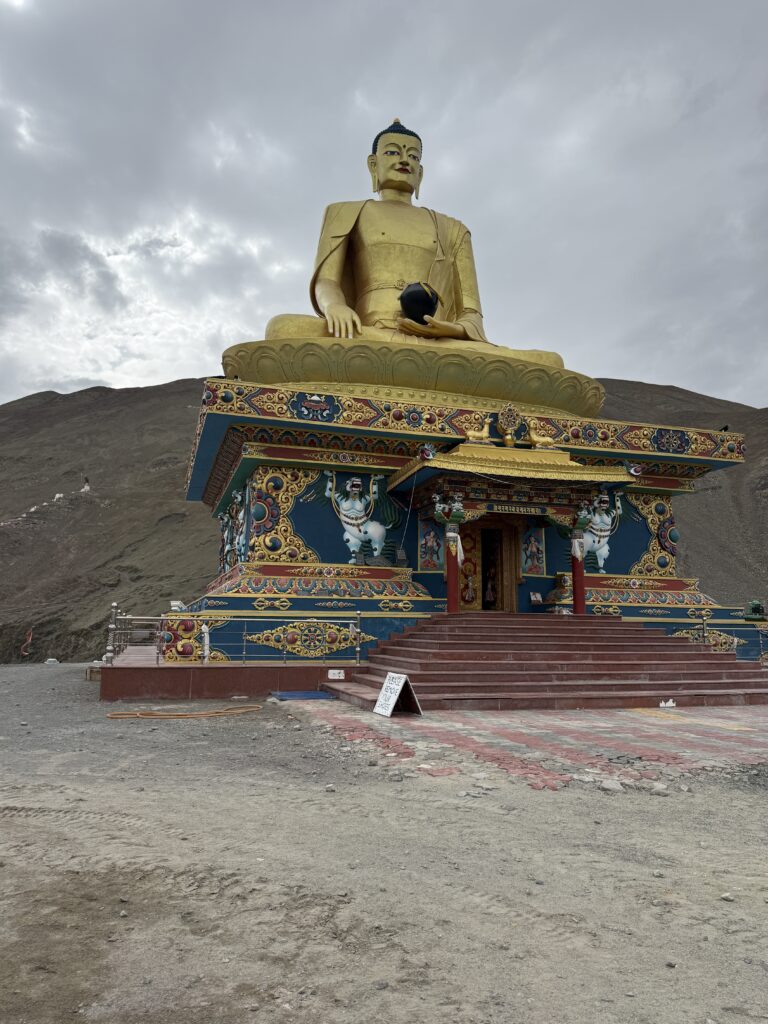
Buddhism arrived in Japan by way of Korea and China around the 6th century CE, entering a culture whose indigenous religious system, Shinto, centered on kami, spirits or deities associated with natural features, ancestors, and specific places. Rather than the two systems fighting to displace each other, Japan developed a durable, centuries-long habit of holding both simultaneously, a Shinto shrine for this occasion, a Buddhist temple for that one, without treating it as contradictory. That syncretic comfort with multiple religious systems at once is still visible in Japan today.
Japanese Buddhist history moves in fairly distinct waves:
The Nara period (710-794) produced the Six Nara Schools, Ritsu, Jojitsu, Kusha, Sanron, Hosso, and Kegon (the Japanese reading of Huayan), largely scholarly, state-sponsored, and philosophical rather than devotional. Very few adherents remain today, but the temples themselves, like Todaiji, are still standing as some of the largest wooden structures on Earth.
The Heian period (794-1185) brought two monks who had studied in China, Saicho and Kukai, home with new schools that would define esoteric Japanese Buddhism. Saicho founded Tendai (the Japanese Tiantai) on Mount Hiei, and Kukai founded Shingon, centered on Mount Koya, deeply tantric, ritually ornate, and strikingly similar in flavor to Tibetan Vajrayana, incorporating mandalas, mantra, and initiation. Mount Hiei, Tendai’s home base, became something like the graduate school of Japanese Buddhism; nearly every major reformer of the following Kamakura period trained there first before founding their own breakaway school.
The Kamakura period (1185-1333) is where Japanese Buddhism fractures into the popular, accessible forms that still dominate practice today. Honen founded Jodo-shu (Pure Land), teaching that sincere recitation of Amida Buddha’s name (the nembutsu) was sufficient for rebirth in his Pure Land, a radical simplification aimed squarely at ordinary people rather than monastic elites. His student Shinran pushed this further into Jodo Shinshu (True Pure Land), arguing salvation came entirely through Amida’s grace (“other-power”) rather than any personal effort at all, a position that let married, non-monastic practitioners fully participate, and Jodo Shinshu remains the single largest Buddhist denomination in Japan today.
Eisai brought Rinzai Zen from China, emphasizing koan practice, paradoxical questions designed to jolt the mind past ordinary logic toward sudden insight. Dogen founded Soto Zen, emphasizing shikantaza, “just sitting,” a more gradualist, less confrontational approach to the same seated meditation practice. The two schools share the same root, Chan, but differ meaningfully in method and temperament, closer to two dialects than two languages.
Nichiren, the most confrontational figure of the period, studied across nearly every existing Japanese school, Tendai, Shingon, Pure Land, the Nara schools, before concluding that only the Lotus Sutra held the complete truth, and that devotion to it, chanting Namu Myoho Renge Kyo, was the sole valid path for the current degenerate age of the Dharma. He was unusually willing to publicly attack every other Buddhist school by name as inadequate or false, which made him one of the more genuinely controversial figures in the tradition’s history, and got him repeatedly exiled.
Soka Gakkai, founded in 1930 and rooted directly in Nichiren’s teaching, became one of the largest lay Buddhist movements in the world in the 20th century, notable for being explicitly lay-led rather than monastic, evangelistic in a way most Buddhist schools historically weren’t, and politically active, it even founded Japan’s Komeito political party in 1964. It’s a useful data point for how far the tradition can stretch: from silent forest monks sitting with a begging bowl to a modern, globally networked lay organization running voter drives, all claiming the same root teacher.
What This Adds Up To
Lay the whole thing out and a pattern becomes visible. Buddhism never simply arrived somewhere and stayed the same shape. It arrived, met an existing belief system already deeply embedded in that culture, Bon in Tibet, Daoism and Confucianism in China, shamanism in Korea, Shinto in Japan, and the resulting form of Buddhism practiced there is the residue of that specific collision. Tibetan Buddhism’s wrathful deities and mountain spirits are Bon showing through. Zen’s suspicion of words and love of paradox is Taoism showing through. Japan’s comfort holding Shinto and Buddhism simultaneously without contradiction is a specifically Japanese religious habit that Buddhism had to accommodate, not override.
None of these branches are more authentically “Buddhist” than the others in any way that survives serious historical scrutiny. Theravada’s claim to be the closest living link to the historical Buddha is a real and reasonable claim, but it’s also a claim that was actively constructed and asserted by the Sri Lankan Mahavihara tradition centuries after the fact, not a simple, uncontested fact of transmission. Every branch, Theravada included, is the product of choices, splits, translations, and cultural absorption stretched across two and a half thousand years.
Which is really just to say: what I sat inside in Choglamsar wasn’t a pure, unbroken transmission from the Buddha’s own mouth. It was the accumulated weight of India, Tibet, Bon animism, the Karma Kagyu lineage, and roughly thirteen centuries of continuous adaptation, all compressed into one room, one horn call, one morning.
I’ve been asked – is Baoism a form of Buddhism? My answer to that question is impossible because of course it is but how could it be? Buddhism isn’t really a thing. It is many things, infinite things, and Baoism can contain them all and also many things that are not Buddhism at all, just like Buddhism does.