
Hinduism, Islam, Christianity, and the Other Faiths
(Note: I like to include photos I’ve taken in my posts but technology is fundamentally broken. Unlike the 1990s and 2000s – things are not designed to work. My self-hosted WordPress installation has broken and won’t let me upload more photos. If I were working within a walled garden, the uploads would work. This is frustrating and I’ve gone down several rabbit holes to fix it without resolve. Ultimately, the entire http/https infrastructure is corrupted and broken. That, however, is not what this post is about. I apologize for the lack of pictures, but hope the words carry the images – CD)
Previously, I traced Buddhism’s family tree, the splits, the schools, the collisions with Confucianism, Daoism, and Shinto that gave us Zen gardens and Yellow Hat monks and everything between. That’s the internal story, Buddhism becoming many Buddhisms.
This is the external story. What happens when Buddhism runs into religions that didn’t grow up next to it, the Abrahamic faiths and, at its own root, Hinduism. Some of these encounters produced quiet blending that lasted centuries. One produced an entirely new religion, deliberately engineered to contain them all.
Hinduism: There Was Never a Clean Line
Start here because it’s the one case where “syncretism” undersells what actually happened. Buddhism didn’t meet Hinduism as an outside tradition running into it later. Both grew out of the same Indic religious and philosophical soil, sharing vocabulary, cosmology, and even some of the same deities from the very beginning. Calling their overlap a fusion is a bit like calling two rivers from the same spring a merger.
Two places show how far that overlap can still run today.
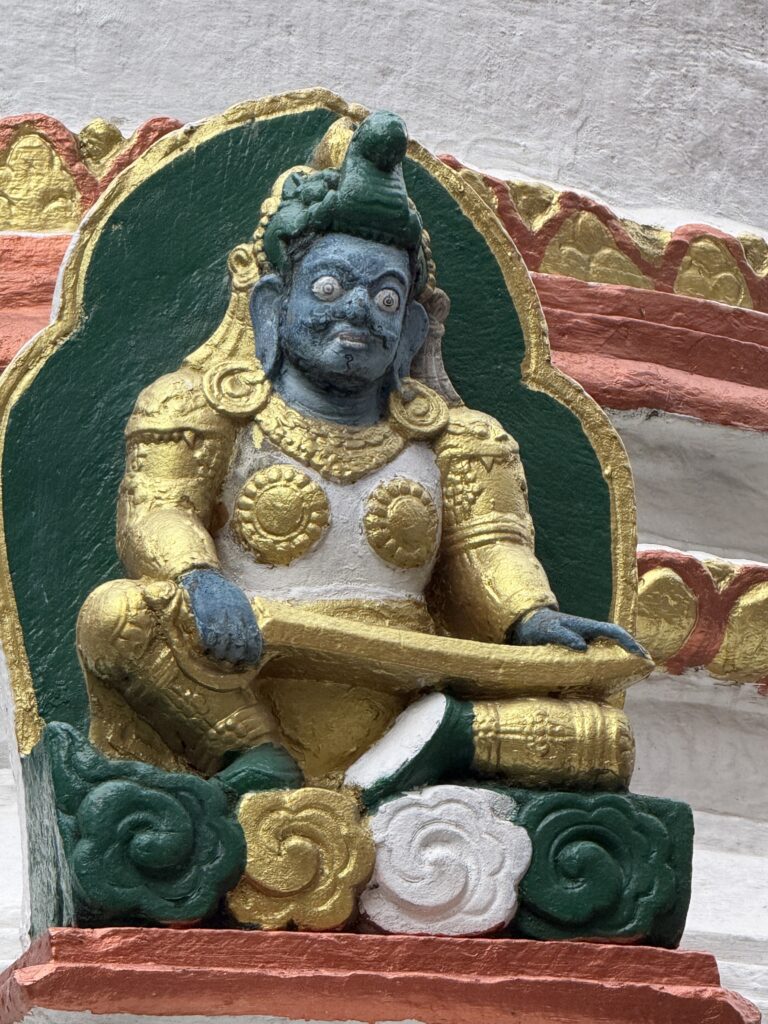
The Kathmandu Valley is home to the Newar people, whose religious life doesn’t sort cleanly into either category. Nepalis regard the Buddha as the ninth avatar of Vishnu. Buddhists in the valley worship fierce Hindu deities like Mahakala as protectors of the Dharma. At major pilgrimage sites, a Hindu priest and a Buddhist priest will perform rituals in the same courtyard, each serving their own community without treating the other as a rival tradition. Newar Buddhism itself is a specific, heavily tantric strand of Vajrayana that developed under centuries of close contact with Hindu caste structure and ritual, to the point that scholars still debate whether to call it syncretism or, less charitably, Hindu absorption of a weakened local Buddhism.
Bali runs a parallel, more formalized version. Balinese religion includes a functioning Śiva-Buddha priesthood, tracing back to two distinct 16th-century lineages, one Śaiva, one Buddhist. Buddhist priests still participate in Bali’s most important ceremonies today, chanting and invoking protective deities alongside the Śaiva clergy who lead the rites, a living division of labor between the two traditions inside a single ceremonial structure.
Underneath both examples sits a deeper truth: Vajrayana Buddhism itself, the tantric current that defines Tibetan and Newar practice alike, drew heavily on Hindu tantra to begin with. Mandala structure, mantra, deity yoga, even specific figures like Tara, trace back through shared or overlapping tantric sources rather than one tradition simply borrowing wholesale from the other.
Islam: Mostly Antagonism, With One Deep Exception
The broad historical relationship between Buddhism and Islam is not a gentle one. The Islamic conquests of India, culminating in the destruction of major centers like Nalanda, are a significant part of why Buddhism nearly disappeared from the land of its own birth. This wasn’t a slow cultural blending. It was, in large stretches, a genuine displacement.
But there’s one place where real, sustained contact produced something closer to fusion, and it happens to sit right along the old trade corridor between India, Persia, and Central Asia.
Balkh, in what’s now northern Afghanistan, was a major Buddhist center before the Islamic conquests, home to the Nawbahar monastery. When the region fell in the early 8th century, the monastery’s own keepers, the Barmakid family, converted and rose to become powerful viziers in the Abbasid caliphate, becoming key brokers who carried Indian and Buddhist learning into the Islamic intellectual world. Balkh later produced Rumi, the most influential Sufi poet in history, and that’s not simply a coincidence of geography. Scholars tracing the roots of Sufi mysticism keep landing back in exactly this region, during exactly the period Sufism was taking its early shape.
A lot of the specifically Buddhist material that reached early Sufism arrived secondhand, filtered through Manichaeism, a now-extinct Central Asian religion that had already absorbed heavy Buddhist influence and then had extensive direct contact, including formal theological disputes, with the early Islamic world. One traceable example: stories of the Buddha’s past lives were adapted into Manichaean form, then rendered into Arabic, and eventually migrated all the way into medieval Christian Europe as the legend of Barlaam and Josaphat, a canonized Christian saint’s story that started out as Jataka tales about the Buddha, mutating across three religions and several centuries in transit.
There’s also a real conceptual resonance worth naming carefully. The Sufi idea of fana, the annihilation of the individual self through merging into the Divine, sits close to the Buddhist realization of sunyata, emptiness, as the dissolution of a fixed separate self. They’re not identical claims, Sufism still operates inside a monotheistic frame where the self dissolves into God, while Buddhist emptiness doesn’t posit a God to dissolve into, but the experiential vocabulary the two traditions use to describe the process overlaps closely enough that comparative mystics have drawn the line between them for centuries.
Two places show where this actually became lived, everyday practice rather than abstract resemblance:
Java, where the Sufi mystics who first carried Islam into the archipelago in the 12th through 15th centuries arrived into a population still steeped in centuries of Hindu-Buddhist civilization. What resulted is a soft, absorptive, mystical form of Islam, still visible today as Kejawen, where Sufi self-annihilation sits comfortably alongside older Buddhist and Hindu liberation concepts rather than replacing them.
Baltistan, in the mountains of Pakistan-administered Kashmir, close to the region I’m traveling through right now, where local Islamic practice, strongly Sufi in character, absorbed elements of Tibetan Buddhist meditation technique directly into Islamic ritual life.
Christianity and Judaism: Real, But Mostly Personal Rather Than Institutional
Neither Christianity nor Judaism produced a lasting syncretic religious institution the way Islam’s contact with Buddhism eventually shaped Sufism in Central Asia. What exists instead is thinner, later, and more individual.
The oldest documented contact runs through the Silk Road, where Nestorian Christian communities coexisted with Buddhist monasteries across Tang-dynasty China and Central Asia. There was genuine cross-pollination of vocabulary and iconography between the two, but it never crystallized into a merged tradition the way Buddhism and Bon did in Tibet, or Buddhism and Shinto did in Japan.
In the modern West, the pattern is different again: not institutional merger but personal dual belonging. It’s common enough to have its own informal shorthand, “JuBu,” for people who hold Jewish identity and ethical practice alongside Buddhist meditation, treating the two as compatible layers rather than competing claims. Thomas Merton’s late-life turn toward Zen dialogue is the most famous Christian case, a serious, monastic engagement with Buddhist practice that he pursued without abandoning his own Catholic vows. This is real and fairly widespread today, but it lives in individual practice and interfaith dialogue rather than in any formal merged church or sect.
Cao Dai: A Case of Deliberate, Engineered Synthesis
Every example above is a story of gradual proximity, centuries of shared geography slowly blending vocabulary, ritual, and cosmology. Cao Dai is the opposite. It’s a religion built on purpose, in the 20th century, by people who set out specifically to fuse the world’s major traditions into one system.
Founded in Vietnam in 1926 by Ngo Van Chieu, a Vietnamese colonial official who reported receiving revelations through spiritualist seances, Cao Dai explicitly combines Confucian ethics, Taoist ritual practice, Buddhist theories of karma and rebirth, and a hierarchical church structure, complete with a pope, cardinals, and archbishops, borrowed directly from Roman Catholicism. Islam and Hinduism are woven in as well, and its pantheon of venerated figures runs from the Buddha and Confucius to Jesus, Muhammad, Joan of Arc, and Victor Hugo, all treated as messengers of the same underlying divine truth arriving at different points in history.
Cao Dai claims somewhere between 2.5 and 6 million adherents in Vietnam today, making it one of the country’s largest religions after Buddhism and Catholicism, and it stands as close to a controlled experiment as exists in comparative religion: what happens when you take everything discussed above, centuries of gradual, accidental blending between Buddhism and its neighbors, and instead try to build the blend deliberately, all at once, as an act of design.
The Shape of It
Line all of this up next to the schools primer and a second pattern shows up, distinct from the first one. Internally, Buddhism kept splitting and re-forming as it moved, Theravada, Mahayana, Vajrayana, the four Tibetan schools, the eight Chinese schools, the Kamakura explosion in Japan. Externally, its contact with other major world religions followed a much more geography-dependent rule: real fusion happened wherever two traditions shared the same villages, the same trade routes, the same intermarrying populations for centuries, Hindu-Buddhist Nepal and Bali, Sufi-Buddhist Central Asia and the Himalayan borderlands. Where contact stayed thinner or arrived later, colonial-era Christianity, the modern Jewish-Buddhist crossover in the West, the blending stayed personal and philosophical rather than institutional.
And then there’s Cao Dai, sitting entirely outside that rule: proof that under the right specific historical pressure, colonial Vietnam, sitting under French Catholic rule while still steeped in Chinese-derived Buddhism, Taoism, and Confucianism, someone can simply decide to build the synthesis on purpose, rather than wait for centuries of proximity to do it for them.