
Every cheap property town in Japan has a story. The story usually goes like this: beautiful setting, fascinating history, incredible price, three and a half hours from the nearest city with a hospital and a department store. The house costs $8,000. Getting to civilization costs you half a day.
Otaru’s story goes differently.
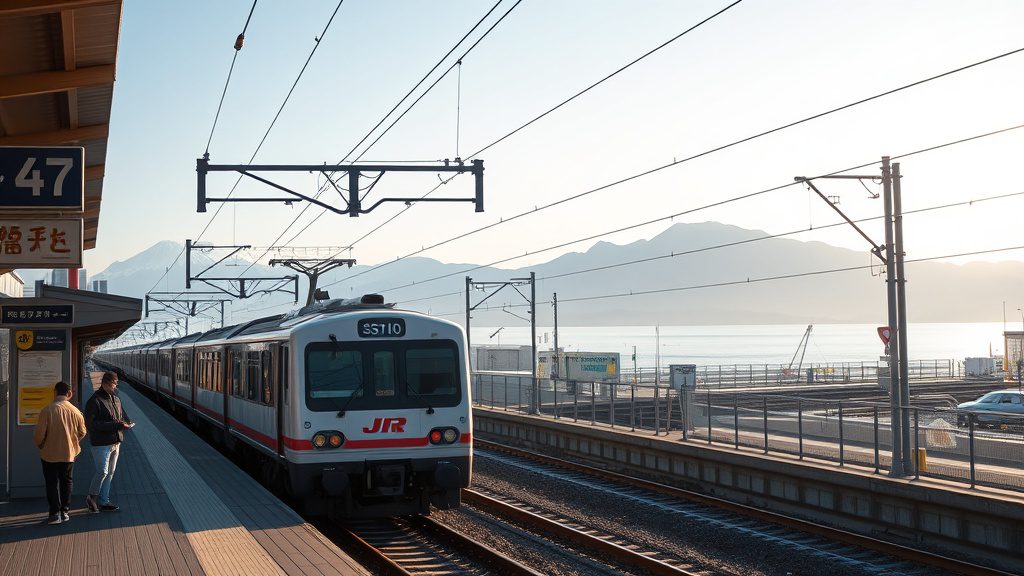
JR Rapid Airport train. Platform 4 at Otaru Station. Thirty-two to thirty-five minutes to Sapporo. Seven hundred and fifty yen. Trains every fifteen to twenty minutes from early morning until late at night.
That’s it. That’s the article. Everything else is elaboration on why this single fact changes the entire calculus of buying cheap property in Japan.
What Thirty-Five Minutes Means
Sapporo is a city of two million people. It’s the fifth-largest metro area in Japan. It has everything a major modern city has — international airport access, university hospitals, department stores, foreign consulates, international schools, English-speaking medical clinics, immigration offices, the full bureaucratic and commercial infrastructure that a foreigner living in Japan occasionally needs.
Most akiya towns in Japan are hours from anything like this. I’ve looked at listings in Shikoku mountain villages (nearest city with an international airport: two hours by car, assuming the mountain road isn’t closed for weather). Noto Peninsula (beautiful, devastated by the 2024 earthquake, four hours from Osaka). Interior Tohoku towns (stunning landscapes, punishing isolation). The properties are cheaper than Otaru. Some are literally free — municipalities giving away houses to anyone who’ll agree to live there.
The catch is always the same: distance from the infrastructure of modern life. If you’re thirty years old, healthy, fluent in Japanese, have a car, and don’t mind being three hours from an international airport, those towns can work. If you’re fifty-four, self-employed, splitting time between Japan and Thailand, and occasionally need to catch a flight to Honolulu to see your daughter — you need a train station.
Otaru has a train station. A good one. Connected to Sapporo by a line that runs along the coast, through tunnels, past the harbor, and deposits you at Sapporo Station in the time it takes to read a newspaper chapter. I’ve made the trip hundreds of times. It’s commuter rail, not an expedition.
The Train
The JR Rapid Airport service is the workhorse. It runs the Otaru-Sapporo-New Chitose Airport corridor, making a handful of stops between Otaru and Sapporo — Minami-Otaru, Zenibako, Hoshimi, Teine, Kotoni — and arriving at Sapporo Station in thirty-two to thirty-five minutes depending on the service pattern.
Regular local trains make more stops and take forty to forty-five minutes. Still faster than most American commutes.
The fare is 750 yen one way — about five dollars. No reserved seats needed; you just tap your IC card and sit down. The trains are clean, heated in winter, air-conditioned in summer, and arrive within seconds of their posted schedule. This is Japan. The trains work.
If you’re commuting regularly, a monthly pass (teiki-ken) runs roughly 16,000 yen — about $110. For unlimited rides between Otaru and Sapporo, all month. I know foreign residents who commute daily on this pass. Their housing costs in Otaru are a fraction of what they’d pay in Sapporo, and their commute is shorter than what most people endure in Los Angeles, London, or Sydney.
What Sapporo Gives You
The question isn’t really about the train. It’s about what sits on the other end of it.
New Chitose Airport. Forty minutes south of Sapporo by another JR Rapid Airport train (same line, keep riding). Direct flights to Tokyo Haneda and Narita (ninety minutes), Osaka Kansai, Nagoya, Fukuoka. International routes to Seoul, Taipei, Bangkok, Singapore, Hong Kong, and multiple Chinese cities. When I fly to Chiang Mai, I take the train to Sapporo, the train to Chitose, and I’m at the airport in about seventy-five minutes from my front door. From Otaru to Bangkok with one connection — that’s the kind of access that rural akiya towns simply do not offer.
Medical care. Sapporo has university hospitals, specialist clinics, and — critically for foreign residents — medical facilities with English-language support. Hokkaido University Hospital is one of the top research hospitals in northern Japan. When I needed dental work, I found an English-speaking dentist in Sapporo in about ten minutes of searching. Try that in a town of 3,000 in Akita Prefecture.
Government services. Sapporo has the Hokkaido Regional Immigration Services Bureau — the office where visa renewals, status changes, and residence card issues get handled. It has foreign consulates. It has the Legal Affairs Bureau branch where property registrations are filed. Having these offices thirty-five minutes away instead of a day trip away matters every time you need to interact with Japanese bureaucracy.
Commerce. Sapporo Station is surrounded by department stores — Daimaru, Stellar Place, Esta. Tanukikoji shopping arcade runs ten blocks through the city center. Yodobashi Camera for electronics. Nitori for furniture. Everything you can’t find in Otaru’s smaller retail landscape sits thirty-five minutes away.
International schools. Hokkaido International School is in Sapporo. For foreign families with children, this is a meaningful factor. The commute from Otaru is feasible for a high school student on the train.
The Shinkansen Question
The Hokkaido Shinkansen is under construction. The extension from Hakodate to Sapporo has been in progress for years, with a target completion in the early 2030s. When it opens, Sapporo becomes a Shinkansen terminal city — connected to Tokyo by high-speed rail through the Seikan Tunnel.
The current Tokyo-to-Sapporo journey by Shinkansen requires a transfer at Shin-Hakodate-Hokuto and takes about five hours. The extension aims to bring that down to roughly five hours direct, which doesn’t sound like an improvement until you factor in the elimination of the transfer and the operational efficiencies of a through-service.
The real impact for Otaru isn’t the Tokyo connection directly. It’s what Sapporo becoming a Shinkansen city does to Sapporo’s profile, and what Sapporo’s rising profile does to the surrounding region. Shinkansen terminal cities in Japan tend to see economic lifts — more corporate offices, more tourism infrastructure, more national attention. Sendai, Kanazawa, and Kagoshima all experienced this after their Shinkansen connections opened.
Otaru sits thirty-five minutes from whatever Sapporo becomes. The properties I’m writing about in this series — the ones currently priced at 3 to 15 million yen — will still be thirty-five minutes from Sapporo when the Shinkansen arrives. Whether that proximity translates to rising property values is speculative, and I’m not making predictions. I’m pointing out geography.
The Price Gap
Here’s where the math gets hard to ignore.
A comparable property in Sapporo — detached house, some land, similar condition — costs three to five times what the same property costs in Otaru. In desirable Sapporo neighborhoods like Chuo-ku or Nishi-ku, the gap widens further. A fixer-upper house in central Sapporo that would cost 15 to 25 million yen has an Otaru equivalent at 3 to 8 million yen.
The difference is a thirty-five-minute train ride.
In most of the world’s major metro areas, living thirty-five minutes from the city center by rail and saving 60-80% on your property cost would be considered a spectacular deal. In London, thirty-five minutes on the Elizabeth Line puts you in zones where property costs barely less than the center. In Tokyo, thirty-five minutes on the Chuo Line still leaves you in neighborhoods where small apartments cost 40 to 60 million yen.
Otaru’s discount relative to Sapporo is outsized by global standards. Part of this is the demographic decline — Otaru is losing population while Sapporo is roughly stable. Part of it is the Japanese preference for new construction, which depresses values of older housing stock more dramatically than in Western markets. Part of it is simply that the Otaru market hasn’t been discovered yet by the volume of foreign buyers who’ve found Niseko or central Sapporo.
I don’t know how long the price gap persists. I know it exists right now. And I know that the train takes thirty-five minutes.
People Who Actually Do This
I’m not the only foreigner who’s figured out this math.
I’ve met foreign residents who work in Sapporo and live in Otaru. English teachers, IT consultants, a translator, a musician who plays gigs in Sapporo’s live houses and sleeps in a house he bought in the Otaru hills for less than his previous month’s rent in Tokyo. The commute doesn’t bother them. The savings are concrete — lower property costs, lower rent if they’re renting, lower cost of living generally.
I’ve also met Japanese commuters on the same route. Sapporo workers who chose Otaru for the space, the quiet, the ocean, the skiing access. They’re doing the same calculation — trading thirty-five minutes on a train for a quality of life they couldn’t afford in the city.
The Otaru-Sapporo corridor isn’t a discovery. It’s an established commuter route. What’s unusual is a foreigner buying property on it for under $30,000. That part still surprises people. The train ride doesn’t.
The Single Slide
If I had to make the case for Otaru property in a single image, it would be a split screen. On the left: a detached house with land, listed for 4 million yen, in a residential neighborhood with mountain views. On the right: a JR timetable showing Otaru to Sapporo, 32 minutes, next train in 14 minutes.
Every other advantage Otaru has — the canal, the history, the seafood, the skiing — is real but secondary. The killer advantage is the train. It’s the reason Otaru isn’t just another cheap property town in the Japanese countryside. It’s the reason the math works for people who actually need to live a connected modern life.
Thirty-five minutes. Seven hundred and fifty yen. Platform 4.