
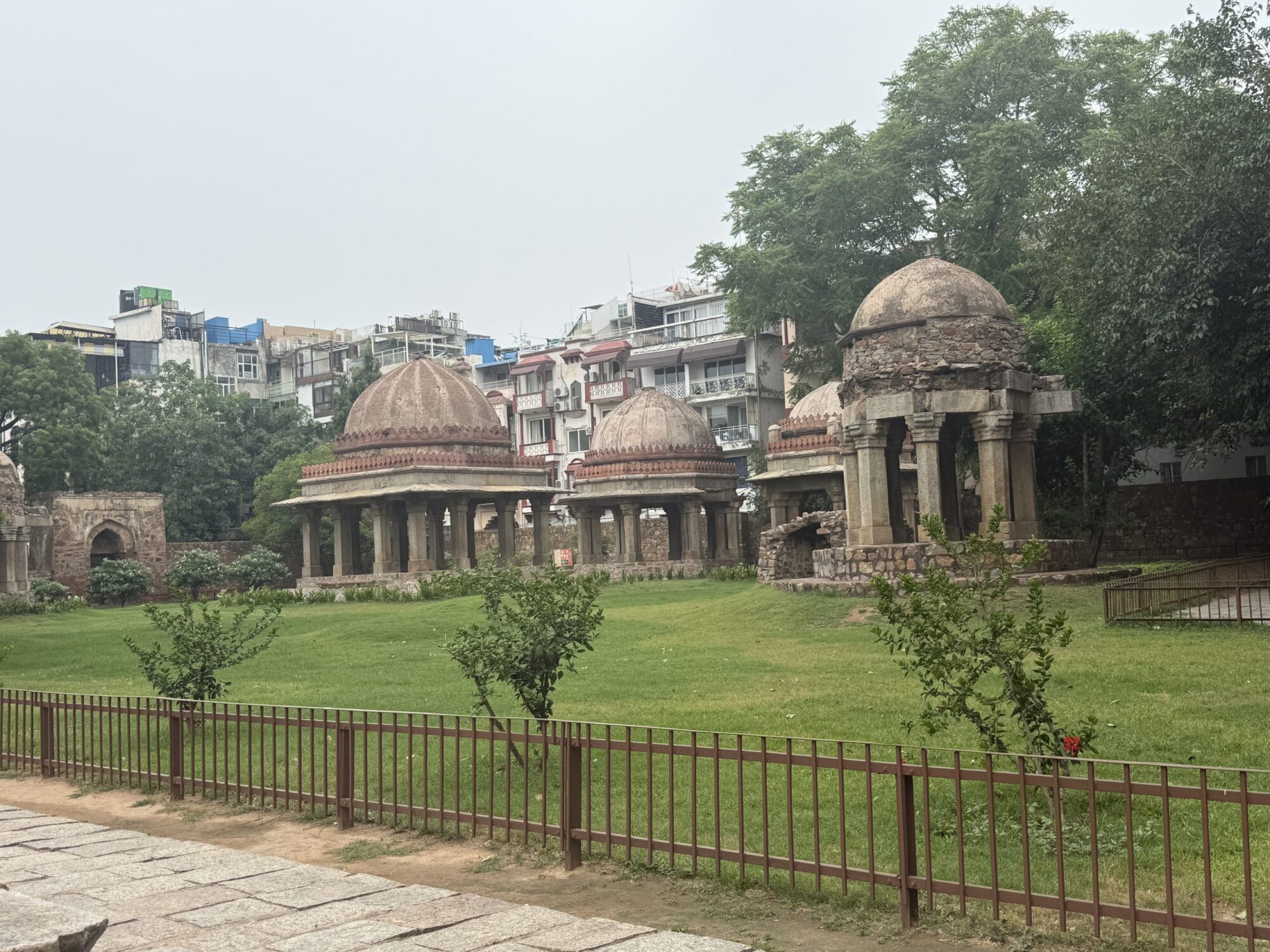
Hauz Khas Village, South Delhi
Before Delhi was Delhi, it was a succession of cities built on top of each other, each one eventually swallowed by either invasion or indifference. Hauz Khas swallowed itself – but still exists.
The name means Royal Tank which if funny to me. Walk around it and you see all the signs that say “This tank this and this tank that…” To me, a tank is connected to a toilet or maybe something that fish swim in at a restaurant or dentist office or a metal vessel to hold hot water.
The Origin: The English language actually borrowed the word “tank” from India in the 1600s. It comes from the Gujarati word tānkh or Marathi ṭānky (meaning an artificial lake or underground reservoir).
– Wikipedia
The British Connection: During the colonial era, British administrators adopted this local usage. If you read British historical texts about India, they frequently refer to vast bodies of water as “tanks”.
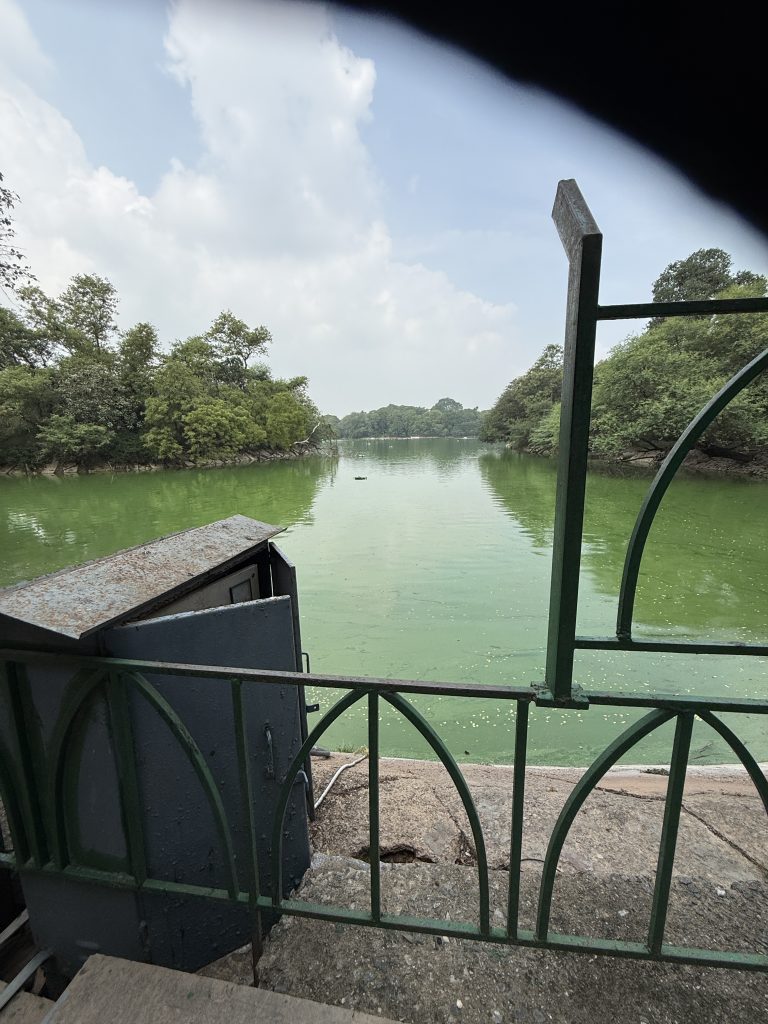
Regardless, In the early 1300s, Alauddin Khilji ordered a vast reservoir dug here to supply water to Siri, his newly constructed fortified city. It was an engineering project on a scale that matched his ambitions, and it worked for a while. Then the empire contracted, Siri was abandoned, and the tank silted up and became a bog – maybe the English call that an aquarium or a fen. Later, Firoz Shah Tughlaq came along in the 14th century, and said to himself “This is a treasure (but not the treasure I’m referring to in the title).” Then he used slaves to dredge it out, and built around it: a madrasa, his own domed tomb, a mosque, and a series of pavilions in the Tughlaq architectural style. He is buried here, in a tomb that still stands at the edge of the lake, quietly waiting for visitors who mostly walk past it on their way to get cocktails.
The pavilions are odd, they look like ornaments put in to give authenticity to a five-star hotel’s grounds. By ancient standards, they are spare, angular, built for permanence, but they still look like ornament.
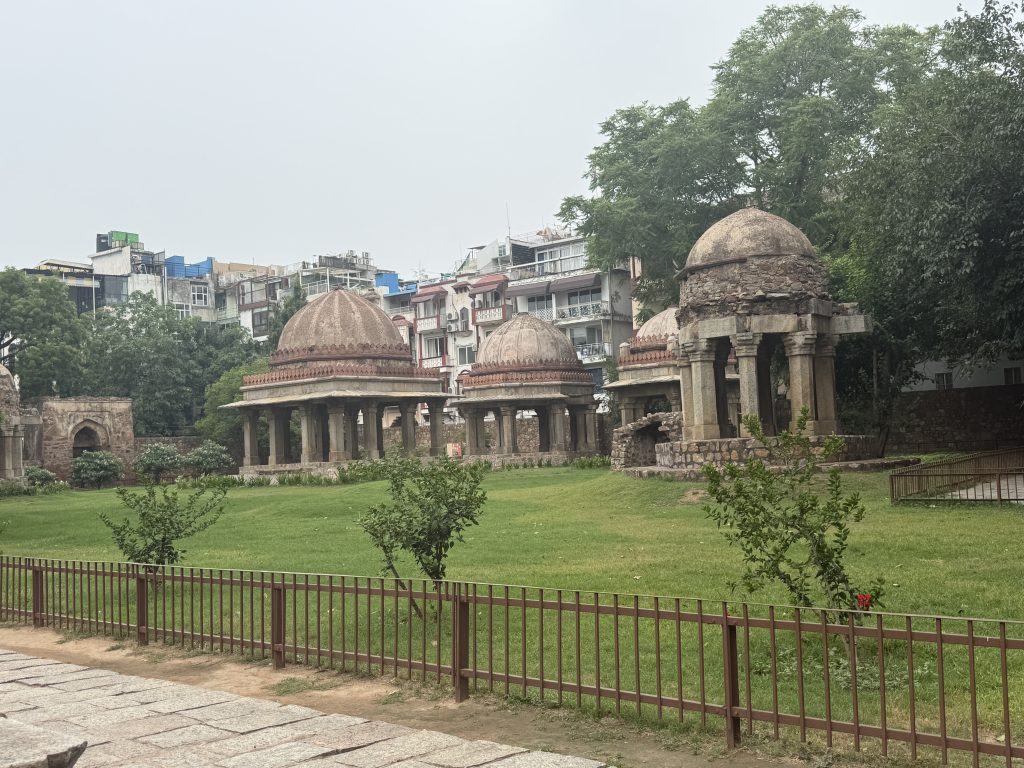
The ruins have been here for seven hundred years. The cocktail bars arrived in the 1990s and never left. We’ll get to those too.
Walking In
You will know you have arrived at Hauz Khas Village before you see the fort. You will know because the tuktuk drivers will materialize from nowhere, moving alongside your vehicle even when it is still moving, and not letting that stop them from offering rates to places you did not ask about. You will know because the men with laminated printouts showing menus, showing room prices, showing tour itineraries and more will step into your path with the annoying confidence of people who have done this ten thousand times and know that even if ninety-nine say no, one will say yes. I’m not that one. Maybe you are. You are to blame if that’s the case.
This is not a complaint about the individuals doing it. It is a description of an economic system. These men are doing exactly what makes sense to do when you are at the entry point of a tourist zone in one of the world’s most populated cities. This is exactly what you do when the difference between a sale and no sale is the difference between your family eating and not eating. Understanding this truism about them does not make them less annoying. It does, however, change the nature of the overwhelm they bring with themselves. Maybe it helps.
The pro move is to walk through it like water through stone. Not aggressive, not apologetic. A slight forward lean, eyes aimed at the middle distance, the word “no” deployed once and not repeated. I did this once and it worked. The second time I decided to see if they would listen as I aggressively said “NO” over and over. They didn’t. This move is only recommended if you want to agitate yourself.
The hawker radius extends about thirty metres from the main entrance. Past that, the lanes open up and the pressure drops down to slick dressed teenagers trying to get you to buy an overpriced cocktail in the rooftop bar they are hawking for at street level..
The Fort
The Hauz Khas Complex sits at the far end of the village lanes, where the concrete abruptly ends. The entry is still listed as free at many online sources, but that is no longer the case. You have to scan a QR code and get a ticket for 250 rupee from the Archeological Institute and a person who just looks like they are charging their phone will scan the QR code you are given and nod you in. Then you simply walk in.
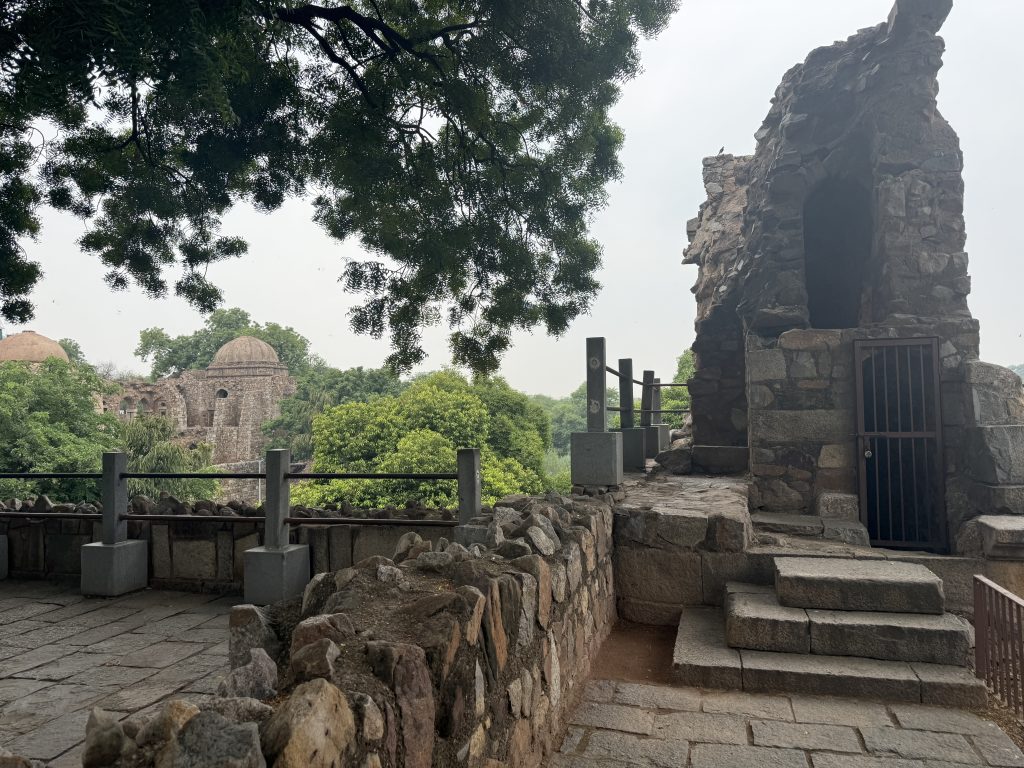
Inside, the ruins of the Tughlaq madrasa stretch along the edge of the lake. It’s a long L-shaped structure of grey stone, its arched doorways open onto broken rooms, its corridors lead to dead ends and unexpected balconies. The rooms are often roofless. Birds nest in the cornices. Chipmunks scurry around like rats but cuter.The stone is warm in the afternoon sun and cool in the shadow. Young Indian couples looking for a place to make out seem to favor it.
Firoz Shah’s tomb anchors the complex at the corner where the two wings of the madrasa meet. It is octagonal, topped with a dome, and contains the grave of a sultan who by all historical accounts was a reasonably competent administrator and an enthusiastic builder. He constructed or restored hundreds of buildings across his territory. I mean, not personally, it wasn’t like he was quarrying the stone or mixing the mortar. No, he enslaved hundreds of thousands of people and made them work to death. That work survived them and it survived him. History tends to remember the buildings and Firoz Shah. Seems to me it would be more interesting if it were turned into a monument that commemorated the slaves. Let me run that number by you again – HUNDREDS OF THOUSANDS.
The big water tank which looks more like a lake to me, lies below the complex, seen from the terrace walls. I walked around it before coming up. This was a miscalculation as I exited one gate of the park to walk around the outside and see the city and come back in on the other side without realizing just how big this park was or just how hot it would get. Thank God for the guys selling coconuts for 80 rupee each.
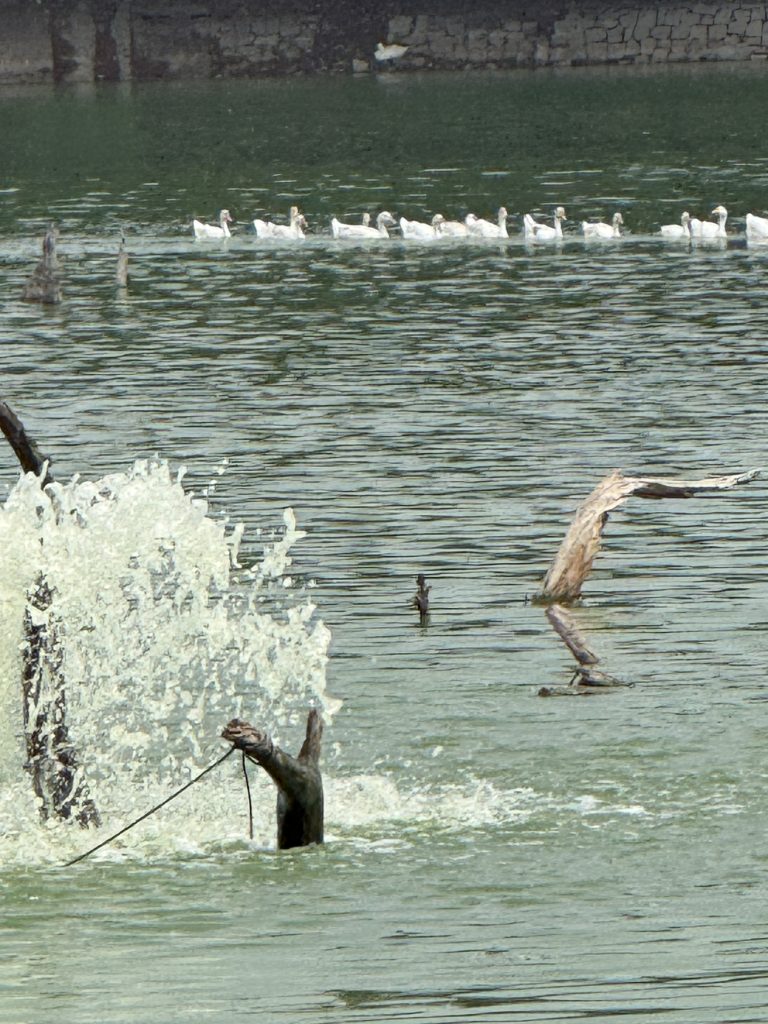
In the 14th century the lake was a functional reservoir. Today it is a water tank maintained by the Delhi government, with geese and water fountains added at some point. I’m told that there is a light and sound show there but I can tell you that I don’t really appreciate such things so I won’t be seeing it. The view from the fort walls is worth seeing though. The green of Deer Park beyond, the water below, the city behind you, and the ruins under your feet connecting all of it to a history you can’t begin to imagine.
Chor Minar
A ten-minute walk north of the village is another ruin that is easy to miss and rarely mentioned in the standard tourist rundowns. This is the ruin I am referencing in the title. Chor Minar: the Tower of Thieves. It sounds like a Disney action adventure film title. In fact, it is a modest cylindrical minaret, perhaps twelve metres high, built during the reign of Alauddin Khilji in the early 14th century. Its surface is pocked with 225 holes. Were these the holes the thieves would peek out of after their their meetings?
I’m afraid not. Nor, are the holes decorative. They are built with a purpose.
They are where the heads went. The thieves heads.

Khilji’s administration had a visual approach to crime deterrence: the severed heads of thieves and criminals were displayed on iron spikes poking out of the holes, visible from the road, functioning as a public announcement about the costs of transgression. The minaret sat on the road into Siri, so travelers would pass it arriving and departing. The message was architectural. I couldn’t find a record of whether it worked or not.
It stands now in a small residential park, surrounded by apartment buildings, visited by almost nobody but also no longer with severed heads on it. I don’t know the crime rate in the neighborhood. There is no entry fee, no sign explaining its history, no crowd. Just the tower, the holes, and the another story the city would prefer not to explain.
Deer Park
Adjacent to the complex and the village, but belonging to neither, Deer Park is what saves Hauz Khas from being purely a transaction. It is large, genuinely green, and almost calm. Is this the treasure from the title?
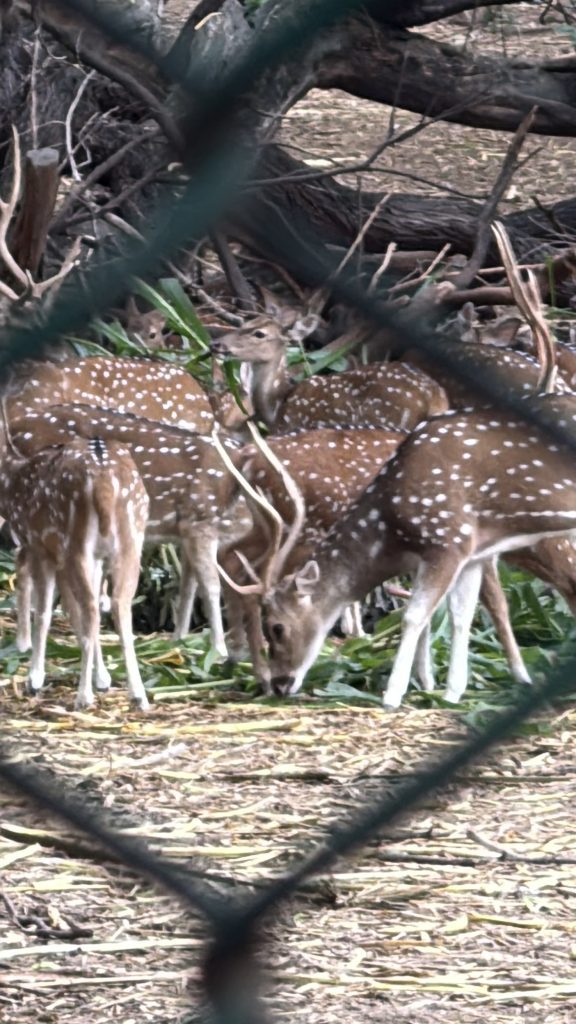
I’m afraid not.The deer are real. They move through the grass in the morning with the easy indifference of animals that have figured out they are safe. Unfortunately for me (and other photographers) there is a double row of fencing separating them from the people. So unlike Nara or Wakkanai, you won’t interact with the deer. You can barely take pictures of them without the fences gettin in the way. Peacocks cross the paths without acknowledging anyone though. There are chipmunks, monkeys, giant bats in the trees, and more species of birds than you will have time to identify. The paths are wide enough for families, narrow enough in places to feel like you are alone.No motorbikes, no tuktuks, no bicycles, no horns – just antlers. Idyllic.
At the southern end, the Hauz Khas lake dominates the view. In the early morning, before the heat has established itself, the combination of water, ruins, and green is the version of Delhi that soothes your soul.
The park has no entry fee and closes at dusk. Come early. The mornings in July are the only hours when the heat is not the primary fact of existence. I’m glad I went.
The Village After Dark
When the afternoon heat breaks, Hauz Khas Village shifts registers. The shoppers thin out, the bars fill up, the music starts. The rooftops come alive. Cocktails at prices that would be ordinary in Miami or Dubai but feel slightly surreal in the middle of a medieval complex in India. There are DJs, there are fairy lights strung between structures that Firoz Shah Tughlaq ordered built six centuries ago, and there is the energy of a city that is young and educated and looking for somewhere to put all of that. There is money here. Lots of poverty but lots of money.
It is not subtle. It is also not without its own kind of charm. It’s not my vibe though, just as Kao San Road in Bangkok and Dubai and Miami all of Phuket and so many other places are not my thing.
The Treasure
Near the fort entrance, if you know to look, there is a basement shop called Cottage of Arts and Jewels. It is more my thing. It is easy to miss because it is small and because the lane leading to it is lined with things competing for your attention and somewhat aggressive touts who will try to get you to look at what they are selling.Don’t do it. Ignore them. Go down the stairs.
Inside, Mrs. Kusum Jain has been keeping the same kind of time as the ruins outside. She has been opening and closing the shop since the 1970s. Her shop holds vintage Bollywood posters going back to the 1950s, hand-painted promotional art for Mughal-e-Azam, Sholay, Mother India, Pakeezah. She will show them all to you alongside historical maps (her favorite), oleographs printed in Germany nearly a century ago, monarchy photographs from the 1890s, antique earrings, artifacts, and books. Most of the collection is her family’s own. What was not inherited has been sourced through decades of knowing where to look.
Mrs. Kusum Jain is the treasure in Hauz Khas. Her shop is nice but she is the treasure. When you walk in, if you smile and interact (even if you tell her you don’t plan on buying anything – which I said right at the beginning) she will tell you stories, show you her favorite pieces, and make you offers that sound insane but actually are not. A two hundred year old illuminated Quran, Mughul paintings, hand drawn maps from the times of British rule. Her kids aren’t interested in her collection. She’s a motivated seller.
She has photographs of her with American, British, and Indian politicians. She has photographs with film stars. They came to her, not the other way around. The pictures are in the shop, which tells you what you need to know about her relationship to the celebrity of it. By the way, she doesn’t allow pictures or video in the shop. You’ll have to visit to see it. Or – you can watch this documentary about her!
Her prices start at ₹300 so it’s worth having a look. The older and rarer pieces go considerably higher. None of it is priced for the faint-hearted, but none of it is junk either. This is not a souvenir shop. It is a collection that happens to be for sale.
She is the human version of what Hauz Khas is supposed to be and mostly isn’t anymore: something rare, maintained with care, still here when everything around it has been renovated into something shinier and more profitable.
The ruins are still there in the dark. The tomb is still there. The Chor Minar is there. Best of all though, Mrs. Jain is still there. In a village that has spent thirty years becoming a place for the young and moneyed go to drink and be seen, she is the living proof that something older persists underneath, waiting to be found by whoever slows down long enough to notice the basement stairs.