
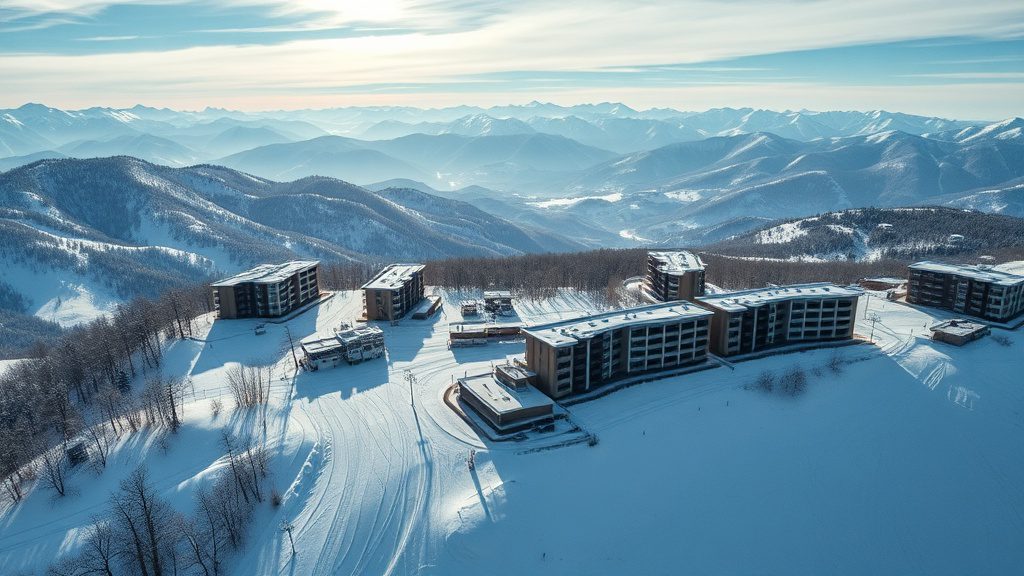
Ninety minutes from Otaru, in a valley surrounded by volcanoes, a small ski town became an international case study in what happens when the rest of the world discovers a place before the prices catch up.
Niseko’s story is worth understanding if you’re thinking about buying property in Otaru. Not because Otaru is the next Niseko — it probably isn’t, and that framing would be dishonest. But because the pattern of what happened there, the sequence and the mechanics, illuminates something about Hokkaido real estate that most foreign buyers don’t think about until it’s too late to benefit from it.
What Niseko Was
In the 1990s, Niseko was a quiet collection of ski areas in the Abuta District of Hokkaido. Kutchan, the nearest town of any size, had about 16,000 people and a main street that emptied out after dark. Pensions — small Japanese-style lodges — dotted the slopes. Lift tickets were cheap. Land was cheaper.
The snow was extraordinary. Niseko sits in the path of cold air masses that cross the Sea of Japan from Siberia, picking up moisture along the way. The result is light, dry powder — six to fifteen meters of it per season — that consistently ranks among the best snow on earth.
But in the 1990s, almost nobody outside Japan knew this.
How It Changed
Australian ski tourists discovered Niseko in the early 2000s. The timing mattered. The Australian dollar was strong against the yen. Flights to Sapporo were cheap. And the powder was better than anything in the Southern Hemisphere — better than most things in the Northern Hemisphere too.
Word traveled fast in the Australian ski community. By the mid-2000s, Australian investors were buying pensions and converting them. Then buying land and building condos. Then building hotels.
The sequence is important because it repeats in every resort-town transformation:
- Tourists discover the place
- Repeat visitors start staying longer
- Entrepreneurial visitors start businesses (restaurants, tour companies, rental management)
- Investors buy property
- Developers build new properties aimed at the foreign market
- Prices rise past what locals can afford
- The character of the place changes fundamentally
Niseko went through all seven stages in about fifteen years. Land in Hirafu village that sold for ¥5 million in 2005 would fetch ¥30 to ¥50 million today. Condos built for foreign buyers sell at prices comparable to central Tokyo. A two-bedroom apartment near the lifts can list for ¥80 million or more — $550,000+ for a ski condo in what was recently a rural farming district.
What Niseko Is Now
Niseko today is functionally an international ski colony embedded in rural Hokkaido. The restaurants serve Australian brunch and Canadian craft beer. Many businesses operate in English as a first language. In peak season, you can walk through Hirafu village and hear more English and Mandarin than Japanese.
This isn’t inherently good or bad. It’s a transformation. The local economy shifted from agriculture and small-scale tourism to luxury hospitality. Jobs exist that didn’t before. Tax revenue increased. But the cost of living rose too, and some of the village-scale character that made the place appealing in the first place has been buried under glass-fronted condo buildings.
The ski community has opinions about Niseko. Many of them are conflicted. The powder is still world-class. The infrastructure is excellent. But something was lost when a bowl of ramen started costing ¥2,000 and the pension where you used to stay got demolished for a boutique hotel.
The Copycat
Furano, about two hours east of Sapporo, is following the same trajectory. It’s roughly where Niseko was ten to fifteen years ago. The snow is excellent (Furano’s microclimate produces some of Hokkaido’s driest powder). Foreign tourists have discovered it. Investment capital is arriving. Prices are rising but haven’t reached Niseko levels.
People who missed Niseko’s early window talk about Furano the way Niseko’s early arrivals talk about their 2005 land purchases — with a mix of excitement and the faint anxiety that comes from trying to time a wave.
Where Does Otaru Fit?
Here’s where I need to be careful, because the temptation to draw a clean parallel is strong and the parallel is imperfect.
Otaru has several structural advantages that Niseko lacked at its inflection point:
Existing tourism infrastructure. Otaru already draws over eight million visitors per year. The canal district, the glass workshops, the sushi row, the music box museum, the cruise ship port — these are established draws with decades of momentum. Niseko had to build its tourism identity from scratch around a single asset (snow). Otaru’s appeal is diversified.
Proximity to a major city. Otaru is 35 minutes from Sapporo by rapid train. Sapporo is a city of two million people with an international airport, hospitals, universities, shopping, and every urban amenity you’d want access to. Niseko is over two hours from Sapporo by car, with no train service. This matters enormously for livability and for property values.
Year-round appeal. Niseko’s economy is heavily seasonal. Winter is booming; summer is quiet (though this is slowly changing with golf and adventure tourism). Otaru has strong tourism across all four seasons — the snow lantern festival in winter, the canal in spring and fall, the beaches and hiking in summer. A year-round draw supports year-round business, which supports year-round property demand.
Established urban infrastructure. Otaru has hospitals, schools, government services, banks, supermarkets, and everything else a city of 100,000+ provides. Niseko had to build much of its infrastructure as it grew. For a foreign buyer considering actually living in the property, this is a significant quality-of-life difference.
The signals. Foreign interest in Otaru real estate is increasing. Akiya marketplace traffic for Hokkaido properties has grown. The cruise port is expanding. Sapporo won a bid to host several events as part of Japan’s ongoing tourism push. The shinkansen extension to Sapporo (now expected around 2030-2031, delayed from the original target) will cut travel time from Tokyo to Sapporo and, by extension, make Otaru more accessible to the rest of Japan and to international travelers.
The Honest Caveat
Otaru is not guaranteed to follow Niseko’s price trajectory. The comparison breaks down in an important way.
Niseko had a singular, world-class, irreplaceable asset: the powder snow. There is nothing else like Niseko’s snow south of Kamchatka. That singularity created a concentrated demand from a global audience of skiers and snowboarders who would pay whatever it cost to access the best snow on the planet. That’s what drove the 5-10x land price increases.
Otaru’s appeal is more diffuse. It’s a charming port city with good food, interesting history, beautiful scenery, and convenient location. But there are other charming port cities in Japan. There are other places with good sushi. The draw is real, but it doesn’t create the same concentrated, price-insensitive demand that world-class powder creates among ski addicts.
What this means in practical terms: Otaru property values are more likely to appreciate steadily than to explode. A house you buy for ¥3 million is more likely to be worth ¥5 or ¥6 million in ten years than ¥30 million. That’s still a solid return on a $20,000 investment, but it’s not Niseko math.
There’s also the depopulation factor working against appreciation in some neighborhoods. Otaru’s population has been declining for decades. Some areas of the city are getting emptier, not fuller. The properties most likely to appreciate are in desirable locations — near the station, near the canal, near the waterfront. The ones up steep hills in aging residential neighborhoods might not appreciate at all.
Why I Bought Anyway
I didn’t buy my house in Otaru as an investment. I bought it as a place to live. The Niseko comparison is useful for understanding the dynamics of Hokkaido real estate, but I’d be selling you something false if I positioned Otaru as a guaranteed appreciation play.
Here’s what I know: I own a house in one of the most interesting small cities in Japan. I paid less than the cost of a used Toyota Camry. If the value doubles over the next decade, great — I’ll have made $20,000 on an asset that also provided me with shelter and a home base in a country I love. If the value stays flat, I still own a house in Otaru for less than most people spend on a vacation.
The Niseko story is instructive because it demonstrates that Hokkaido real estate is not static. Foreign interest is growing. Infrastructure is improving. The yen’s weakness against Western currencies makes Japanese property more accessible to foreign buyers than it’s been in decades. These are real dynamics that affect real prices.
But the lesson I take from Niseko isn’t “buy now before prices explode.” It’s more fundamental than that. It’s that places change. The quiet fishing village becomes a tourist destination. The tourist destination becomes a resort. The resort becomes something unrecognizable to the people who loved it when it was a fishing village.
Otaru is in the early chapters of whatever its version of that story turns out to be. I’d rather be here now, living in it, than show up in 2035 and wish I’d paid attention when a house cost ¥3 million and the canal was still full of Japanese tourists eating croquettes instead of Instagram influencers filming content.
Whether the property appreciates is secondary. Being somewhere while it’s still itself — that’s the real value proposition.