
Tourism’s Gentrification Cycle Playing Out in Little Tibet
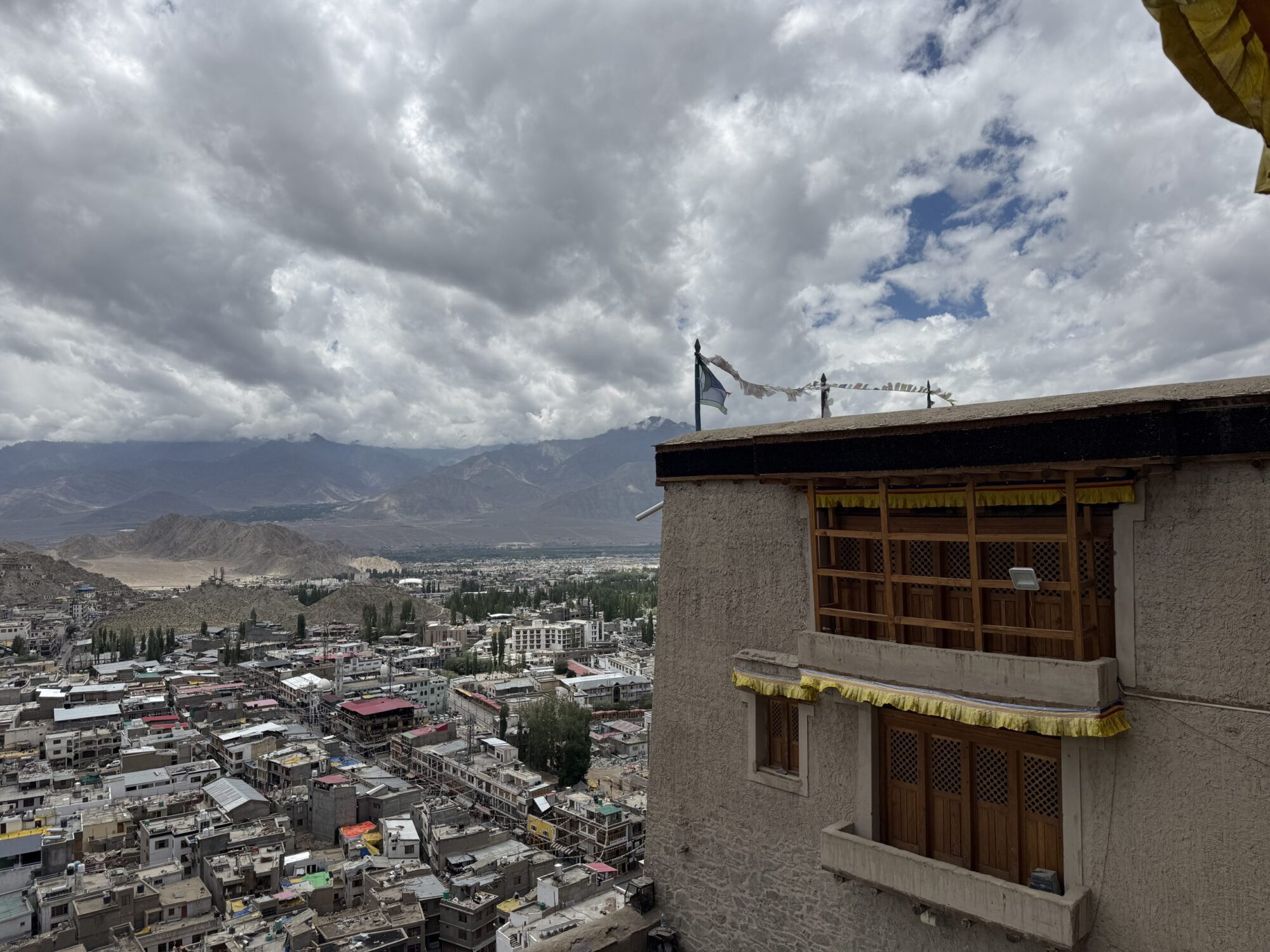
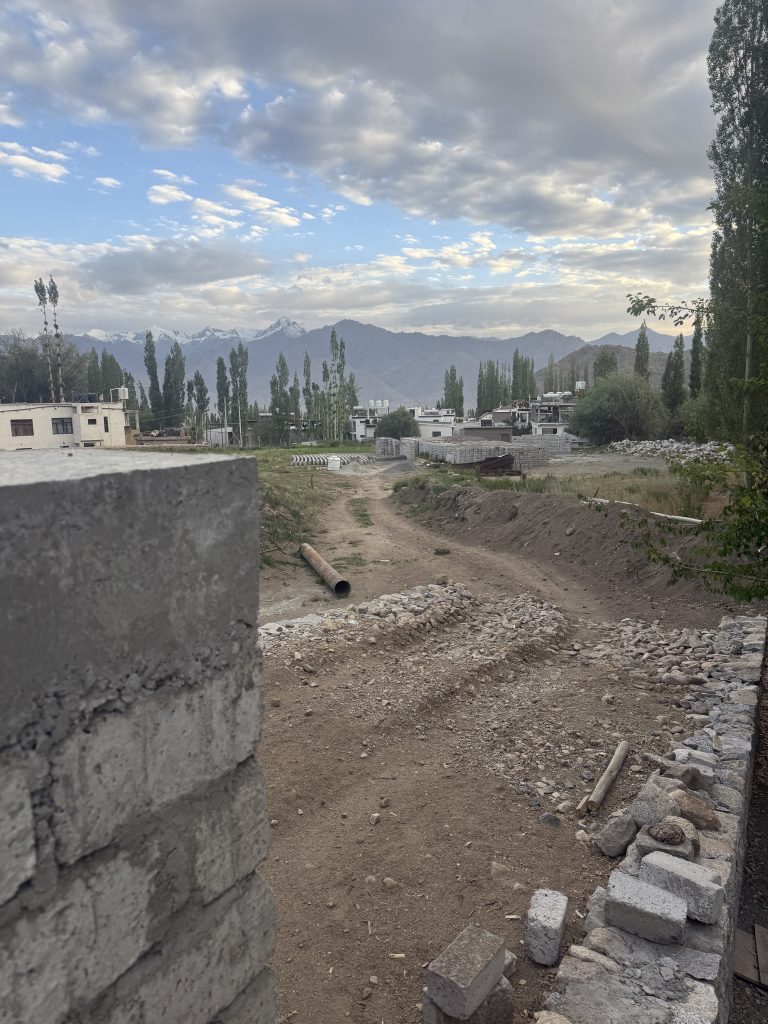
Leh, India in Ladakh of the Himalaya is sometimes called Little Tibet because of how many Tibetans are living here in exile. I am writing this from Main Bazaar Road, which locals and every tour operator in Leh simply call the Market. Ten minutes’ walk from here is Changspa Road, the cafe and guesthouse strip where I ate hummus and pita next to backpackers comparing Kashmir photos. Ten minutes the other direction is Fort Road, a solid row of restaurants that split the difference between the two. Between all three, and increasingly around them, cranes and half finished concrete and mud brick frames are going up faster than the town’s water table can apparently handle.
This isn’t a new observation. Locals have been saying it for a decade. But it’s new for me and sitting in it for a few days, the pace is hard to process. A high altitude desert town (11,530 feet) of roughly 30,000 permanent residents is absorbing hundreds of thousands of seasonal visitors a year, and the building stock is not only trying to keep up in real time, with predictable consequences, but they are also planning on bringing in more.
How Leh got here
Ladakh only opened to outside visitors in 1974. Before that it was pilgrims, researchers, and government officials only. For the first few decades, tourism grew slowly and stayed small scale, mostly homestays and family run guesthouses built the traditional way, mud brick and stone, suited to the climate.
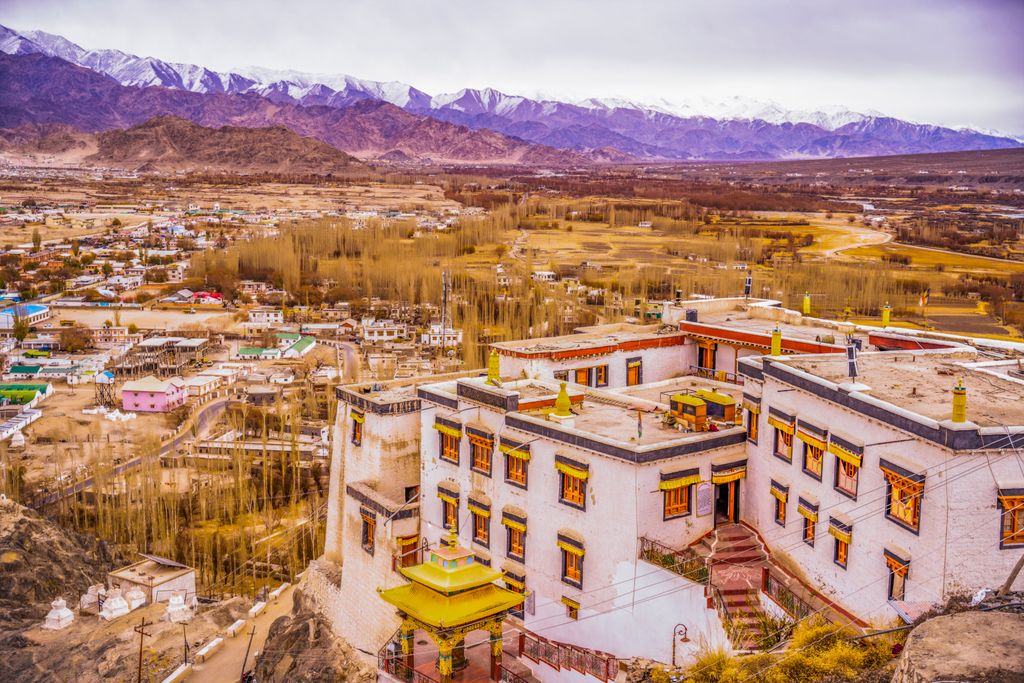
The real acceleration is recent. In the mid 2010s Leh had around 219 registered hotels. By 2022 that number had passed 800, nearly a fourfold jump in under a decade. In the two peak months of June and July 2022 alone, roughly 250,000 tourists passed through. Every one of those new hotels needs water, and nearly all of them rely on groundwater, drilled through private bore wells with no coordinated management. Hoteliers in some parts of town now report the local water table has simply run dry within a kilometer radius, forcing tanker trucks to haul water in.
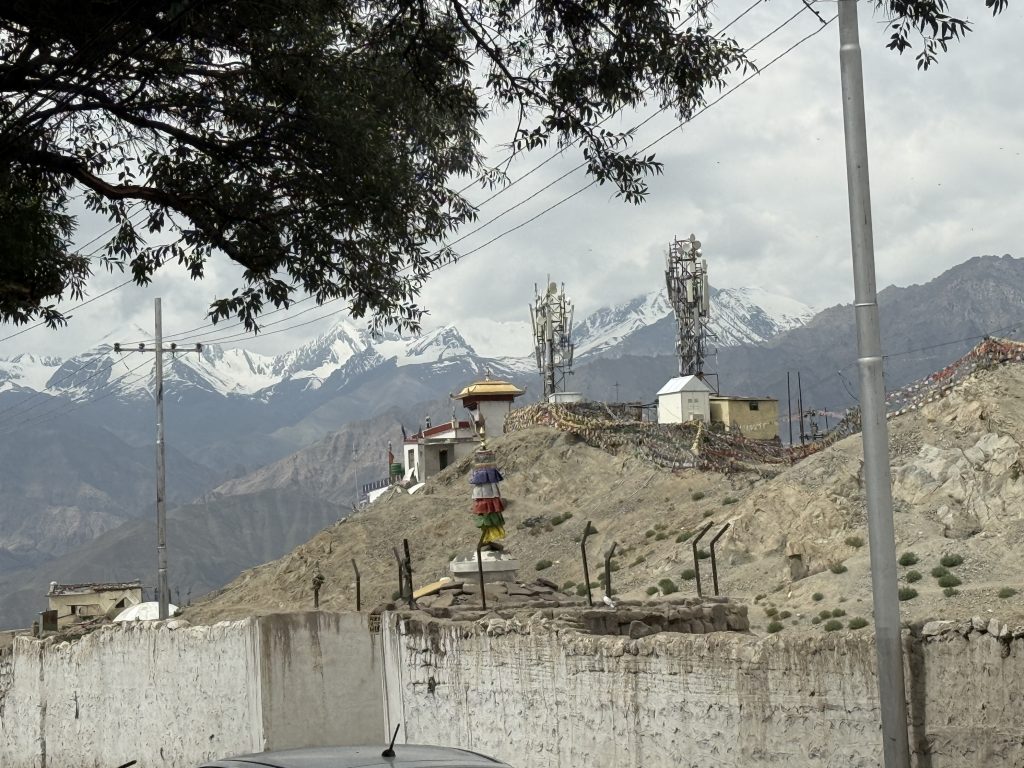
The construction itself compounds the problem. Traditional Ladakhi buildings were built for this environment: thick mud walls, small windows, passive solar heating, minimal water demand. What’s replacing them is generic concrete guesthouse and hotel stock, built fast, built cheap, and built without much regard for the climate it’s sitting in. These buildings will need more heat and more air conditioning. Not just because of the spoiled guests but because of the way they are built.Environmental assessments of the region now list unregulated, non eco-friendly construction as one of the primary threats to Leh’s water resources and biodiversity, alongside waste management and air pollution from the growing vehicle fleet.
What every toilet and PLAStic bottle actually costs
The number that staggered me: an average Ladakhi resident uses about 21 litres of water a day. A tourist, through hotel plumbing, hot showers, and Western style bathrooms, uses up to 75 litres. That’s not a modest gap, it’s one person using an entire family water supply in a day. The whole equation of why the water table is collapsing in a desert that gets almost no rainfall and depends entirely on shrinking glacier melt is the other part of that.
And it isn’t just the volume, it’s what happens after. Leh has no centralized sewage treatment system to speak of. Hotel and guesthouse septic systems are largely self designed and self regulated, and no government department actually has authority over how a property sources its water or disposes of its sewage. The practical result, reported by researchers and local officials alike, is that faulty septic tanks leak directly into groundwater and the streams the town still depends on for drinking water, agriculture, and daily life. The same aquifer being drained by hotel bore wells is being contaminated by the waste those hotels produce. It’s a closed loop closing on itself.
Laundry adds another layer nobody talks about as much. Every hotel and guesthouse sheet, towel, and pillowcase gets washed on site or sent out to be washed, day after day through a six month season, with detergent-heavy greywater running into the same strained system, often untreated. Multiply that by over a thousand properties and it’s a second water crisis stacked on top of the first.
Then there’s plastic. Local estimates put daily plastic bottle use in Leh at over 50,000 during tourist season, with total waste generation reaching around 16 tonnes a day. At Pangong Lake alone, several hundred cars a day each carrying four or more single use bottles per passenger adds up to something like 5,000 to 10,000 bottles littered in a single high altitude basin, daily, in peak season, with no functioning waste management system to catch it. Leh had no landfills at all until the Srinagar and Manali highways opened it to road traffic. Two decades ago this was a place that recycled almost everything it generated. Now the open landfills produce fumes that locals describe as making the already thin air borderline unbreathable near them.
The three commercial zones, and what’s happening to each
Main Bazaar Road is the historic commercial core and remains the most commercialized stretch in Leh: souvenir shops, pashmina sellers, trekking outfitters, pharmacies, ATMs. It’s dense, transactional, and built for extracting tourist spend efficiently. A car free pedestrian section was introduced here as a sustainability gesture, and it has become genuinely popular with both locals and visitors, doubling as a produce market for women from nearby villages. But surrounding it, the building density keeps climbing, and what used to be a purely local bazaar increasingly carries the same pizza and multi cuisine restaurant overlay you’d expect on Changspa. It also carries the same Chinese knockoffs of real regional products that you will find in every other marketplace in this country, that country, any country with tourist infrastructure. I can buy the same trinket souvenirs in Leh, Shanghai, Bangkok, Seoul, or Honolulu.
Changspa Road built its identity as the backpacker and long stay traveler zone, guesthouses, cafes, yoga studios, wood fired pizza ovens, a relaxed garden seating vibe. It’s touristic in a softer, curated way rather than a hard sell. That softness is exactly what makes it valuable real estate now. Land here has gone from agricultural or residential use to guesthouse construction at a pace that mirrors the citywide hotel boom, and the strip keeps extending outward as new guesthouses and ‘home stays’ fill in what used to be open ground.
Fort Road sits between the two in both geography and character, a tighter restaurant row that hasn’t seen the same density of new hotel construction as Changspa, but has absorbed real spillover as Main Bazaar and Changspa both fill up.
When a spare room becomes a hospitality enterprise
An estimated 75 percent of people living in Leh and its surrounding areas now run either a hotel or a guesthouse out of their own property. Three out of four households. That number captures something the skyline can’t. This isn’t primarily outside developers descending on an untouched town, it’s a wholesale conversion of the domestic fabric of Leh into hospitality inventory, one family compound at a time.
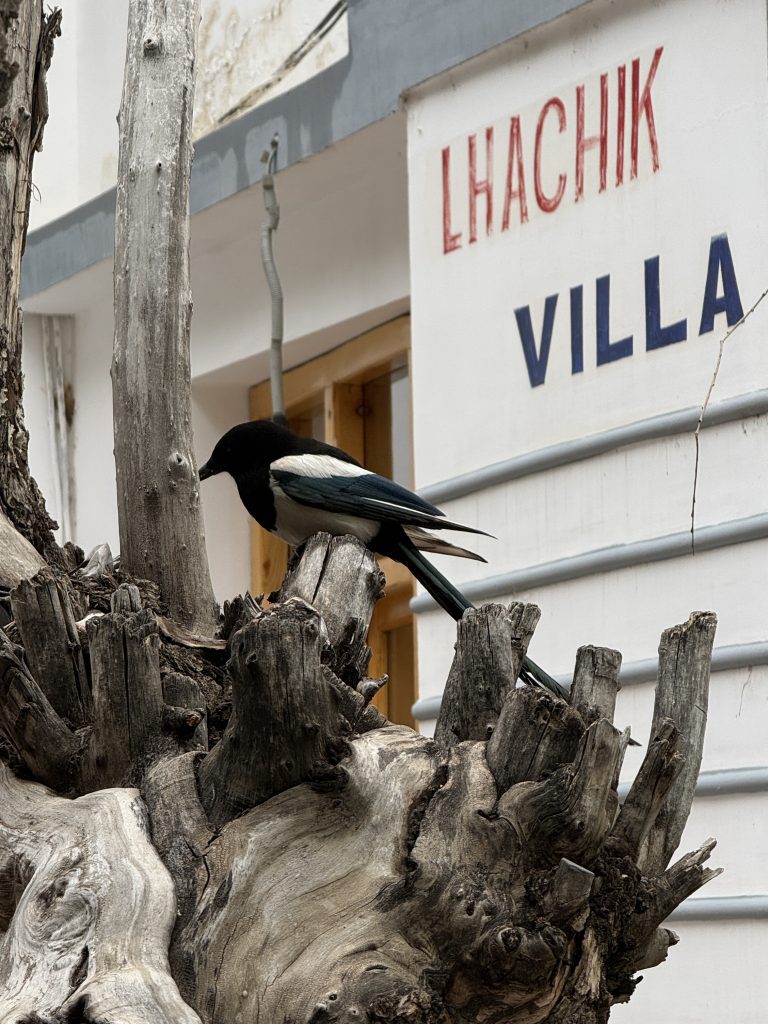
The mechanism is simple and, on an individual level, rational. A Ladakhi household with a courtyard and a spare wing can convert it into four or six guest rooms and earn more in a six month season than farming or herding would bring in a year. Multiply that decision across a town of roughly 30,000 permanent residents and you get a place where the traditional Ladakhi home, the unit that used to organize family life, labor, and even water use around a functioning household economy, has been steadily re-engineered into a small commercial hospitality operation. What was once a homestay offering a spare room and a home cooked meal has, in aggregate, become something closer to an unplanned hotel district, just distributed across thousands of individual properties instead of a few large buildings. And, many of the homesteads have now upgraded to the size of small hotels in other places. They still call it a homestay but these are hotels with some local charm.
That shift also explains why regulation has been so hard to enforce. You can zone and inspect a cluster of hotels. It’s a different problem entirely when the informal hospitality sector is threaded through nearly every residential block in town, each property making its own decisions about water sourcing, septic design, and construction, with no centralized oversight capable of tracking any of it.
Where the money comes from, and where it goes
Two very different capital stories are running in Leh at once, and they explain a lot about who benefits from the boom and who absorbs its costs.
The first is genuinely local. Family run guesthouses, financed out of household savings or small loans, are Ladakhi owned and Ladakhi operated, and at least in principle keep their profits circulating in the local economy. This is the story behind that 75 percent statistic, ordinary residents converting their own homes into small businesses.
The second story is external capital, and it’s become contentious enough that the region’s own tourism industry organized against it. In April 2026, the Ladakh Travel Trade Alliance, the All Ladakh Hotel and Guest House Association, and more than a dozen other trade and civil society groups, spanning Buddhist, Muslim, and taxi and transport cooperatives, jointly adopted a resolution explicitly naming the problem: increasing entry of outside investors and large external businesses seeking to dominate the tourism sector. Their language is worth quoting , because it names exactly what’s visible from the street. They describe growth that has historically been organic and community driven, now facing pressure from vested interests whose unregulated involvement risks displacing local stakeholders, eroding traditional livelihoods, and destabilizing the region’s socio-economic balance.
In plain terms: outside money, often from elsewhere in India, is buying into or building large scale hospitality and commercial projects, capturing tourist spend at a bigger scale than a family guesthouse ever could, while much of the profit leaves the region rather than recirculating through it. This mirrors what researchers have documented for years, that within Leh, a small number of large hotel owners benefit disproportionately, while merchants and tour operators who arrive only for the season take a significant share of total tourist spending out of Ladakh entirely, and the roughly 90 percent of Ladakhis living outside Leh see very little of the tourism economy at all.
Government policy has, if anything, been accelerating capital flow into the sector rather than slowing it down. As of June 1, 2026, all 1,257 registered hotels and guest houses across Ladakh, 1,078 of them in Leh alone, were granted formal industry status by the Lieutenant Governor. The reform cuts electricity tariffs from commercial to industrial rates, lowers water tariffs, and opens the door to concessional bank financing and capital subsidies previously reserved for industrial projects. It’s explicitly designed to improve project viability and enhance investor confidence, in the government’s own words, meaning it’s designed to make building more hotels cheaper and more attractive to capital, at precisely the moment local trade groups are asking for the opposite.
So the funding picture splits cleanly: household savings and small local loans on one side, keeping money circulating within Ladakhi families, and increasingly incentivized institutional and outside capital on the other, which scales faster, builds bigger, and sends a meaningfully larger share of its returns outside the region it’s extracting water and land from. Mass extraction of all resources.
The next frontier: where high end commercial is heading
The areas worth watching are the ones just outside the current three zones, where cultivated land and residential areas are being eyed for the next wave.
Choglamsar, a riverside settlement a short drive from Leh along the Indus, is the clearest example. It’s historically been mixed residential, with a visible Tibetan presence including the SOS Tibetan Children’s Village school, and has stayed less commercial and more community oriented than central Leh. In 2026 the Ladakh administration announced a project to develop parts of Choglamsar into a curated “Valley of Flowers” tourist attraction, part of a broader push to draw visitor traffic outward from the saturated core. That’s the pattern to watch: government sponsored beautification and infrastructure projects tend to precede a wave of private commercial investment, not follow it.
More broadly, the same reporting that flagged the Choglamsar plan noted that Ladakh’s tourism has been almost entirely concentrated in Leh, Nubra, and Pangong, the most ecologically fragile parts of the region, while the vast majority of Ladakh outside those zones sees almost none of the economic benefit. That imbalance is itself driving policy conversations about diversifying tourism into villages, which if it happens, will eventually bring the same construction pressure to towns that have so far been spared it.
A rough timeline
- 1974 — Ladakh opens to outside visitors after decades of restricted access.
- 1974 to early 2000s — Slow growth, small scale traditional guesthouses, tourism largely additive to existing village economies.
- 2010 to 2018 — Steady tourism growth accelerates; described by industry figures as the strongest growth period the region has seen.
- Mid 2010s — Around 219 registered hotels in Leh.
- 2015 — Major flash floods hit the region, with over double average rainfall and significant damage, an early sign of the climate volatility that would keep intensifying.
- 2022 — Registered hotels in Leh exceed 800. Peak season (June and July) draws roughly 250,000 visitors. Groundwater depletion becomes an acute, localized crisis in parts of town.
- 2025 — A brutal year for the region: a terrorist attack in nearby Pahalgam in April, followed by brief India-Pakistan armed conflict that halted tourism entirely; record rainfall in August cuts off roads for weeks; a September statehood protest in Leh turns violent. Tourism revenue drops sharply across hotels and taxis.
- Early 2026 — Ministry of Tourism’s vision document for Ladakh formally names unregulated, non eco-friendly construction, water depletion, waste, air pollution, and biodiversity loss as the region’s central challenges.
- April 2026 — Over a dozen Ladakhi trade and civil society groups, including the Ladakh Travel Trade Alliance and the All Ladakh Hotel and Guest House Association, jointly pass a resolution opposing unregulated outside investment in tourism, warning it threatens to displace local stakeholders and destabilize the region’s socio-economic balance.
- June 1, 2026 — Ladakh’s Lieutenant Governor grants formal industry status to all 1,257 registered hotels and guest houses in the territory, cutting electricity and water tariffs to industrial rates and opening concessional financing, explicitly to enhance investor confidence in new hospitality projects.
- Mid 2026 (in progress now) — Choglamsar development project underway, aiming to extend the tourist footprint beyond the saturated Leh core. Construction continues around Main Bazaar, Changspa, and Fort Road even as the industry absorbs the previous year’s disruptions and pushes back against the outside capital reshaping it.
The cost of overtourism
The pattern isn’t unique to Leh. It’s the same arc that’s played out in mountain towns and small islands worldwide: an authentic, low impact destination gets discovered, infrastructure races to catch up, water and land get consumed faster than they regenerate, and the built environment slowly stops resembling the place people came to see in the first place. What makes Leh distinct is the speed and the stakes. This is a literal cold desert, sitting at over 11,000 feet, dependent on shrinking glacier melt for its entire water supply, trying to absorb hotel growth rates that would strain infrastructure in a temperate lowland city.
Walking Main Bazaar right now, the commercial energy is real and the disturbance is real too, at the same time, in the same block. Three out of four households here have already turned part of their home into a business. The sewage from that business is quietly seeping into the same ground that business draws its water from. And the region’s own trade groups are now on record saying the next wave of capital coming in isn’t theirs, and isn’t going to behave like theirs did. Whether Ladakh diversifies tourism outward in a genuinely sustainable way, or just exports the same unregulated pattern, funded increasingly by outside money, to Choglamsar and the next village down the Indus, is probably the single most consequential open question for this region’s next decade.