
The coffee arrives in a glass, already sweet, the color of old blood held up to light. Somchai pours it without hurry, as though time itself has forgotten this corner of the bay. His shack squats beneath a tin roof a hundred meters from the half-drowned hull, the air thick with mangrove rot and the faint metallic taste of rust.
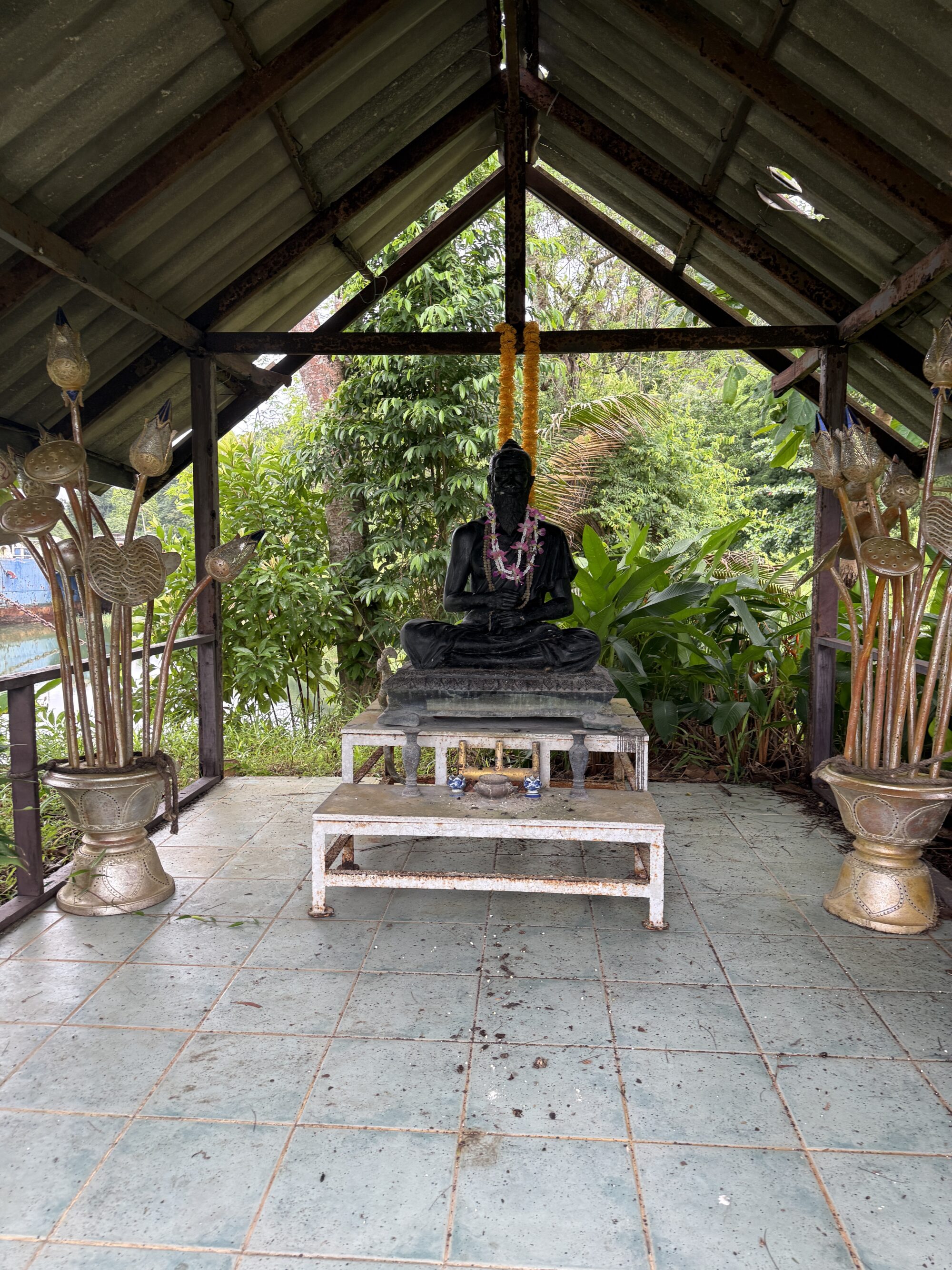
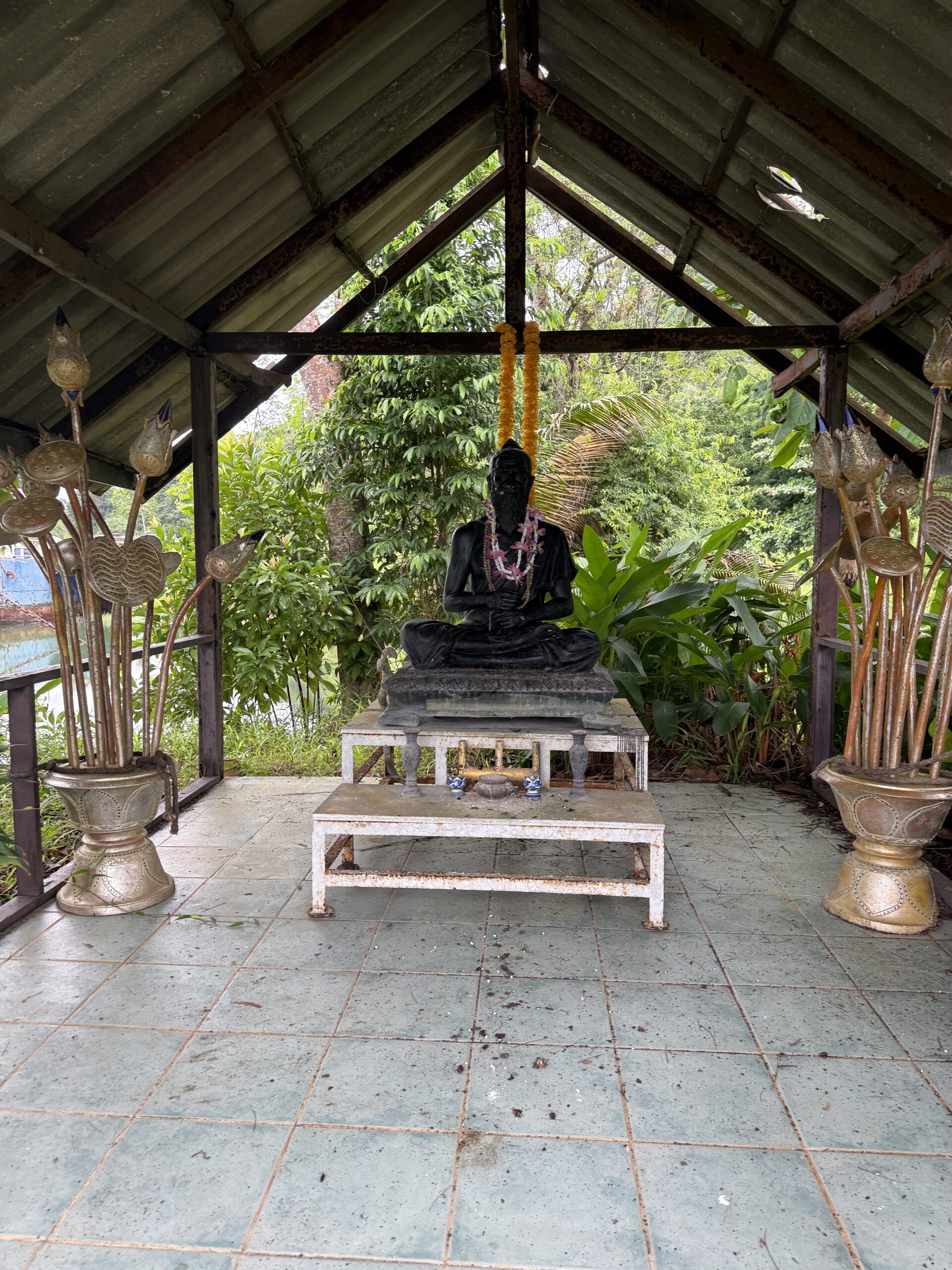
Just beyond the doorway stands a small open shrine—corrugated iron, rust-eaten beams, twin stands of metal lotuses flanking a black statue of a bearded man seated in eternal meditation. Flower garlands and prayer beads hang from its neck like offerings to something that still listens. The resemblance is uncanny. The carved face is Somchai’s own, or the face he will one day become, watching us with eyes that have already heard every version of the story he is about to tell.
He speaks broken English, but when I walked up he tried to speak to me first in what sounded like fluent Russian, then Turkish, and then Chinese. My assumption was that he spoke Chinese better than English not that I looked Chinese. I answered in broken Nyet, broken Nesselsenz, broken Ni hao. We established it had to be English.
“You want real one,” he said, “or tourist story?”
I told him I wanted the real one.
I’d already tipped him a hundred baht, so he knew. The ask was only for show. He smiled the slow, private smile of a man who knows the difference is thinner than smoke.
The Ship
“She never meant be beautiful,” he began. “LST—Landing Ship, Tank.”
Flat-bottomed, blunt-nosed, built in the last months of the great war to crawl up onto enemy beaches and spill tanks onto the sand like a metal animal giving birth. Ugly. Honest. American steel, 1945. One of thousands, indistinguishable, the way soldiers become indistinguishable once the photograph is old enough.
“Korea then long sleep. Then Vietnam.”
They woke her in ’66 and sent her into the rivers, the Delta, the places where smaller boats could not go. Floating fortress, floating hospital, floating pad for the machines that fell from the sky. She earned her scars there—campaign stars, citations written in a language most of her crew could not read. She was useful. She was needed.
“Fire find her. Two time.”
The Fire
“August 1970. Big Fire. ”
The air did not move. Below decks the men slept in their own sweat, the generators growling like animals that had never known silence. A fuel line parted in the generator room. The fire did not hesitate. It climbed.
“In dark smoke taste like oil and burn paint. Men die.”
They passed one another hand over hand up the escape ladder. A young coxswain named Delgado went back down. Twice. He brought two men into the cleaner air. The third time he descended for a man who should never have been that far aft, a quiet sailor from some cold northern place who had signed his name in a language the others could not pronounce. Delgado never came up again. The Coast Guard cutter that came alongside fought beside them for three hours until the foam was gone and the generator rooms were flooded to the chest and the lights had died.
“Navy say, one dead. Truth three.”
Delgado and the two he could not fully save. The papers preferred the smaller number. Recruiting posters do not smile when three empty bunks are left behind.
Somchai’s voice dropped. The statue in the shrine was seriously creeping me out.
“Ship no die.” The peace that followed did not want her. She was sold, stripped of her name, turned into an ore barge, a floating coffin for rock and dust. Eventually she drifted into the hands of a man who needed a better story than the one he owned.
The Lie
“Khun. Real-estate money want big story for big new resort.”
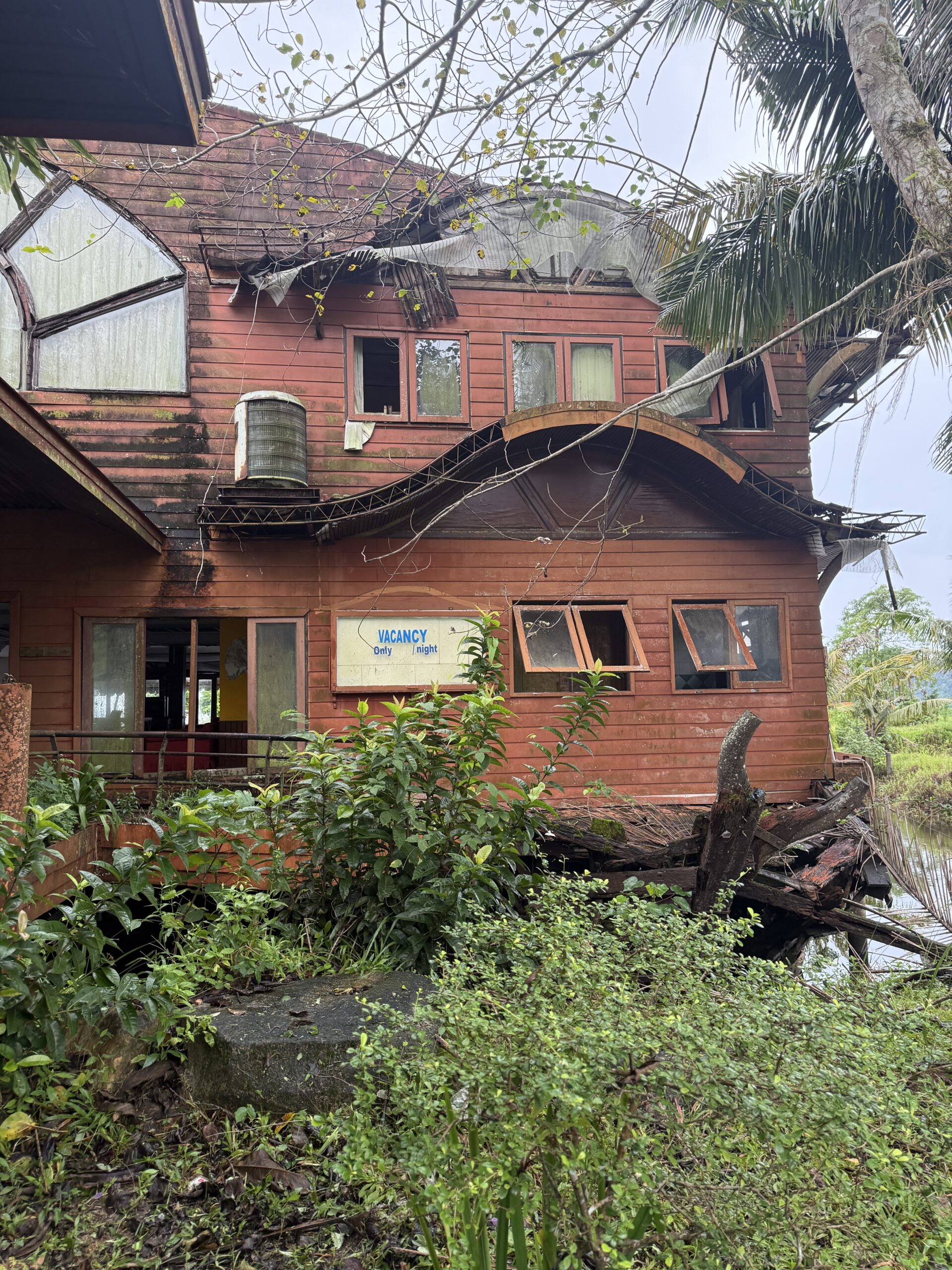
A man who had made his fortune in Phnom Penh and then watched that fortune turn to ash when the deals there collapsed. He came to this bay with an old hull and a hunger for something grander. He bought the land from the fishing families. He built Koh Chang Grand Lagoona around her. He called her a former Thai Navy landing ship, a vessel of honor. The brochures glowed with the lie. News stories repeated it until the lie became the only truth anyone could remember.
“Ship remember. Fire remember.”
The Second Fire
The man with the Russian sounding name came in the years when the resort still pretended to be alive. A businessman whose marriage had ended the way some marriages do—quietly, completely. He drank for seven nights. On the seventh he climbed to the highest rail and looked down at the black water for a long time. Then he went in. The staff called it a fall.
“I here. I see way he sit, way he wait, way water swallow he.” It received him without struggle. He went on his own terms and knew he wasn’t coming out.
It was clear there was no saving him.
The one left behind in the smoke and the rising water of 1970. The ship hadn’t taken him the first time. It had been waiting to finish the conversation.
“He return to ship that no kill him,” the circle closed. He hadn’t known it was the same ship. Maybe he never knew. The old wiring, the same restless electricity that had sparked in the generator room half a century earlier, woke again. December 3rd, 2024. He watched from this side of the bay as the second fire rose. It did not care that the upper decks were empty of guests. It did not care that the story painted on the hull was false. Fire recognizes its own. It burned the barge and the naval ship with the same appetite, the same memory. By morning the upper decks were gone. Only the blackened ribs remained, and even those are being cut away now, piece by piece, as though the island itself is trying to forget.
Yet the forgetting never quite succeeds.
We sat in the heavy silence that followed stories like that. The tide moved around the skeleton across the water. In the shrine the black statue kept its counsel, garlands fading, beads clicking faintly in a breeze that had not yet reached us. Somchai refilled my glass without asking.
I sipped, surprised but not surprised that now it was liquor.
“You believe?” he asked at last.
“I believe,” I said.
He nodded, satisfied. The statue’s carved eyes did not blink. Somewhere in the mangrove the last of the smoke still seemed to linger, patient, waiting for the next name to return.