
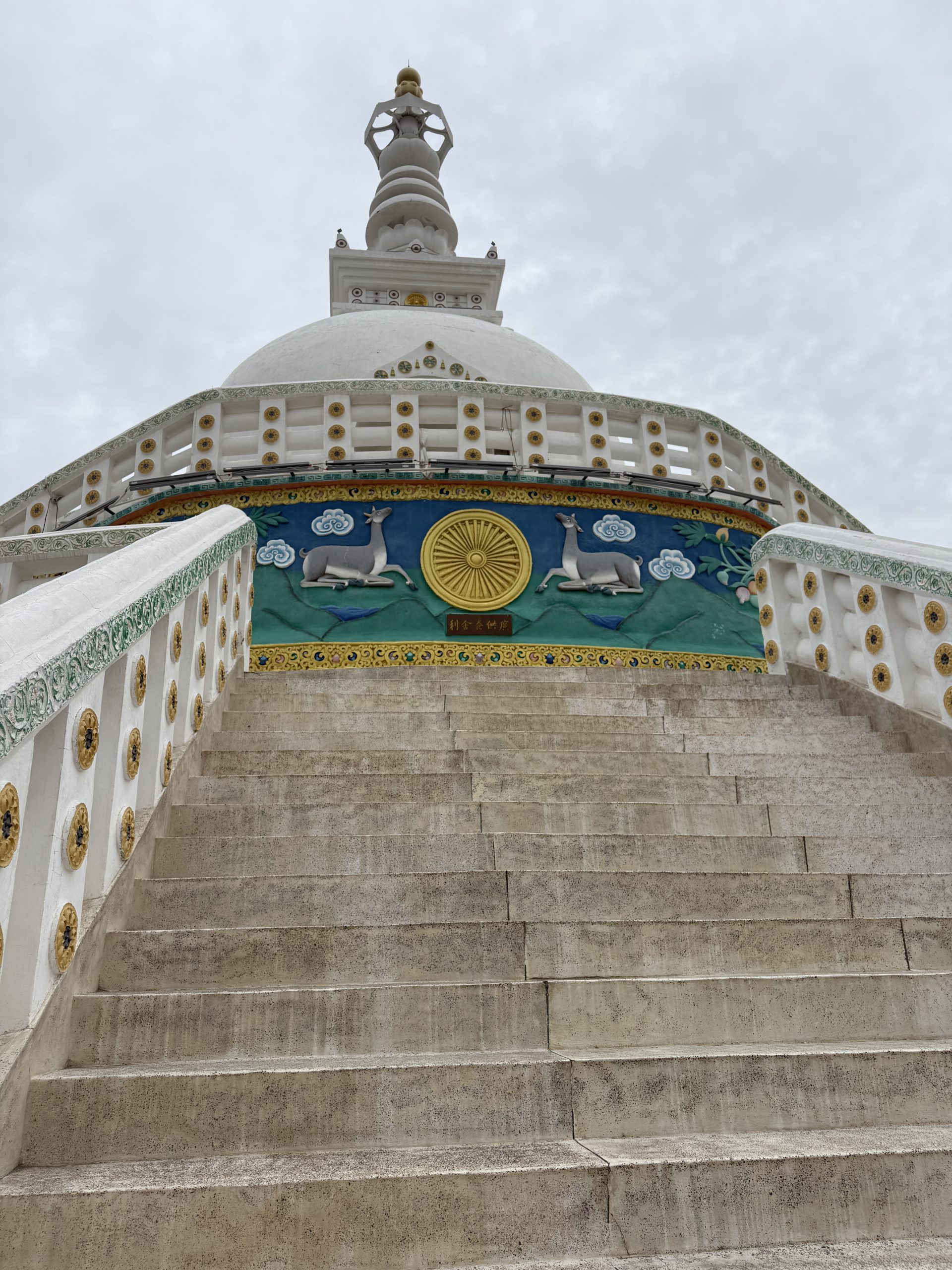
The Two Economies of Stillness in Leh, India
There’s a monk on Changspa Road who will teach you to sit still for three days, feed you, put a roof over your head, and drive you back into town when it’s over, all for about 5,500 rupees. Call it seventy-five bucks.
A few hundred meters away, on the same road, you can book a “transformative journey” with a Western yoga school that flies a cohort in from Europe, walks them through the same monasteries, points them at the same mountains, and charges upward of 1,500 euros for the privilege. Same skyline. Same thin air. Same 11,000 feet of altitude doing whatever altitude does to a nervous system. Flight not included. Different economy entirely.
I’ve been in Leh and other places where business hippies converge (Bali, Kauai, Jeju, Thailand) long enough now to notice the two variations don’t talk to each other much.
The cheap one here in Leh is Mahabodhi International Meditation Centre. It’s the real article: founded and run by a Ladakhi Buddhist monk, Bhikkhu Sanghasena, doing serious charitable work in the region on top of the retreats. That’s what the retreats pay for. Their silent courses run out at the Sambodhi center near Choglamsar, a village ten kilometers outside town that’s also home to a Tibetan refugee settlement. You sign up, leave a small deposit, show up with a sleeping bag and modest clothes. Dorm beds, shared bathrooms, plain food, a monk leading you through it. The price hasn’t moved much in years because it was never built to extract anything. It’s not selling you Ladakh. It’s just teaching you to sit in it.
The expensive one is an entire industry that showed up because the setting is unbeatable and the business hippie never stops looking for new ways to extract from your unsettled feelings. Eco-retreat lodges. Certified instructors flown in for the season. Booking platforms that list Leh next to Bali and Ubud and Hanalei like they’re interchangeable SKUs. None of it is Ladakhi. None of it particularly needs to be, that’s not really the pitch. The pitch is thin air, prayer flags, and a Buddhist backdrop rented for the week, priced the way wellness tourism gets priced everywhere: by what a stressed-out professional will pay to feel like they found themselves somewhere remote.
Layer on top of that the other thing moving through this town, which has nothing to do with yoga. Specifically: the Hummus Trail. Every year a wave of young Israelis, fresh off mandatory military service, works its way through a well-worn circuit, Leh, Manali, Kasol, Dharamshala, Rishikesh, down to Goa. There’s a Chabad House right on Changspa Road, same strip as the yoga studios and the German bakeries, doing Shabbat dinners and kosher food and, less visibly, informal triage for kids who’ve come apart somewhere on the trail after two or three years of service and however many months of decompression. It’s not a wellness retreat. It’s closer to a waystation. But it shares the block, and the street, and probably some of the same clientele on any given week, with the people paying four figures to “reconnect.”
None of this is a scandal. I’m not dissing the people who need to recover from mandatory military service by a military that pretends to be a government nor from stressed out tech professionals. I have some opinions on business hippies and Isreal itself (they are connected) but I can save that for another time. This is about tourism.
Business hippies and exploitive tourism do this everywhere where a visitor lands on something authentic: it builds a parallel, pricier version alongside the real thing, sells the aesthetic without the substance, and mostly nobody gets hurt (except local communities, honest business, exploited cultures – but again we can save that for another time). The retreat centers aren’t lying, exactly. You probably will feel something up there. Altitude alone will do strange things to your head in three days, whether or not a monk is involved.
But it’s worth knowing, if you’re standing on Changspa Road deciding where to spend your week, that you’re choosing between two different things wearing the same clothes. One is a Ladakhi Buddhist institution that’s been doing this work for decades at a price that assumes you’re a backpacker, not a client. The other is an import, dressed in the same robes, priced for people who measure a retreat’s worth by what it cost an the inability of their coworkers to participate in it.
I’ve done my research. I bet you can guess which way I’m leaning.