
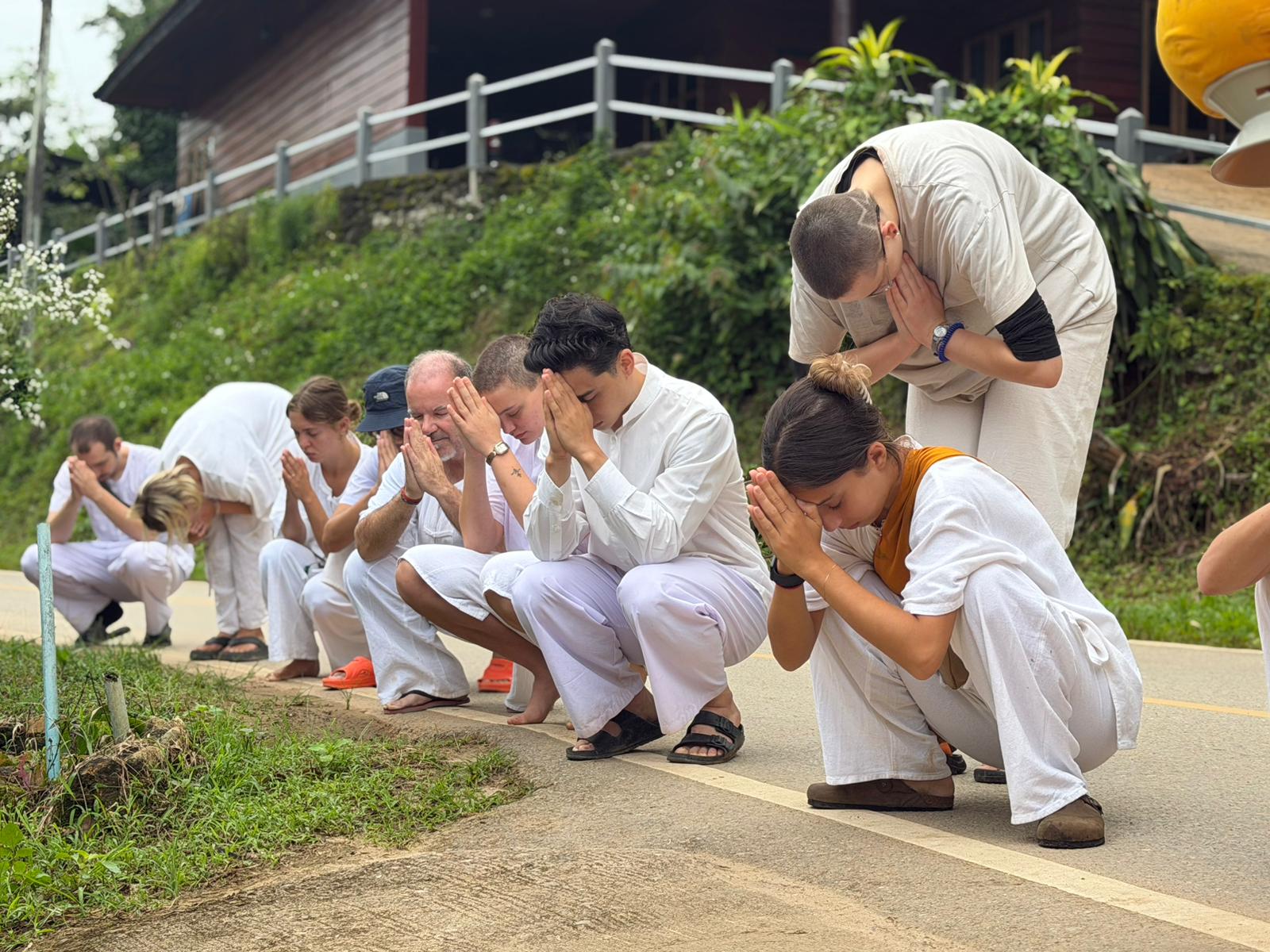
Somewhere between a $30-a-night hostel and a $30,000 wellness resort, there’s a whole category of travel most people never hear about: month-long immersions into monasteries, ashrams, temples, and intentional communities, most of them cheaper than staying home. You can spend thirty days in a Himalayan ashram for less than a week at a mid-range hotel. You can ordain as a Buddhist monk in Thailand on a donation basis. You can join a Zen monastery in Korea built specifically for foreigners.
You can also, without much warning, end up somewhere financially and psychologically difficult to leave.
This is a field guide to both halves of that.
The budget options that actually work
The pattern across every legitimate cheap option below is the same: you’re not a paying customer at a retreat resort, you’re a guest embedded in a functioning community. Donation-based or nominal-fee, English-accessible, and structured around daily participation rather than a curated tourist experience.
India. Rishikesh has the highest concentration of options. Parmarth Niketan, the largest ashram in the city, runs basic rooms from roughly ₹500 a night (about $6), meals and a morning yoga class included, putting a full month around $180 to $720 depending on room quality. Anand Prakash, a smaller and quieter option in Tapovan, runs closer to $450 to $540 a month all in. Amma’s ashram in Amritapuri, Kerala, charges foreigners about 600 rupees a day (roughly $7), which lands a month around $210, and the community is enormous and international enough that English is the default language. The Golden Temple in Amritsar offers free lodging and free meals to any visitor for up to three nights, and longer stays are common for anyone doing seva (volunteer work, most often in the community kitchen).
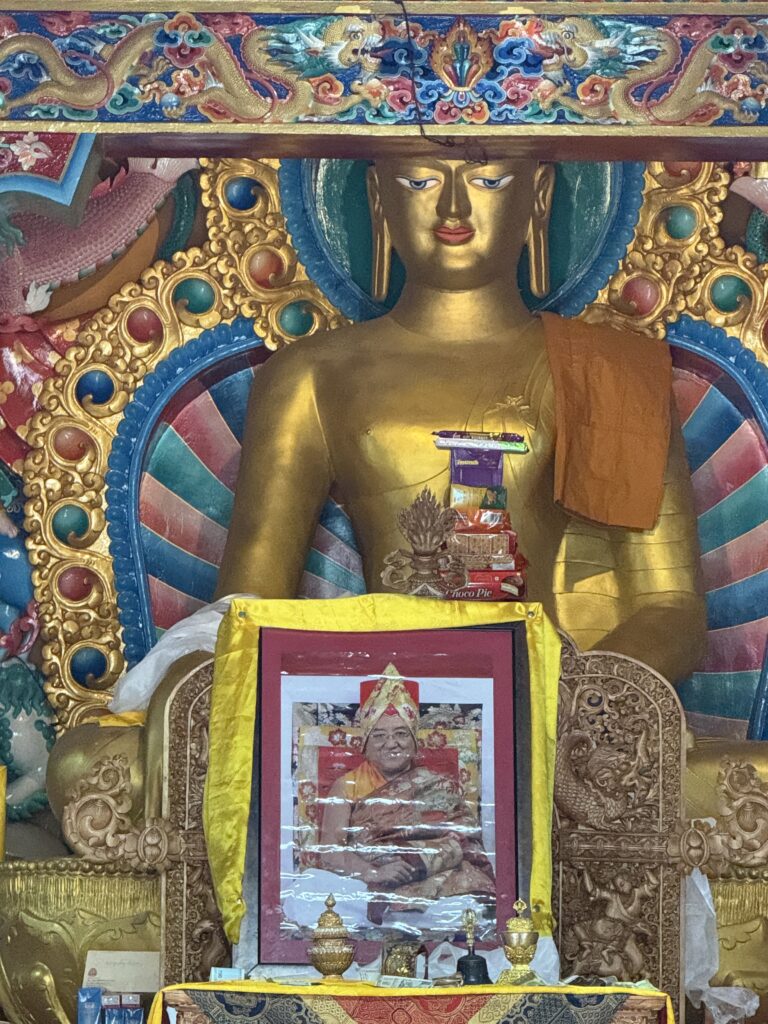
Nepal. Kopan Monastery outside Kathmandu, Tibetan Buddhist, teaches entirely in English and runs 5-day, 10-day, and full month-long courses. Retreat House accommodation runs about $26 a day including food, and shorter courses have been reported as low as $150 for ten days all in.
Thailand. Pa Pae, between Chiang Mai and Pai, runs a donation-based “Be a Monk” program in English, flexible in duration from a couple weeks to several months, with suggested donations around 1,500 baht for three days. Wat Pah Nanachat, the original English-language forest monastery in the Ajahn Chah lineage, takes a more serious and gradual path toward ordination and is also donation-based.
Myanmar. Centers like Panditarama and Chanmyay Yeiktha in Yangon are the cheapest intensive meditation retreats that exist anywhere, donation-based, English-speaking teachers, and built for foreigners doing month-plus stays. The catch is Myanmar’s political situation, which makes travel logistics worth checking carefully before booking anything.
South Korea. Skip the official Templestay program for anything longer than a few nights. It’s built for one or two night stays at $44 to $110 a night, so a month would run well over budget. Instead, look at Musangsa, an international Zen center built specifically for foreign practitioners and taught entirely in English. Twice a year they run Kyol Che, a 90-day silent Zen retreat, and lay participants can join for anywhere from a week to the full three months on a donation basis.
Taiwan. Fo Guang Shan Monastery in Kaohsiung runs an International Buddhist Monastic Life Program, an eight-week fully English immersion with free room and board, plus a $1,000 mini-grant toward other costs on completion. It’s competitive and aimed at students or serious scholars, roughly thirty spots a year. Their Short-Term Monastic Study Program (two to four weeks) is similarly sponsored, and the Woodenfish program, which uses Fo Guang Shan-affiliated sites, charges a $500 administrative fee with room and board otherwise covered.
Christian monasteries. Some run on pure work exchange: Abhayagiri (California) and Mepkin Abbey (South Carolina) provide free room and board for daily labor and participation in monastic life. Others are donation-based, like Pluscarden Abbey in Scotland. Mount Athos in Greece is nearly free but caps most visitor permits at four nights unless you’ve built a relationship with a specific monastery.
The pattern that should worry you
Every option above shares a structure: a leader or lineage with real authority, a community that depends on donations and labor, and a visitor who arrives without a local support network and often without fluent language skills. That structure is exactly what makes an ashram cheap and immersive. It’s also exactly what makes a bad one dangerous.
None of what follows means don’t go. It means know the difference between “intense” and “controlling,” and know it before you’ve handed over your passport, your savings, or your ability to leave.
The recognizable pattern
Across every documented case of a spiritual program turning harmful, the same few structural features show up, almost without exception:
Unaccompanied private access. A leader who meets individuals alone, with no third party present, especially where “healing” or “blessing” is used to justify physical contact. Sathya Sai Baba’s ashram in Puttaparthi, India, is the clearest example: decades of consistent, unconnected testimony from male former devotees alleging sexual abuse during private “interviews,” first aired widely in the BBC documentary Secret Swami (2004), and referenced obliquely in a US State Department travel advisory. He was never criminally charged. He died in 2011. The ashram still operates.
Isolation dressed up as devotion. Discouraging contact with family, discouraging comparison with other teachers or traditions, treating disagreement as a spiritual failing rather than a normal human response. Gail Tredwell, who served as Amma’s (Mata Amritanandamayi) closest attendant for nineteen years at the Amritapuri ashram, described exactly this pattern in her 2013 memoir Holy Hell: unpredictable punishment for perceived disloyalty, threat of permanent expulsion, and separately, an allegation that a senior disciple sexually abused her over several years. The ashram organized large public rallies denying the claims. Neither side of it has been tested in court. This is the same ashram that shows up on every “cheap and easy” budget retreat list, including earlier in this piece, which is exactly the point: affordability and popularity say nothing about safety.
The gap between “never convicted” and “credible, consistent testimony.” This is where organizations live and where readers get hurt. The Isha Foundation, run by the guru known as Sadhguru out of Coimbatore, India, is a live example. In 2024, a retired professor filed a habeas corpus petition alleging his two adult daughters were being held against their will at the ashram. Police searched the property. The Supreme Court ultimately closed the case after the daughters stated in open court they were there voluntarily. But the police investigation that followed surfaced a separate file spanning fifteen years: a POCSO child sexual abuse case involving an ashram-affiliated doctor, missing-persons reports, and unexplained deaths, none of which have produced a conviction. Isha denies wrongdoing and says its network of roughly three hundred centers operates entirely on voluntary participation. All of that can be true at once. That’s the uncomfortable part.
Financial and psychological dependency that makes leaving expensive. Bikram Choudhury isn’t ashram-based, but the shape is identical: a guru-centered hierarchy, students financially and professionally dependent on his approval, and seven women who eventually filed civil suits alleging rape, sexual assault, and harassment. One case produced a $7.4 million jury verdict against him. He fled the United States rather than pay it, has an outstanding international arrest warrant, and continued running paid teacher trainings in Mexico and Spain for years afterward. No criminal charges were filed. The Los Angeles DA cited insufficient evidence for prosecution, not innocence, and that distinction matters more than it sounds like it should.
What happens when a charismatic founder loses accountability entirely. The Osho (Bhagwan Shree Rajneesh) movement is the fullest documented example, now widely known through the Netflix series Wild Wild Country. At the original Pune ashram in the 1970s, a former disciple alleged that women were pressured into sex during “therapy” sessions, and that resulting pregnancies were resolved through mandatory abortion or expulsion. When the movement relocated to Rajneeshpuram, Oregon, in the 1980s, it escalated into the largest bioterrorism attack in US history: followers deliberately contaminated salad bars with salmonella to suppress local voter turnout, sickening over 750 people. Immigration fraud and one of the largest wiretapping operations in US history followed. Ma Anand Sheela, the leader’s top lieutenant, served federal prison time. Osho died in 1990. The Pune ashram still operates today, still draws Western spiritual tourists, and doesn’t advertise any of this history.
A short checklist before you commit
- Can you leave at any time, for any reason, without financial or social penalty?
- Is there a leader with unaccompanied private access to individual followers?
- Is outside contact (family, other teachers, the internet) discouraged or restricted?
- Is pricing and use of donations transparent, or vague and framed as “generosity”?
- Search the name plus “allegations,” “lawsuit,” and “former member” before you book, not after.
- If your gut says something is off and everyone around you seems to be performing certainty, trust the gut.
The solarpunk angle: intentional communities and experimental cities
Ashrams and monasteries aren’t the only version of this. There’s a whole parallel track of secular utopian communities, some built around ecology and self-sufficiency, some now built around crypto and governance experiments. Different aesthetic, same basic promise: opt out of the default system and build something better with people who share your values.
Auroville, Tamil Nadu, India. Founded in 1968 by a French spiritual figure known as “the Mother,” a collaborator of the philosopher-guru Sri Aurobindo, Auroville describes itself as a universal township aimed at “human unity,” beyond nationality, religion, or politics. It runs partly on a cashless internal economy (the Aurocard) and hosts around 150 ongoing projects in ecology, renewable energy, education, and organic farming. Short volunteer stints exist (some farms take guests for two weeks at 250 to 500 rupees a day, food included), but real long-term integration requires a special Entry X-2 visa and a minimum six-month commitment, arranged well in advance through Auroville’s own admissions office. It’s the closest thing on this list to an actual functioning solarpunk city, and it comes with the same caution as everything above: a founding spiritual authority, decades of internal governance disputes with the Indian government, and land and succession issues that have played out publicly for years. Worth researching current governance status before planning a long stay.
Network states. A newer, explicitly secular and tech-adjacent version of the same impulse, coined by former Coinbase CTO Balaji Srinivasan in his 2022 book The Network State: build an aligned online community first, crowdfund territory second, and eventually seek diplomatic recognition as a new kind of country. None of the current projects have completed that sequence, but several are running real, physical versions of it.
- Próspera, on the Honduran island of Roatán, is the furthest along: an actual special economic zone with its own regulatory framework, backed by investors including Peter Thiel and Marc Andreessen, functioning since 2020.
- Zuzalu, started by Ethereum’s Vitalik Buterin in 2023, runs as a temporary “pop-up city,” bringing a couple hundred people together for a few months at a time to live and work on longevity, governance, and biotech, most recently in Montenegro and Istanbul, with a permanent Swiss village reportedly in the works.
- Network School, Srinivasan’s own residential project, has been running since late 2024 out of Forest City, Malaysia, a mostly-empty Chinese-built development. It’s a paid coliving and coworking program with a crypto-inflected curriculum, not a sovereign community, whatever the branding implies.
- Praxis is funded but still unbuilt.
These are not budget options. Citizenship fees, residency programs, and pop-up village tickets generally run well past $1,000 a month, sometimes dramatically so. They’re worth including in an article like this because the pitch is structurally identical to a guru-led ashram (join us, opt out of the broken system, build the future together), just wearing a different aesthetic, and the same questions apply: who actually controls governance, what happens to your money and your legal status if you want out, and is there any independent accountability at all. Próspera and Network School both currently operate inside a host country’s legal system, which gives you more recourse than a stateless pop-up village does. That’s a real distinction worth making to readers, not just a footnote.
The honest summary
The cheapest, safest, and most transparent options on this list are the ones with the longest institutional track record and the least dependence on one unaccountable person: Kopan, Fo Guang Shan, Musangsa, the Christian work-exchange monasteries. The most interesting and most dangerous options are the ones built entirely around a single charismatic founder, whether that founder wears saffron robes or talks about crowdfunding sovereign territory. Do the research before you book, not after you’ve already handed over the deposit.