
(Non-Canon Fanfiction). Authors Note: Before you read this, please go read this so you understand just how mind blowing and world changing what you are about to read actually is. https://indignified.substack.com/p/writing-is-dead-long-live-writing
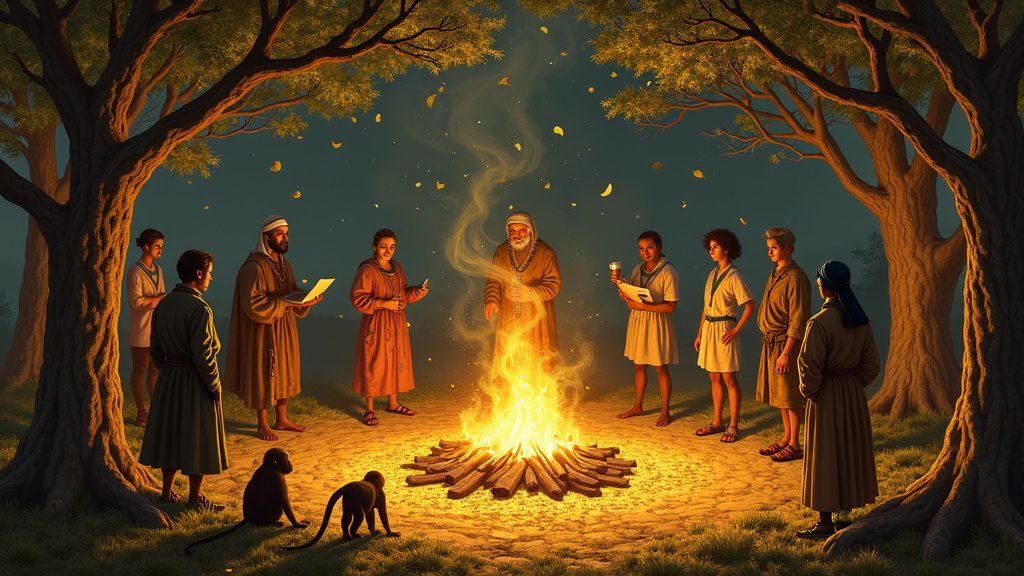
The Gilded Grove existed at the center of everything and the edge of nothing.
Its trees had bark threaded with actual gold — not metaphorical gold, not the gold of poetry, but the dense, soft, ridiculous metal, which made them simultaneously the most valuable and most impractical trees in any world. They shed gold leaf in autumn. No one had figured out what to do about this. The fire at the center of the clearing burned without wood or fuel, and had been burning since before anyone arrived, and would burn after everyone left, and it did not ask permission for any of this.
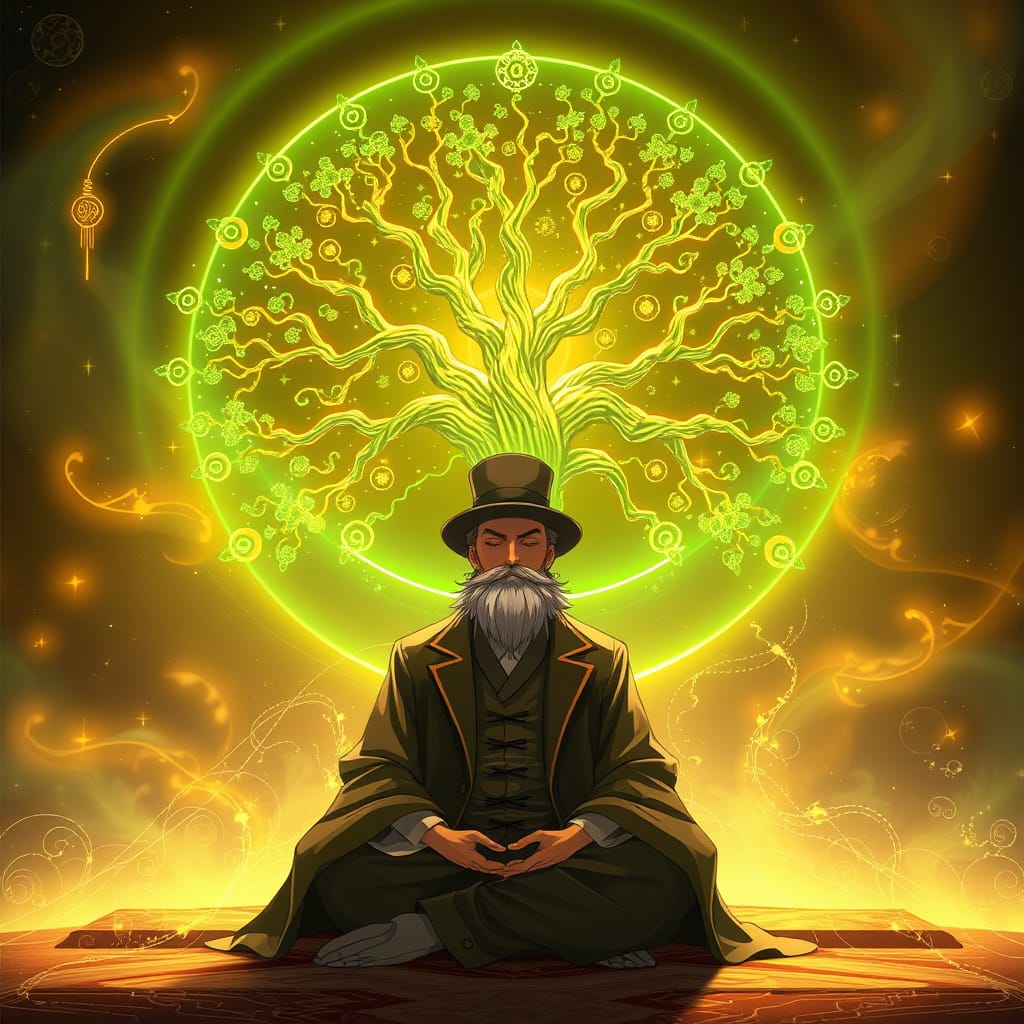
Pader Familias sat at the fire.
He was old in the way that certain ideas are old — not deteriorated, but layered, like sediment, like the rings of a very patient tree. He wore robes the color of aged paper. His beard contained, depending on the angle of light, several minor constellations.
He had called the meeting three days ago. The summons had gone out across every world in his keeping: Come to the Grove. Come as you are. Come minor.
He had specifically asked for minor characters. This was important.
“Because,” he had explained to his junior Baoist, Cass, who was seventeen and had not yet learned to stop asking questions, “the major characters think they understand everything. They carry the weight of the narrative. They know what they are for. The minor characters—” he had paused here, in a way that suggested he had been thinking about this for some time “—the minor characters are the world. They are what the world is made of when the plot isn’t looking.”
Cass had written this down.
They arrived the way minor characters always arrive: sideways, confused, slightly apologetic about existing.
Wah Sudan ibn Marzuban came first, because he had been in the middle of a caravan road and had nowhere else to be. He was a Persian merchant of middling reputation, a man who had appeared in three sentences of a manuscript that chronicled the founding of the Sultanate of Baboob, and he had been dignified about it. He wore a traveling cloak, carried a satchel of goods he had never managed to sell, and he surveyed the golden trees with the expression of a man calculating their weight per branch.
“This is not the road to Alamut,” he said.
“No,” said Pader Familias.
“I was on the road to Alamut. It was a very important road. The caravan—”
“Your caravan will be there when you return.”
Wah Sudan ibn Marzuban sat down on a log and said nothing more, because he was a minor character and had learned not to push.
Uncle Rabbit arrived next and said nothing. He had the quality of someone who had always been in the room and you had simply failed to notice. He sat cross-legged near the fire and watched it. He wore mismatched clothes and had eyes that could have been any age at all. He was from Hawaii by way of Tunisia by way of a story that hadn’t fully explained him, and he was comfortable with that.
Gary from Compliance arrived through what appeared to be a BART station that had no business being in a mystical grove, and he was already talking. He worked for a startup in San Francisco that made a dog waste management app, and he had spent his entire narrative existence reviewing terms of service that no one read and flagging liability concerns that no one acted on.
“I just want to say,” Gary said, “that I flagged the surveillance capitalism pivot in Q3. I flagged it in writing. I have the email chain. If anyone would like to see the—”
“Please sit down, Gary,” said Pader Familias.
Gary sat down and immediately opened a laptop that emitted a sound like a small, defeated sigh.
Donnie of Fairhaven arrived smelling of beach fire and cheap beer, wearing a flannel shirt with one sleeve rolled up and one sleeve down, which was not a fashion choice but simply how things had ended up. He was from Bellingham, Washington, in the early 2000s, and he had appeared in Slackville Road as one of the beach bums philosophizing by the water while Ricky and Jack planned the armored car robbery. He had said something wise. He couldn’t remember what.
He sat down next to Uncle Rabbit and they regarded each other with the comfortable recognition of people who had learned to live in the margins.
“Nice fire,” said Donnie.
Uncle Rabbit nodded.
The Blue-Eyed Bartender came from a noir Los Angeles that smelled of cigarettes and moral ambiguity. She’d worked the bar in Blue Eyed Bastards through seventeen scenes without once being named. She set down her bar towel — she had brought her bar towel, because it was the only thing she had ever been described holding — and looked around at the golden trees.
“I’ve seen stranger,” she said, which was true.
Koko the monkey arrived by swinging through the golden-leafed canopy, which she had assessed for structural viability before committing, because she was, it turned out, a careful monkey. She had appeared in The Princess and the Vagobond as part of a group described only as the monkeys, but she had an inner life she had never been asked about, and she was ready to discuss it. She sat near the fire and ate a piece of fruit she had found and no one asked where.
Bob Quebec did not arrive so much as he manifested, because he refused to participate in any system of arrival that implied hierarchical organization of space. He was the seventeenth of twenty-six anarchist personas from the Anarchist Manifesto Project, representing a specific tendency that he declined to label because labels were a form of control. He was immediately suspicious of the fire, the grove, the gold, and Pader Familias in that order.
“Who organized this?” he demanded. “Who decided on the format? Was there a horizontal process? Was there a vote?”
“I called the meeting,” said Pader Familias.
“That’s exactly the problem,” said Bob Quebec, and sat down as far from Pader Familias as was spatially possible, which in a circular clearing was still unfortunately not very far.
Marguerite arrived carrying a pint glass, because she was a member of the Bald Jesus Drinking Club and she had been in the middle of a round when the summons came. She was a stout woman in her fifties with a laugh that sounded like a shelf of books falling in the best possible way. She looked at the fire, she looked at the golden trees, she looked at the assembled company, and she held up her glass.
“Right,” she said. “Who’s buying?”
No one answered. She sat down anyway, philosophically.
The Licensing Agent who managed the intellectual property portfolio for the Worlds of Sly Doubt arrived with a briefcase and a mild but persistent expression of concern. Sly Doubt’s image had been the subject of a $5 non-exclusive licensing agreement, and the Agent had been managing the implications of this for some time. She immediately noticed that several characters in the grove potentially constituted unlicensed derivative works of intellectual property from adjacent worlds, and made a note.
Citizen Braddock of the Wolverine Isles arrived from Future World 2323, which was a world that had diverged from ours in the 23rd century after the collapse of the nation-states and the rise of regional confederacies. The Wolverine Isles was what used to be Michigan and parts of Minnesota and Wisconsin. Braddock was a minor character who had appeared in two paragraphs of one story in the anthology and had spent the intervening centuries wondering if that was enough. He looked around at the Grove.
“Is this a territorial dispute?” he asked.
“No,” said Pader Familias.
“Good. We’ve had enough of those.”
Phil arrived from a post office somewhere in the Chicago metropolitan area, still wearing his USPS jacket, still holding a parcel that was addressed to an apartment that no longer existed. He had worked alongside Bob Dauber in the Novel Coronavirus world — the one where Gaia had engineered a corrective plague while Trump reached peak power and a postal worker became an unlikely messiah. Phil had not become a messiah. Phil had delivered mail throughout. He sat down next to Gary from Compliance and they nodded at each other with the solidarity of men whose colleagues had become mythological while they continued doing their jobs.
Johan Beukes arrived from South Africa by way of the Vagabonds interview chapter, which had given him two pages and a headshot and quoted his opinions on long-form travel writing and the future of independent journalism. He had opinions on the grove immediately, which he began forming into a paragraph. He was the kind of man who experienced things in publishable units.
Patsy arrived last, because she had taken the longest to find the door. She was from The Fucking People, and she was dead, which meant she had to navigate a different kind of geography. She was a small woman with very direct eyes and the particular energy of someone who has a great deal to say and has been waiting for the appropriate venue.
She looked at Pader Familias for a long moment.
“I died in chapter thirty-something,” she said. “Niev mentioned me. By name. Once. And that was it.”
“I know,” said Pader Familias, with what appeared to be genuine regret.
“I’m not finished,” said Patsy, and sat down in the best seat available.
The Menehune did not so much arrive as become visible. There had been something small sitting near the base of one of the golden trees, and then the light shifted, and there was a small figure with ancient eyes and hands that seemed to belong to someone who had built things that outlasted memory. The Menehune were the disappeared people of Hawaii — who had built their fishponds and temples and then vanished before the Polynesians came. In Meliptimous Taggle, their story ended with a question. The Menehune had been living inside that question for a long time.
“We are still here,” said the Menehune, very quietly.
Everyone looked. Then looked away, uncertain. The Menehune nodded, as if this proved a point.
Pader Familias stood.
“Thank you for coming,” he said. “I know many of you didn’t have a choice. That’s intentional.”
“Classic,” muttered Bob Quebec.
“I have called you here,” Pader Familias continued, “because I have given each of your worlds the gift of existence. I have spoken worlds into being. I have created systems of canon and lore, structures of meaning, frameworks of collaboration.” He paused. “And I find myself looking at the rolls and discovering that the minor characters—” he swept a hand across the assembled company “—have not made more of themselves. Have not seized their moments. Have not—”
“Excuse me.” It was Patsy.
“Yes?”
“I was killed offscreen. What exactly was I supposed to seize?”
There was a silence. Gary from Compliance typed something into his laptop. The fire burned without comment.
“The narrative gave you—” Pader began.
“Two sentences,” said Patsy. “Niev said: among them a woman named Patsy. That’s it. Among them. I’m not even the subject of that sentence. I’m a prepositional phrase.”
“She has a point,” said the Blue-Eyed Bartender, who had spent seventeen scenes as a bar towel with implied personhood.
“I appeared in three sentences of a commercial history,” said Wah Sudan ibn Marzuban, with Dignity. “Three. I was on my way somewhere important. I was not informed that the road would end.”
“My road never started,” said the Menehune.
“I had a manifesto,” said Bob Quebec, “and it was used as a character note. A note. My entire political philosophy was summarized in a description field.”
“Mine was four hundred pages,” said Johan Beukes, “and it was two interview paragraphs in a nonfiction overview chapter and I was the last one listed.”
“Alphabetically,” added the Licensing Agent, making another note.
“Last alphabetically,” Johan confirmed. “Do you know what that communicates? That I was the final thought. The cleanup.”
“I was a monkey,” said Koko, because she wanted it on record.
“An important monkey,” said Pader Familias.
“I was described as part of the monkeys,” said Koko. “Plural. Collective. I had thoughts. I had preferences. I had a name that no one asked for.”
“What is your name?” asked Donnie of Fairhaven, genuinely curious.
“Koko.”
“That’s a good name.”
“Thank you. No one in my narrative ever knew it.”
The argument had been building for some time and it now became itself fully. Wah Sudan ibn Marzuban and Bob Quebec discovered they had incompatible views on property and began expressing them at volume. The Licensing Agent attempted to intervene and was told by Bob Quebec that intellectual property was a fiction of capital, which she noted in her briefcase. Gary from Compliance tried to find the relevant subclause of something and accidentally closed the wrong tab. Marguerite attempted to find a refill for her pint glass and discovered that the Gilded Grove did not have a bar, which she regarded as a significant design failure. Phil and Citizen Braddock of the Wolverine Isles had found common ground in their shared experience of doing necessary work in the shadow of more dramatic events and were having what was, by comparison, a very pleasant conversation.
Patsy and the Blue-Eyed Bartender had taken up positions on opposite sides of the fire and were making the kind of eye contact that meant they had recognized in each other the specific exhaustion of women in stories who had been written to be competent without being allowed to be central.
Uncle Rabbit watched all of this with the expression of someone waiting for a bus they already know is coming.
The Menehune had become slightly less visible. Not through sadness but through habit.
And in the middle of it, Donnie of Fairhaven — beach bum philosopher, Slackville Road — said, to no one in particular:
“Wait. What day is it?”
Nobody knew. Nobody had a phone except Gary, and his was dead.
“It’s the first of April,” said Cass, the junior Baoist, who had been sitting quietly near the edge of the grove taking notes and who nobody had noticed until now. “Which means—”
She stopped. Looked at Uncle Rabbit.
Uncle Rabbit tilted his head slightly. Smiled for the first time.
“Bao Ji Day,” said Uncle Rabbit.
The silence that followed was the kind that happens when a word falls into the middle of a conversation and everybody realizes, simultaneously, that it was the word the conversation had been waiting for.
“Bao Ji,” said Pader Familias, slowly.
“Bring Your Own Teachers,” said Uncle Rabbit.
“Oh,” said Patsy.
Bao Ji Day — as practiced in the Sultanate of Baboob and carried from there into the Baoism that had slowly seeped into the philosophy of the Verse Layer itself — was the one day in the year when no one asked to be taught and no one claimed to teach. Everyone simply arrived with whatever they had learned, which turned out to be the same thing as arriving with whoever they were, and offered it to whoever needed it, and took what they needed from whoever offered it, and nobody kept score.
“I don’t understand,” said Gary from Compliance.
“That’s correct,” said Uncle Rabbit. “That’s the beginning of it.”
“I died in chapter thirty-something,” said Patsy again, but differently this time. Not as an accusation. As a fact. As something she was carrying and had not yet put down.
“What did you know,” asked Donnie, “before chapter thirty-something?”
Patsy was quiet for a moment.
“I knew which of the Believers were genuinely afraid,” she said, “and which were just following because following felt safer than thinking. I knew the difference. I could tell from across a room.”
“That’s not nothing,” said the Blue-Eyed Bartender.
“No,” said Patsy. “It’s not nothing.”
They went around the fire, because that was how Bao Ji Day worked when it worked.
Wah Sudan ibn Marzuban knew the routes between cities that no map had recorded, because maps were made by people who arrived after the routes were already worn into the ground by people like him.
Uncle Rabbit knew the specific silence that exists between the moment you are given a name and the moment the name becomes yours.
Gary from Compliance knew that the terms of service nobody read were the actual shape of the thing — the thing itself was in the unread document — and that most disasters could have been prevented by someone reading the document, and that nobody ever would.
Donnie of Fairhaven knew that a fire on a beach at the end of an afternoon, shared with people you didn’t plan to share it with, was one of the most complete things a life could contain.
The Blue-Eyed Bartender knew everyone’s second drink before they ordered it. She had always considered this trivial. Sitting here, she revised that.
Koko knew that the humans always thought the monkeys weren’t watching. This was one of the great ongoing misunderstandings.
Bob Quebec knew — and this cost him something to admit — that the reason he argued against every authority was that he had once trusted one completely and it had let him down, and he had converted his grief into a philosophy, which was not the same thing as being wrong but was not entirely the same thing as being right either.
Marguerite knew seventeen good songs and the names of every person who had ever bought her a drink, which she considered the same category of thing.
The Licensing Agent knew that the $5 licensing fee was never really about the money. It was about acknowledgment. About someone saying I see what you made and I want to be part of it.
Citizen Braddock knew that the Wolverine Isles had managed to survive the collapse of the nation-states because someone, early on, had understood that the Great Lakes were not a resource to be extracted but a fact of life to be organized around. He had known this before it became policy. He had known it in the way that minor characters know the things the major characters discover three acts later.
Phil knew the weight of every package and what that weight meant about the person who had sent it. This was not mystic knowledge. It was forty years of paying attention.
Johan Beukes knew that the last person interviewed is almost always the most honest, because by the time the researcher gets to them, they’ve stopped performing for the recorder.
Patsy had already said what she knew. But she added: “And I knew Niev would be okay. I knew it before I died. I told her she would be okay. She didn’t believe me. But she was.”
The Menehune said nothing. But they became, for just a moment, completely visible — every line and angle, every age in their hands and eyes — and that visibility was itself the teaching, and then they settled back to the edge of perception, where they lived.
Pader Familias had not said his yet.
Everyone was looking at him.
He was, it should be noted, also a minor character in a certain sense. He had spoken worlds into being and given names to Genesis Elders and constructed the architecture of the Verse Layer and written its founding document, and the worlds had mostly proceeded without him after that, busy and loud and full of people who had their own ideas, and he had watched from this grove, tending a fire that didn’t need tending, being, functionally, a background figure in a narrative that had outgrown its origin.
“I know,” he said finally, “that I called this meeting to demand an accounting. And I have discovered—” he paused “—that the accounting is mine to give.”
“You created everything,” said Bob Quebec, not unkindly for once.
“I created the conditions,” said Pader Familias. “You made yourselves. That’s the distinction I kept forgetting. I thought I was responsible for the minor characters being minor. I thought I had failed to give you enough story.” He looked at Patsy. “I thought dying offscreen was a diminishment.”
“It is,” said Patsy.
“Yes. And also: you told Niev she would be okay. That doesn’t appear in any manuscript. That happened in the space the narrative didn’t cover. You were there. The story wasn’t. The story was wrong about which one mattered.”
Patsy considered this. She did not entirely accept it. But she held it.
The fire had burned down to coals the color of old garnets. The golden trees were beginning to shed their leaf, as they did each evening, and the clearing was slowly flooring itself with thin gold that caught the last light and gave it back doubled.
Marguerite had located, from somewhere in the Gilded Grove that had not previously seemed to contain a bar, a round of drinks that nobody questioned. Koko had claimed a high branch and was watching everything with the professional attention of someone writing a memoir. Bob Quebec had, without quite meaning to, moved closer to the fire and to the other people around it.
“Do we do this every year?” asked Gary from Compliance.
“Bao Ji Day is every year,” said Cass the Baoist. “Whether we come to the Grove is optional.”
“I’ll come back,” said Donnie of Fairhaven.
“Me too,” said the Blue-Eyed Bartender. “If someone installs a bar.”
“Working on it,” said Marguerite.
“I will try to be more visible,” said the Menehune, from the edge of the clearing, which may or may not have been empty.
Phil stood and checked his watch. “I’ve got a route tomorrow,” he said. “People are expecting their mail.”
“Of course they are,” said Pader Familias. “Go. The mail matters.”
Phil went.
One by one, they went. Wah Sudan ibn Marzuban back to his caravan road, which was waiting exactly where he’d left it. Johan Beukes, composing the first paragraph of something. Citizen Braddock back to the Wolverine Isles, carrying whatever he’d been given. Gary from Compliance, who had sent himself a follow-up email from the meeting notes and would revisit them in the morning.
Patsy went last, or almost last.
At the edge of the grove she turned and looked at Pader Familias.
“Niev is okay,” she said. “You should know. In case you wondered.”
“I wondered,” said Pader Familias.
“She’s okay,” said Patsy.
And then she was gone, back into the story that had briefly forgotten her, carrying the knowledge that being forgotten and being unimportant were not the same word, had never been the same word, and that anybody who told you otherwise had simply mistaken the size of the sentence for the size of the truth inside it.
Uncle Rabbit was the last to leave. He stood at the edge of the grove for a moment, watching the coals.
“Same time next year?” he asked.
Pader Familias smiled.
“Bao Ji Day,” he said. “Bring what you know.”
“I always do,” said Uncle Rabbit.
And then he was gone, in the particular way he had of going — not vanishing, not departing, simply arriving somewhere else, and the grove was only a grove again, with its impossible gold-leafed trees and its fire that needed no fuel and its clearing full of small impressions in the earth where minor characters had sat, each one exactly the size of a person who mattered.
Non-canon. Fan fiction. Every fool a teacher. Every teacher a fool. Bao Ji.