
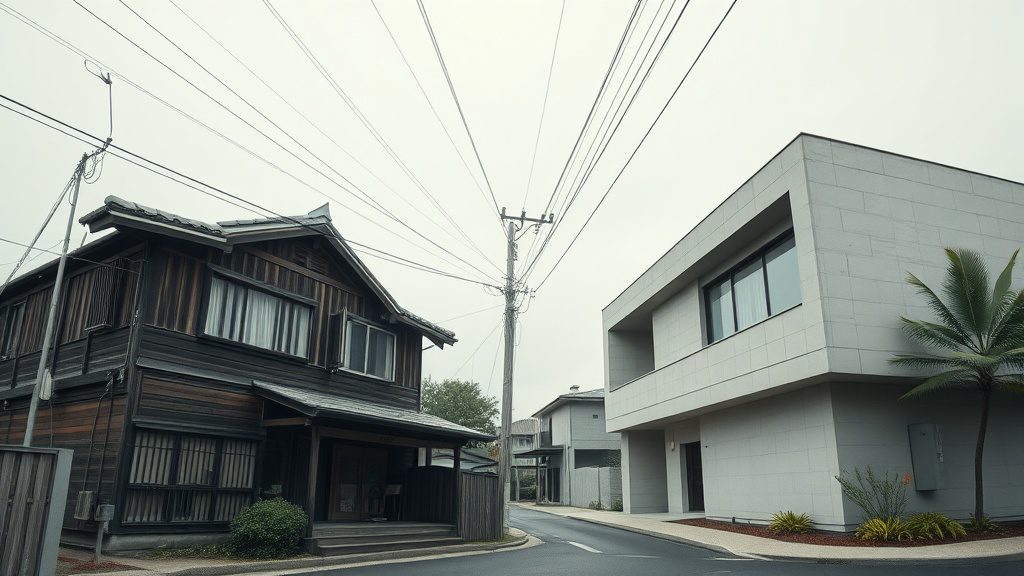
A 40-year-old house in the United States is normal. A 40-year-old house in England is new. A 40-year-old house in Japan is a tear-down.
This is the single most disorienting thing about Japanese real estate for Western buyers. The house you’re looking at — solid foundation, intact roof, functioning plumbing — is valued at zero. Literally zero. The listing price is for the land. The structure on top of it is considered spent, and in many cases, the cost of demolishing it is subtracted from the land value, making the house a negative asset.
If you grew up in a culture where houses appreciate, where a “vintage home” commands a premium, where your parents’ house is worth more than they paid for it — Japan’s approach to residential buildings will feel like an error. But it’s not an error. It’s a system built on different assumptions, shaped by earthquakes, fire, climate, tax policy, and a cultural relationship with impermanence that has no Western equivalent.
Understanding this system is the key to understanding why akiya exist, why they’re cheap, and why buying one might be the smartest real estate move available to a foreign buyer in 2026.
The Numbers
The Japanese tax code depreciates wooden residential buildings over 22 years. That’s the official useful life. After 22 years, the structure’s book value reaches zero. This isn’t a guideline or a suggestion — it’s the depreciation schedule that banks, appraisers, and tax authorities use. A wooden house built in 2004 has zero structural value in 2026, according to the system.
Reinforced concrete (RC) buildings get 47 years. Light steel frame gets 27 years. But the vast majority of Japanese houses — and virtually all the akiya you’ll encounter in Otaru — are wooden construction. Twenty-two years.
In practice, the average Japanese house is demolished at about 30 years old. In the United States, the average house lasts 70-plus years before demolition. In the UK, more than 100 years. Japanese houses don’t physically collapse at 30 — they’re demolished because the economics and culture say it’s time to start over.
The scrap-and-build cycle has defined Japanese residential construction since the postwar era. Build, live in it for a generation, demolish, build again. The land persists. The house is temporary.
Why Japan Does This
Several forces converge to make this system feel logical from the inside, even if it looks wasteful from the outside.
Earthquakes. Japan sits on four tectonic plates and experiences more seismic activity than almost anywhere else on Earth. Building codes evolve rapidly — the major revision in 1981, another significant update in 2000 — and each generation of code improves earthquake resistance substantially. A house built in 1975 to the pre-1981 standard was state-of-the-art then and is potentially dangerous now. The gap between old and new seismic performance isn’t academic — it’s the difference between a house that survives a magnitude 7 event and one that doesn’t.
In a country where the question isn’t whether the next big earthquake will come but when, the calculus tilts toward newer construction. Retrofit is possible but expensive, and for many homeowners the cost of seismic retrofit approaches the cost of demolition and rebuild. When the numbers are close, the culture says rebuild.
Postwar construction quality. Japan’s rapid economic growth from the 1950s through the 1980s produced an enormous volume of housing built fast. The priority was getting people into homes after wartime destruction and during urbanization — quality was secondary to speed. Much of the housing stock that’s now reaching akiya status was built during this era, with lower-grade materials and simpler construction techniques than what came before (traditional Japanese carpentry) or after (modern engineered systems).
These houses weren’t designed to be permanent. They were designed to be adequate for a generation. And they were.
Tax and financing structures. The 22-year depreciation schedule creates a self-reinforcing loop. Banks won’t lend against a structure valued at zero, so buyers of older houses struggle to get mortgages, so demand for older houses drops, so prices fall, so the depreciation assumption appears validated. The system discourages what it predicts.
New-build mortgages, by contrast, are easy to get and come with favorable rates. The entire financial infrastructure pushes buyers toward new construction, reinforcing the cultural preference.
Cultural attitudes toward impermanence. This is the part that Westerners either find profound or frustrating, depending on temperament.
Japanese architectural tradition has always embraced the temporary. Shoji screens are paper. Tatami mats are grass and straw. Fusuma doors are wood frames with paper panels. These are materials designed to be replaced, not preserved. The Ise Grand Shrine, one of Japan’s most sacred structures, is ceremonially demolished and rebuilt every 20 years — and has been for over a thousand years. The rebuild is the tradition. Permanence was never the point.
Modern Japanese houses descend from this lineage in spirit if not in material. A house is shelter for this household, this generation. The next generation builds its own. The wooden frame that kept you warm is not expected to keep your grandchildren warm — and there’s no sentiment that it should.
Contrast this with, say, England, where living in a house built in 1750 is a point of pride and the beams in the ceiling are a selling point. Or America, where “character” and “original features” add value. Different assumptions, different markets.
What This Means for Foreign Buyers
When a Japanese seller lists a 40-year-old house, the price reflects land value minus demolition cost. The house is free. Sometimes the house is worse than free — it’s a liability the seller is paying you to take on, because demolition runs ¥1-3 million and the seller doesn’t want that bill.
For a Japanese buyer, this makes sense. They’re going to knock it down anyway. They want the lot. The old house is trash to haul away before construction begins.
For a Western buyer, the calculation is completely different.
A 40-year-old house in Otaru is younger than most houses in any American suburb. The suburbs that sprouted outside American cities in the 1950s and 1960s — Cape Cods, ranch houses, split-levels — are now 60-70 years old, and people buy and sell them constantly at prices reflecting both land and structure value. A 1985 house in the US is a “newer home.” The same 1985 house in Japan is end-of-life.
The structural difference doesn’t justify the value gap. Japanese houses from the 1980s and later are perfectly sound buildings. The wood hasn’t rotted. The foundation hasn’t crumbled. The roof holds. Yes, the windows are single-pane and the insulation is thin and the kitchen is from another era — but these are renovation targets, not structural failures.
Western buyers who are comfortable living in “old” houses — and by the standards of most of Europe, a 40-year-old house is practically new — can exploit a cultural bias that has nothing to do with the physical condition of the building.
This is the foreign buyer advantage in a single sentence: you’re immune to a stigma that collapses the price.
The Caveat
The depreciation-to-zero rule is applied too broadly, but it isn’t always wrong.
Some 40-year-old houses genuinely should be demolished. The ones to watch for:
Pre-1981 earthquake code. The 1981 revision (新耐震基準, shin-taishin kijun) was a major leap in seismic standards. Houses built before it are calculated for lower quake forces than current code requires. This doesn’t mean they’ll fall down in any earthquake — many pre-1981 houses survived the 2011 Tohoku quake — but the margin of safety is measurably lower. If you’re buying pre-1981 construction, have a structural assessment done, or at least understand what you’re accepting.
Severe structural damage. A cracked foundation, rotted support beams, a ridgeline that sags visibly — these are genuinely expensive problems, sometimes more expensive than the house is worth even at akiya prices. Cosmetic damage is cheap. Structural damage is an open question mark on every estimate.
Asbestos. Used widely in Japanese construction from the 1960s through the mid-1990s, particularly in roof tiles, insulation panels, and joint compound. Asbestos in place and undisturbed is not an immediate health risk. Asbestos during renovation — cutting, sanding, demolishing — is. Abatement costs vary wildly: ¥500,000 for minor areas to several million yen for extensive contamination. If you’re planning to renovate, assess for asbestos before budgeting.
Fire damage. Even minor fire damage can compromise structural integrity in ways that aren’t visible. Charred wood loses load-bearing capacity. Heat warps steel connectors. If a property shows any evidence of fire — discoloration, replaced sections that don’t match, the smell — dig deeper before committing.
The Philosophical Part
There’s something worth sitting with in Japan’s approach to houses, something that goes beyond real estate math.
In the West, we build for posterity. A house is supposed to outlast you. It’s supposed to gain value. It’s supposed to be the thing you hand down, the physical evidence that you were here and you built something permanent. Home equity is retirement planning. Houses are investment vehicles first and shelter second.
Japan builds for function. A house is supposed to serve the people living in it right now. When it no longer does — when the family changes, when the standards evolve, when the building ages past its design life — you let it go and build something that fits the present. The land endures. The house doesn’t need to.
Neither approach is correct. They’re answers to different questions. The Western model asks: how do I preserve what I’ve built? The Japanese model asks: how do I build what I need?
For the foreign buyer standing in front of a “worthless” Japanese house that’s perfectly solid, perfectly livable, and perfectly priced at a number that wouldn’t cover a kitchen renovation back home — the answer to both questions might be the same house.
The market says it’s worth nothing. The market is wrong in a way that works in your favor. That won’t last forever. Eventually, enough foreign buyers will recognize the gap between cultural depreciation and physical reality, and prices will adjust. But right now, in 2026, in Otaru — the gap is wide open.