
A Quarter Century to Find the Blue Demon
In late 1999, I had a strange vision of a blue demon fucking a red woman. He had four faces. A few weeks later, a loose page fell out of a book on tantra. They were on it. There was no explanation. The image had been in the book but wasn’t part of it. It looked like it had been torn from a different book. I went to the public library in Bellingham, Washington, because that’s where we used to go to find out things, and the librarian pointed me to a book on Tibetan Buddhism. That’s when I first met Chakrasamvara. I found him. I found a name. I found an explanation. Now, more than a quarter century later, here I am in Kathmandu.
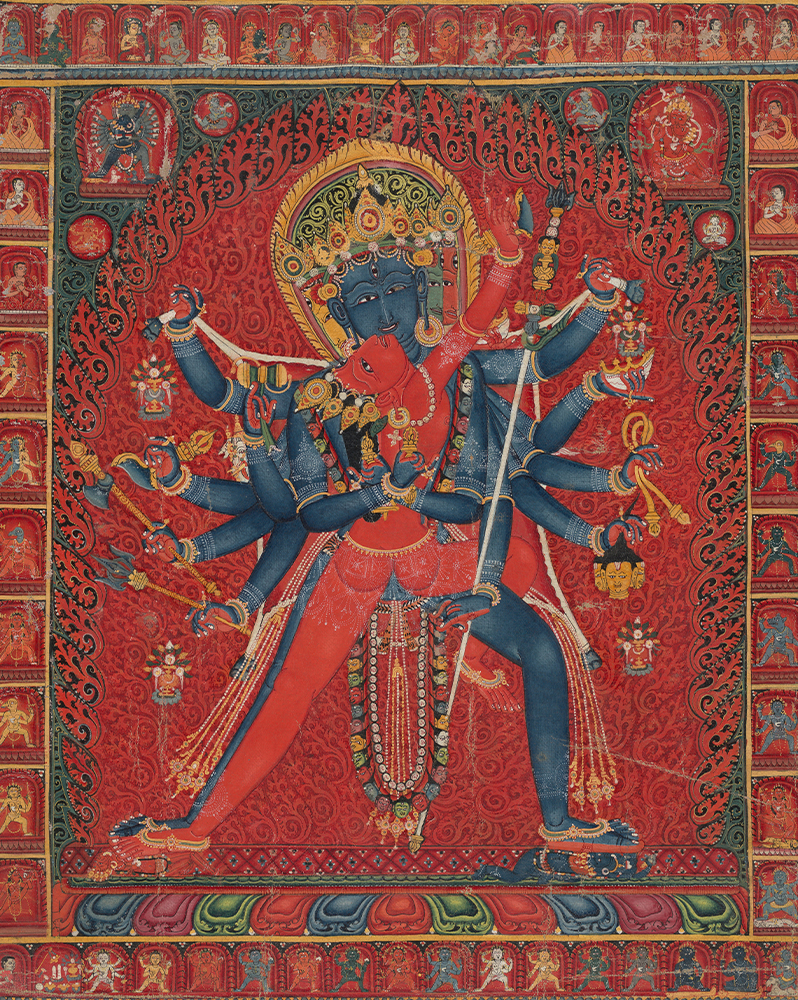
I did not know, standing in that library aisle at twenty-eight years old, that the god I’d seen had a name, a lineage, a valley that claims to have been founded because of it. I just knew the image would not leave me. Blue skin. Multiple faces, each with a third eye. A woman wrapped around him in an embrace that was somehow both violent and tender, both bodies mid-transformation rather than mid-act. I put the book back on the shelf eventually. The image did not go back on any shelf. It has been sitting in me for three decades, waiting, apparently, for me to walk into the valley where it supposedly began.
What I Was Actually Seeing
The deity is called Heruka Chakrasamvara, sometimes just Chakrasamvara, sometimes Cakrasamvara depending on which transliteration you trust. He belongs to the highest class of tantric practice in Vajrayana Buddhism, Anuttarayoga Tantra, which is the tier of teaching that works directly with desire, anger, and the body rather than around them. Nothing here is meant to be softened for public consumption. That was never the design.
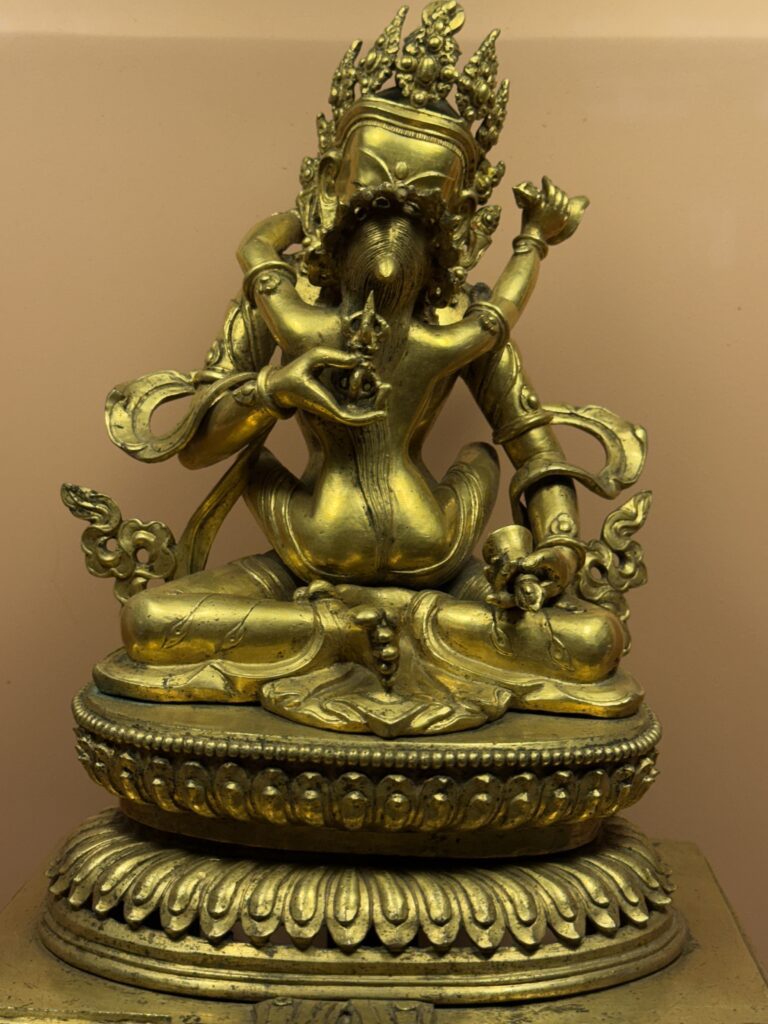
The consort in the vision, the red or sometimes dark figure wrapped around him, is Vajravarahi, also called Vajrayogini in her related forms, the “Diamond Sow.” Their union is not depicted as an act of pleasure so much as a diagram of enlightenment itself, wisdom and method fused into a single inseparable form. He often carries a tiger skin over his back and stands with weapons in several of his arms, trampling figures beneath his feet, wrathful and serene at once. It is not an easy image to hold. It was not designed to be.
The Valley That Was Founded by This Vision
Here is the part that undid me a little when I learned it. Kathmandu Valley, according to Newar Buddhist legend, was once a lake. Manjushri came to meditate at its edge and had his own vision there, of Chakrasamvara in union with his consort on a lotus of light rising from the water. He read the vision as a sign the ground beneath the lake was sacred, so he cut open the gorge at Chobar and drained it, and the valley I am now walking through is what was left behind.
I keep turning that over. A mythology built on the same image that found me, unbidden, in a public library on the other side of the planet, decades before I had any reason to know it existed. I am not claiming mystical significance for myself in saying that. I am only noting the coincidence honestly, the way I’d note any strange loop, and letting the reader decide what to do with it.
Where He Actually Lives Here
I went looking for him properly once I arrived, and the deity proved harder to find in daylight than in memory.
At Swayambhunath, the great hilltop stupa that sits at the mythological center of the founding story, there is a small tantric temple called Shantipur, tucked beside the main chaitya, largely unnoticed by the crowds circling the stupa’s Buddha-eyed gaze. Shantipur is dedicated to a form of Chakrasamvara, associated with ether, the fifth element, and its rituals are kept deliberately restricted, songs and dances that are not staged for an audience. I stood near it and understood, more than I had from any book, that this was never meant to be a public image. It was meant to be earned, or at least approached carefully, which a library aisle in Washington state cannot really offer a person.
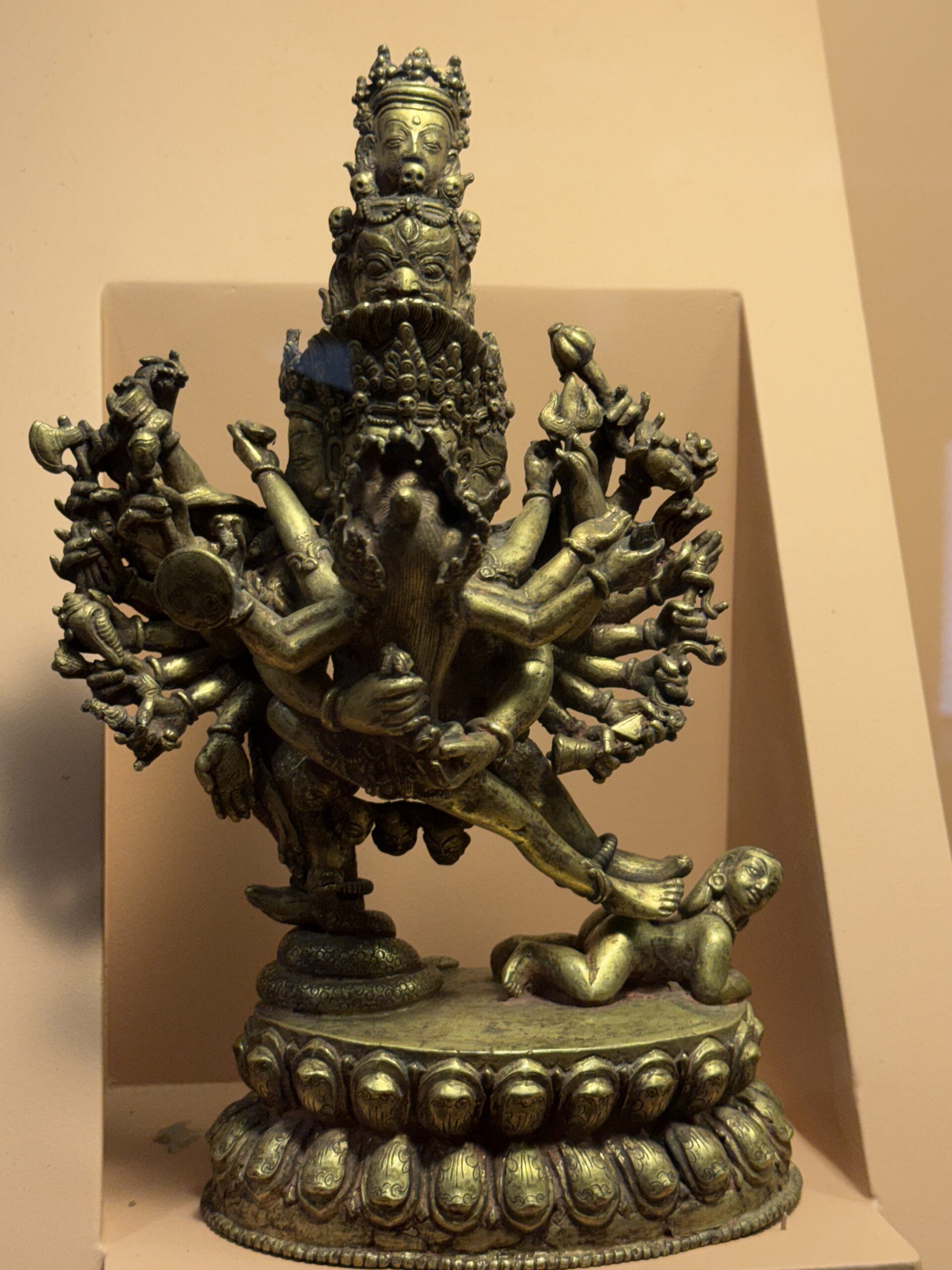
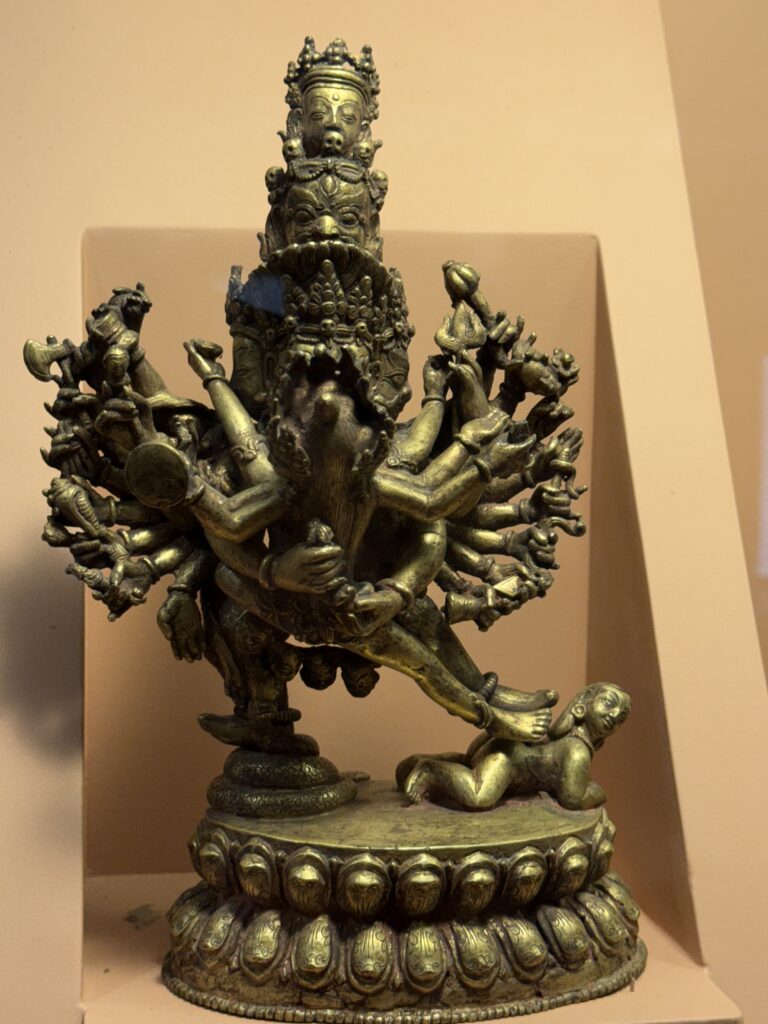
The clearer encounter came at the Patan Museum, across the river in the old city of Lalitpur. There, in a room full of quietly extraordinary bronze and stone, is a sculpture of Chakrasamvara and Vajravarahi in full embrace, twelve arms, multiple heads, the whole wrathful-tender architecture of the thing rendered in metal instead of memory. I stood in front of it longer than the other museum visitors around me probably thought was normal. It was, more or less, the first time I had seen the exact image from 1996 standing in front of me as an object rather than a picture in a book or a shape behind my eyes.
The Lineage Behind the Image
The deity has a documented human chain behind him too, which grounded the whole experience for me in something other than pure vision. The Mahasiddha Tilopa received the transmission of the Chakrasamvara Tantra directly from a dakini, and devoted himself to it for twelve years before passing the practice to his student Naropa, whose caves are still a recognized pilgrimage site in this valley. From Naropa the lineage moved to Marpa, the translator, and from Marpa to Milarepa, one of Tibet’s most revered poet-saints. Somewhere in that chain, a vision like mine, or something structurally similar to it, has apparently been happening to people for a thousand years, then getting handed carefully forward, teacher to student, rather than left to arrive at random in the minds of strangers in far-off library stacks.
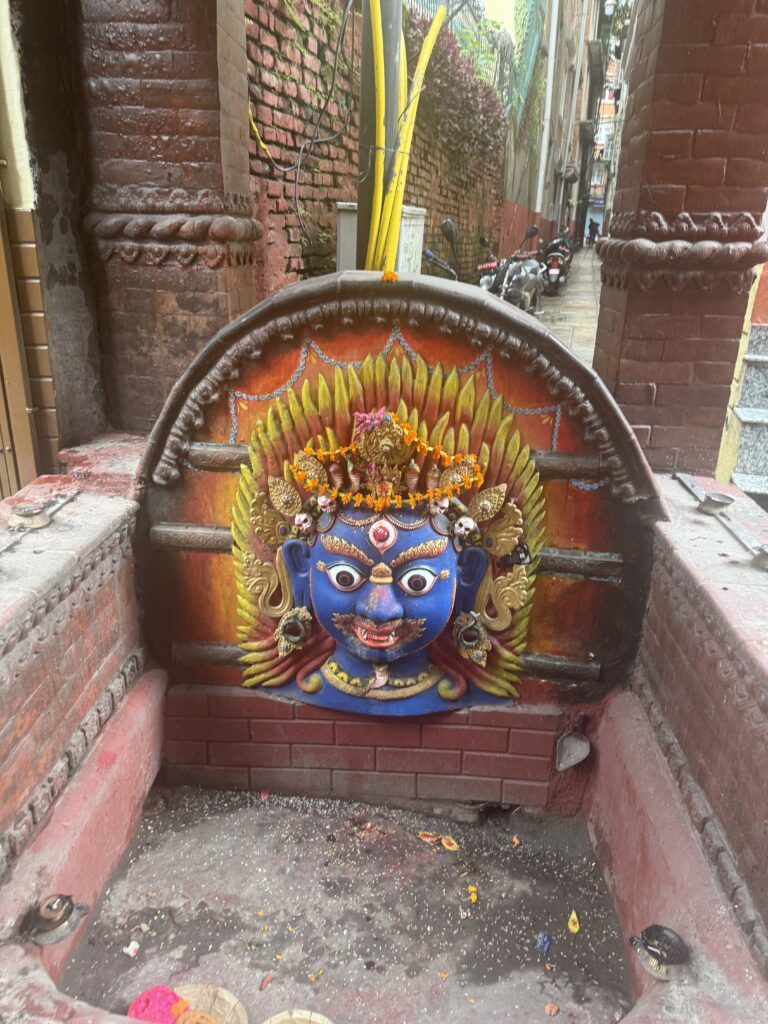
I do not know what to make of the fact that it arrived in mine anyway, unasked, unlineaged, decades before I had any teacher to hand it to me. Baoism, the practice I have spent years building, holds that the capacity to recognize truth from noise, Rox from Tox, already lives in every person, without requiring an outside authority to grant it first. I did not choose Chakrasamvara. He chose to show up in a Bellingham library and refuse to leave. Maybe that is its own kind of confirmation of the thing I already believed. Maybe it is just a coincidence I have spent thirty years dressing up as meaning.
Either way, I have now stood where the vision is said to have first appeared to Manjushri, and in front of the bronze that finally matched the shape in my memory. The demon did not get less strange for having a name and a museum case. If anything, he got stranger, now that I know how many people, across how many centuries, have apparently seen him too.