
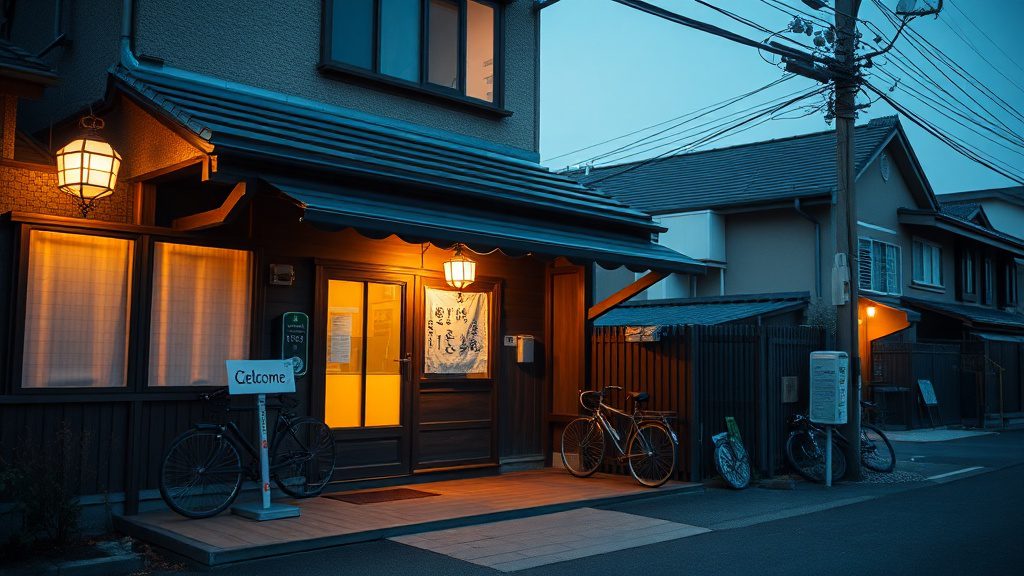
Maybe. But probably not the kind of money you’re imagining.
When people hear “I bought a house in Japan for $20,000,” the next sentence out of their mouth is usually about Airbnb. They picture a ski-season rental near Niseko, a canal-district listing pulling ¥15,000 a night, passive income flowing while they sit on a beach in Thailand. The math in their head is simple: cheap house plus tourist demand equals free money.
The real math is more complicated. The money is possible — just smaller, slower, and more regulated than the fantasy version.
Short-Term Rental: The Minpaku Law
Japan legalized vacation rentals nationally in 2018 with the 住宅宿泊事業法 (Minpaku Law). Before that, running an Airbnb-style rental was technically illegal under the Hotel Business Act unless you held a hotel license. The Minpaku Law created a legal category for private home rentals, and it came with rules.
The 180-day cap. Nationally, a registered minpaku property can operate as a vacation rental for a maximum of 180 days per calendar year. Not 180 days per platform — 180 days total. This single rule kills the “rent it year-round on Airbnb” plan. Half the year, your property must sit empty or be used for something else.
Local authority override. The national law lets municipalities impose additional restrictions. Some have. Kyoto limits minpaku to January 15 through March 15 in residential zones — that’s 60 days, not 180. Parts of Shinjuku and Shibuya restrict to weekends and holidays only. Osaka carved out a special zone where 365-day operation is legal, but with its own requirements.
Otaru and Hokkaido generally haven’t imposed restrictions beyond the national framework. The 180-day limit applies, but there’s no further local squeeze. This makes Otaru comparatively permissive, though “comparatively permissive” still means half-year maximum.
Registration requirements. You must register your property with the local prefectural government as a minpaku business. This involves submitting floor plans, fire safety documentation, proof that the property meets building standards, and designation of a management entity. If you’re a non-resident foreign owner, you need a Japan-based property manager registered as a 住宅宿泊管理業者 (housing accommodation management business) to handle operations on your behalf.
The registration isn’t onerous, but it isn’t a five-minute online form either. Budget a month for the paperwork and expect to pay your property manager ¥50,000-100,000 for setup, plus their ongoing management cut — typically 15-25% of gross revenue.
The alternative: hotel license. If you want to operate year-round, you can pursue a 簡易宿所 (simple lodging) license under the Hotel Business Act. This removes the 180-day cap but adds requirements: fire safety equipment (extinguishers, smoke detectors, emergency lighting), building code compliance, health department inspection, and in some zones, a minimum number of rooms or floor area. For a converted akiya, meeting these requirements might cost ¥500,000-2,000,000 in upgrades. Some Otaru properties can get there. Many can’t without substantial renovation.
The Airbnb Opportunity in Otaru, Specifically
Otaru has real tourist demand, but it’s seasonal and concentrated.
Winter (December-March): Ski tourism. Otaru itself isn’t a ski town, but it’s an hour from Kiroro and an easy connection to Niseko via car or bus. Some visitors stay in Otaru for the atmosphere and day-trip to slopes. Winter also brings the Otaru Snow Path Festival in February, which draws crowds.
Summer (June-September): Cruise ships dock at Otaru Port. When a large cruise ship comes in, the canal district fills with thousands of day-trippers. Some independent travelers stay overnight. Summer is also when domestic Japanese tourists visit Hokkaido to escape the heat of Honshu.
Shoulder seasons: Quiet. Otaru in April or November is a sleepy port town. Occupancy rates for vacation rentals drop hard.
Realistic Airbnb numbers for a well-located, well-presented Otaru property:
- Nightly rate: ¥8,000-15,000 depending on size, location, and season
- Occupancy during high season (Dec-Feb, Jul-Aug): 50-70%
- Occupancy during shoulder/low season: 10-30%
- Gross annual revenue at 180 days cap with mixed occupancy: ¥600,000-1,200,000
After management fees (20%), cleaning costs, platform fees (3%), supplies, and utilities during guest stays, you might net ¥350,000-750,000 per year. On a ¥3 million purchase, that’s an 11-25% gross yield, netting maybe 8-15% after all costs. These are real returns, but they require a furnished, guest-ready, well-managed property — which means upfront investment beyond the purchase price.
And you’re doing this 180 days max. The other 185 days, the house sits or you use it yourself.
Long-Term Rental: Simpler, Steadier, Smaller
If the regulation around short-term rental sounds like more than you want to deal with, long-term rental is the straightforward alternative. Find a tenant. Collect rent monthly. No day limits, no registration, no guest turnover.
The process: list the property through a local Otaru real estate agent (不動産屋). They find tenants, handle viewings, manage the lease contract. The agent takes one month’s rent as a finder’s fee. Some also charge the tenant key money (礼金) — one to two months’ rent as a non-refundable payment to the landlord, standard in many Japanese lease agreements though declining in less competitive markets.
Realistic Otaru rents. For a basic 3LDK house in a residential neighborhood:
- Lower end (older, unrenovated, less convenient location): ¥25,000-35,000/month
- Mid range (functional, decent condition, reasonable access): ¥35,000-50,000/month
- Upper end (renovated, near station, parking): ¥50,000-70,000/month
These are not Tokyo rents. An Otaru house that cost you ¥3 million might rent for ¥40,000/month. That’s ¥480,000 per year gross.
The yield math:
Purchase price: ¥3,000,000
Annual rent: ¥480,000
Gross yield: 16%
That looks fantastic compared to almost any real estate market in the developed world. And the gross yield on cheap Japanese property genuinely is high by international standards.
Now subtract the costs:
- Property tax: ¥50,000-60,000
- Management fee (if using a property management company): ¥48,000-96,000 (10-20% of rent)
- Insurance: ¥20,000-40,000
- Maintenance reserve: ¥50,000-100,000
- Vacancy allowance (assume one month vacant per year): ¥40,000
Total deductions: ¥208,000-336,000
Net income: ¥144,000-272,000
Net yield: roughly 5-9%
Still good. Still better than a savings account. But you’re making ¥12,000-22,000 per month net — $80-$150. You are not getting rich. You are covering the carrying costs of the property and putting a small amount in your pocket.
Tax implications. Rental income earned in Japan is taxable in Japan, whether you live there or not. For non-resident landlords:
If your tenant is a company (corporate tenant): the company withholds 20.42% of rent at source and remits it to the tax office. You get 79.58% of the rent, and the tax is handled.
If your tenant is an individual: no withholding occurs. You’re responsible for filing a Japanese tax return and paying income tax on the rental profits. This requires either doing it yourself (in Japanese, at a Japanese tax office) or hiring a tax accountant. Budget ¥50,000-100,000 per year for a tax preparer.
You may also owe tax in your home country on the same income, with a foreign tax credit for what you paid in Japan. Talk to a tax professional in your country. The double-taxation conventions between Japan and most Western countries prevent actual double taxation, but the paperwork to claim the credit is on you.
The Realistic Picture
A cheap Otaru akiya is not a money machine. Here’s what it can do:
Cover its own costs. Rental income from a long-term tenant can pay property taxes, insurance, basic maintenance, and management fees, with a small surplus. Your housing asset becomes self-sustaining. It’s not costing you money every year — and in real estate terms, a self-sustaining asset that you own outright is a strong position.
Provide seasonal income. If you live in the house part-time and rent it short-term during peak season, you can generate ¥200,000-500,000 during the months you’re away. Enough to fund your next trip back.
Appreciate (maybe). This is the speculative part. Japanese houses depreciate. Land values in Otaru have been flat to slightly declining for decades. But — and this is a real but — Hokkaido’s tourism infrastructure is growing, Niseko-area money is spilling outward, and Otaru’s combination of charm, access, and affordability makes it a reasonable bet for modest long-term appreciation. Modest. Not a flip-it-in-two-years play.
The most honest framing: you’re not buying an income property. You’re buying a house you can use, in a place you want to be, for a price so low that the downside is capped. If it also generates enough rental income to pay its own bills, you’ve eliminated your housing cost. If the area appreciates over the next decade, you’ve built equity with an entry price that most real estate investors would consider a rounding error.
That’s the value proposition. It won’t make you rich. It might make you free — at least from one monthly payment that most people carry until they die.