
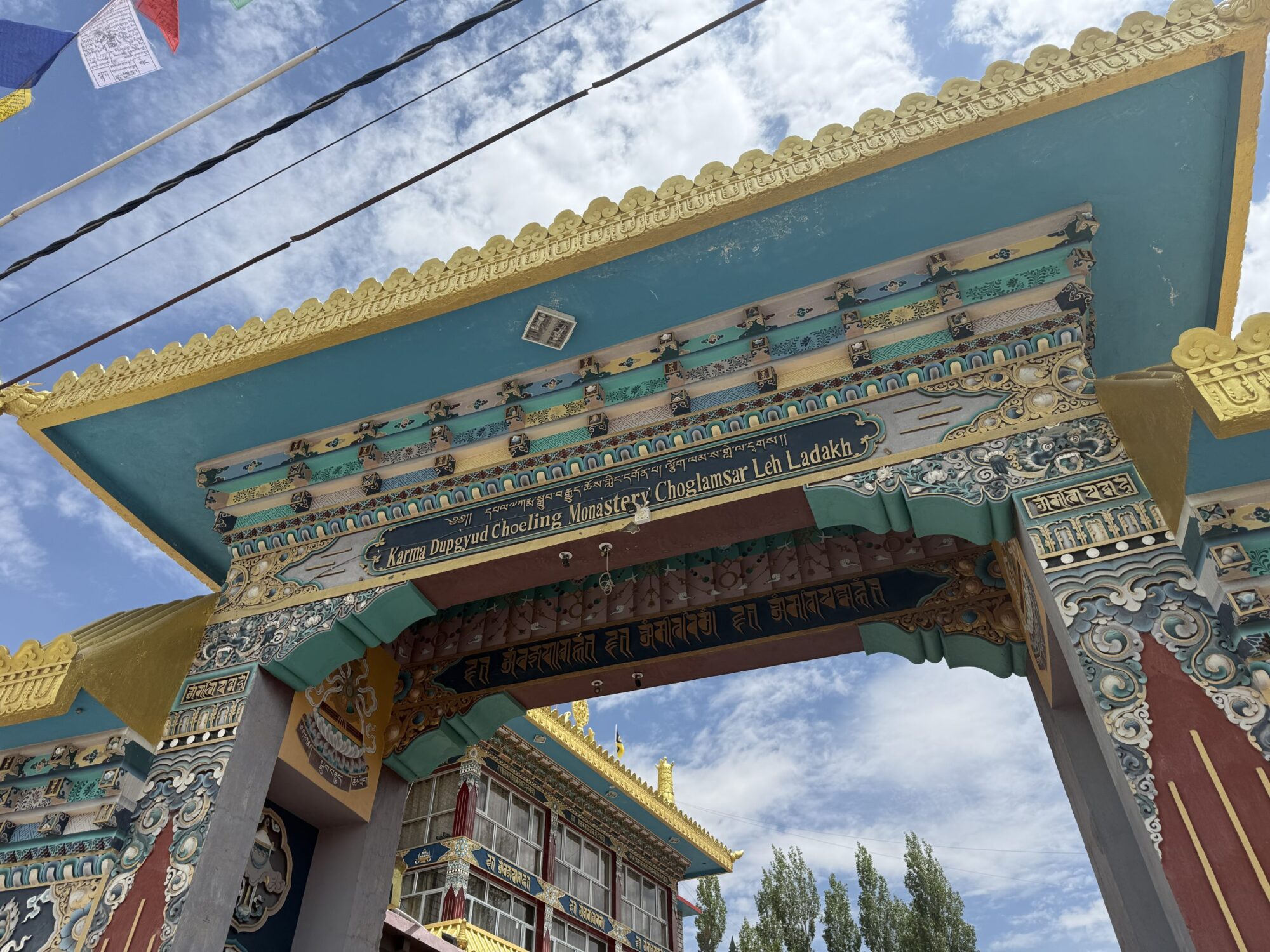
First Light, First Monastery
I could have watched a video or read a book at the guesthouse I’m staying at in Leh to learn about what Tibetan Buddhism sounds like. This morning, I didn’t do that. Instead, I sat on an old carpet next to two child monks shortly after sunrise and was blown away as a room full of monks showed me what the it actually sounds like. This wasn’t a performance. I just happened to be there. I was the only one who isn’t a monk and the only one not wearing purple robes.
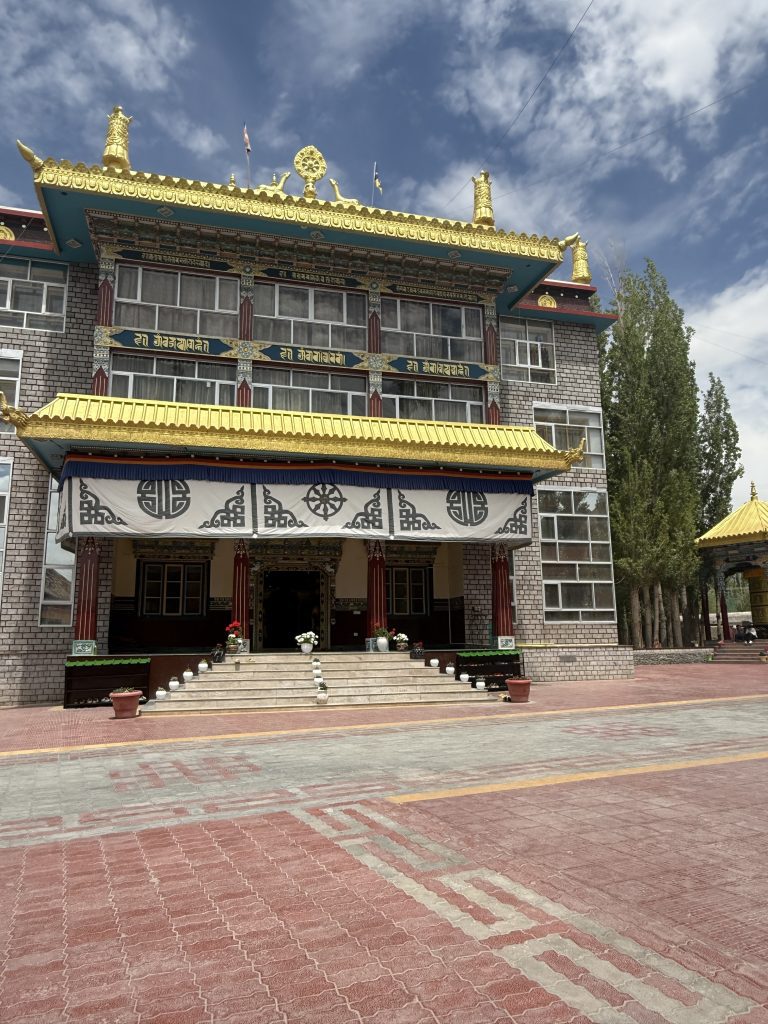
It was my first time inside a Tibetan monastery for a live morning session. Not a museum tour, not a photo stop between passes. The real thing, happening whether I was there to witness it or not.
Getting In Wrong and Being Let In Anyway
I knew the etiquette but I didn’t know I would be there until I was there. Shoulders covered, knees covered, shoes off, silence, ask before photographing. I got most of it right and blew one part entirely: my knees were bare when I showed up at the gate, randomly because I’d gotten on a random bus and gotten off at a random stopped and walked where my feet took me. I braced for a polite turn-away.
The monk smiled and waved me in. I pointed at my knees. He smiled bigger. “No problem. Go in.”
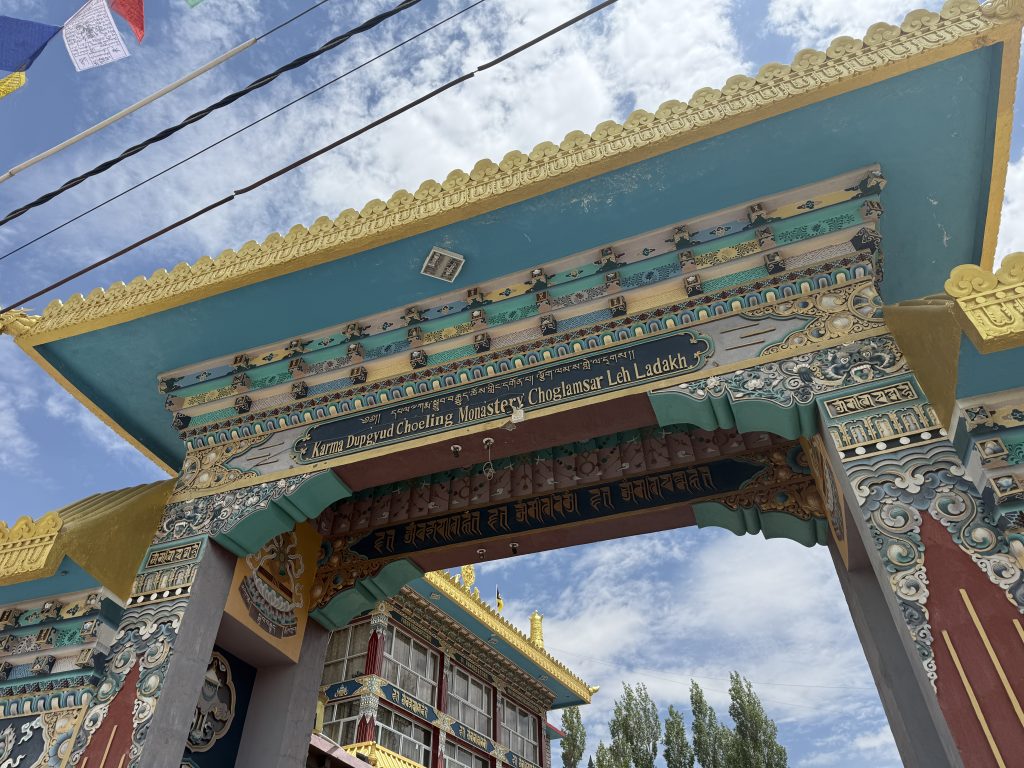
I really didn’t expect that. The guidance travelers get in advance exists so nobody has to be turned away at the door, but it’s not the actual point of the place. The actual point is something closer to attention and respect, and a monk standing at his own gate gets to decide what that looks like in the moment. He decided I was fine. I was fine. I still wished I’d brought something to cover my knees. I couldn’t pull my shorts down lower without exposing my ass, so the knees were the choice I made.
Tone discord until it’s not
The horns come first. Long ones, the dungchen, stretching ten or twelve feet. I’m guessing. I didn’t measure them. I’ve read that they are telescoped down for storage and unfolded for the ceremony. I didn’t see that thought. Two monks with them on one side of two lines of monks, and the sound isn’t so much a note as a base line. Low, rolling, closer to something an elephant might produce than something you’d hear in a band. It’s not there to be pretty. It’s there to call everyone else in and to mark that something is going on.
Underneath and around that, the higher reed instrument, the gyaling, cuts through with a thinner, more insistent voice. The player never seems to stop for breath, which I later learned isn’t an illusion, it’s a technique, circular breathing, so the sound never actually breaks. I thought only didgeridoos did that. Nope, I was uninformed.
The other monks chanting and beating a variety of drums. I don’t know which was more powerful, the chanting or the drums.
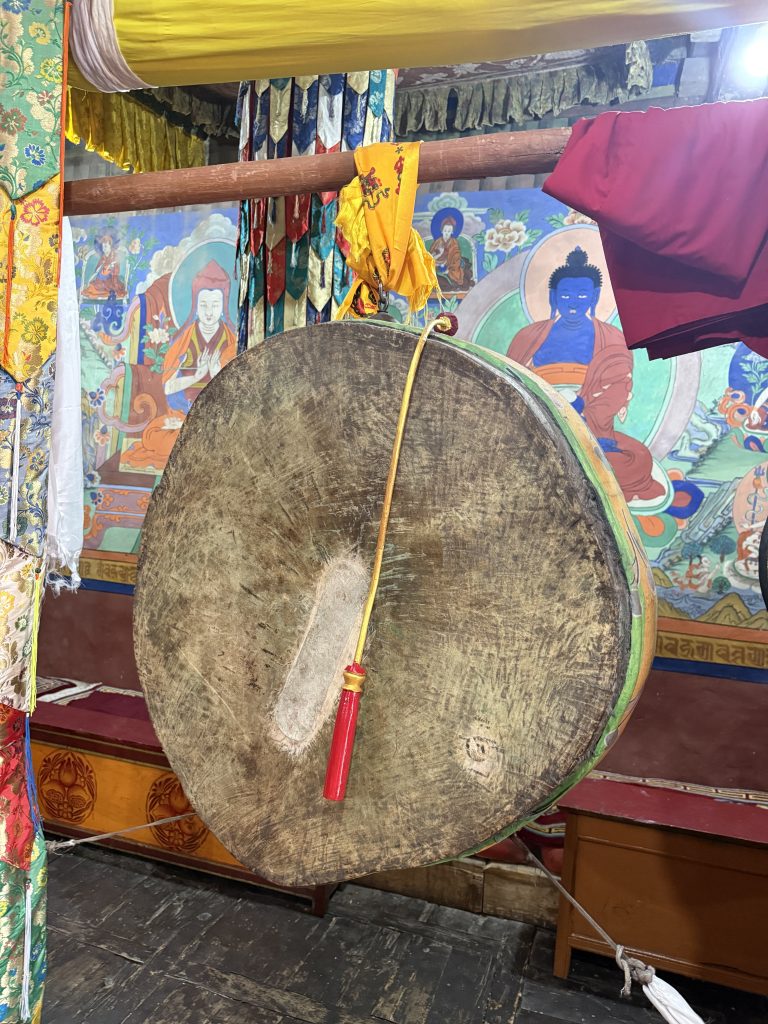
Cymbals that don’t so much crash as roll and shimmer, monks working them with a precision that looks almost like sign language. A large drum on a stand keeping the whole thing anchored in time. I thought of this as a taiko drum but I’m sure it has a unique name.And under all of it, the chant. Deep, layered, some voices seeming to hold more than one pitch at once. Not a melody, not a song, not a dirge. More like a current you get pulled into. Like the Indus River I’d been wandering along to get here. Too powerful to ignore.
The words matter
I looked up afterward what the words meant, since none of it is in a language I speak. No one there spoke English with me. I would have asked them but as it was, I had to guess based on the name of the monastery and what the internet might say about what they would be chanting on a Saturday morning. I think it was iseveral different things stacked together: Buddhist sutra, mantras like the six-syllable invocation of Chenrezig, the bodhisattva of compassion, and dedications where the merit of the whole ceremony gets offered outward, to the monastery, the region, everyone. That’s a thing about Tibetan Buddhism. It’s universal not singular.
I was honored and amazed to be sitting inside somebody else’s daily practice, one that happened whether anyone else was there or not. And even not knowing the actual words, the words carried the meaning to me. I felt it. This was a reminder of compassion. A reminder that we all suffer and when we know that, it makes the suffering of all less through the shared burden bearing. That was what I felt.
What I learned later
I’d assumed, wrongly, that Tibetan Buddhism was its own separate branch alongside the two traditions most people have heard of, Theravada and Mahayana. It isn’t. It’s Vajrayana, a tantric current running through Mahayana itself. Theravada is the older, more austere lineage found across Southeast Asia, focused on individual liberation through the Buddha’s original path. Mahayana widened that into a vow to liberate all beings, and added the wider cast of bodhisattvas along with it. Vajrayana took that Mahayana foundation and layered tantric method on top of it: visualization, mantra, mandala, ritual instrument, all aimed at getting somewhere in one lifetime instead of counting on countless ones.
Tantra deserves a special note. Like many, I’d been conditioned to think of Tantric Buddhism as being connected with sex. Usually, some hippie dude using it to get sex with hippie chicks. And while sex itself is a small part of it, it turns out that Tantra isn’t the thing pop culture flattened it into at all. It’s a technique to use ordinary experience, body, breath, sound, as fuel rather than obstacle. I’ve spent time with a Vipassana meditation teacher in Honolulu who introduced me to that idea. Use your demons to make yourself better.
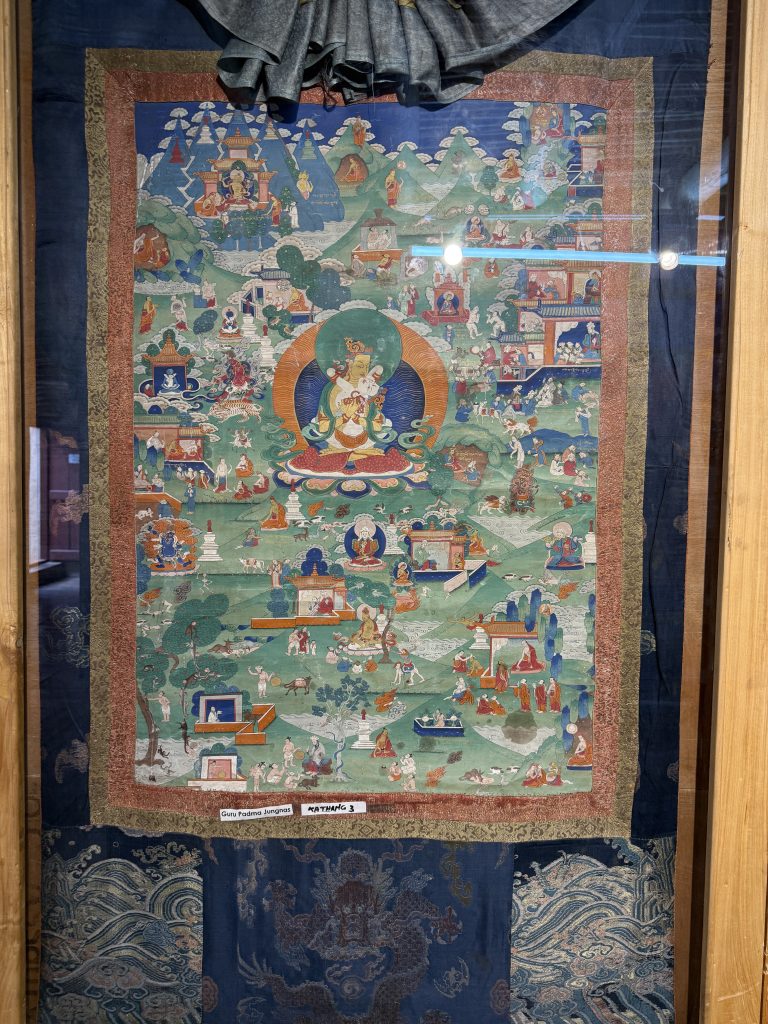
And if you get away from all that misunderstanding about Tantra that I had, then it becomes clear that what I was actually experiencing this morning was a certain aspect of that. A reminder to let our better selves use the suffering brought on by our lessor selves to become a closer version of our best self in our best world. The sounds and textures of the morning were, in a sense, the words of the Buddha being transmitted in a wordless form. This wasn’t decoration. This wasn’t a tourist spectacle. This was a room full of monks ranging in age from very you to very old, running an ancient, very deliberate system, and letting a barefoot traveler with bare knees sit quietly in the corner of it.
I don’t know what I expected when I got on that random bus this morning. I wonder how long I will still be feeling this?