
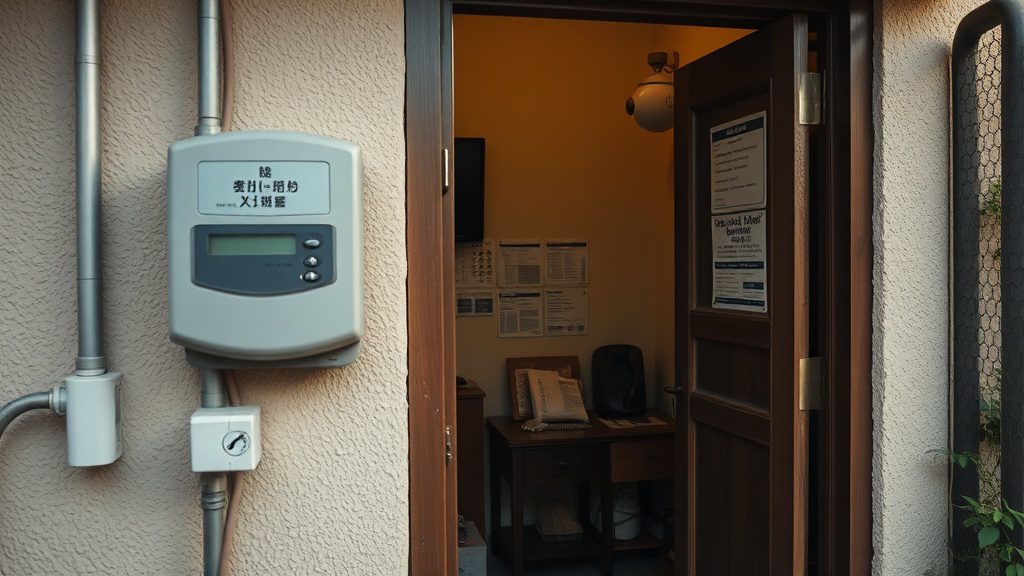
You have the keys. The deed is recorded at the Legal Affairs Bureau. The house is yours. Now you need electricity, gas, water, internet, a way to throw away your garbage, and a relationship with the people who live on your street.
All of this is doable. None of it is in English.
Here’s how the first week actually works.
Electricity: The Easy One
Hokkaido Electric Power — 北海道電力, usually called HEPCO — is your electricity provider. This is the one utility you can often get started same-day. If your house has a smart meter (most do now), HEPCO can flip the switch remotely once you apply. No technician visit, no waiting around.
Apply online at HEPCO’s website or walk into a local office. The online form is in Japanese, but it’s a standard web form — name, address, start date, payment method. Google Translate on your phone handles it. If the house hasn’t had power in a while, they may need to send someone to check the breaker panel, but this is unusual.
Budget ¥8,000-15,000/month depending on the season. Winter is the expensive end — you’ll run space heaters, heated toilet seats, and every warm thing you own. Summer is cheap. Hokkaido doesn’t need air conditioning most years.
Gas: This One Requires a Human
Gas in Otaru comes in two flavors depending on your neighborhood: city gas (都市ガス) or propane (プロパンガス). Check which one your house uses before you close. City gas is piped in and cheaper. Propane is delivered in tanks and costs roughly 1.5 to 2 times more per unit.
Either way, you need a technician to come turn it on. They check for leaks, light pilot lights, and verify your appliances are compatible. Someone must be in the house during this visit. Schedule it for your move-in day if you can.
If you’re on propane, you’ll sign a delivery contract with a local supplier. The supplier often owns the equipment at your house — the meter, the regulator, sometimes even the lines. Switching suppliers means negotiating equipment removal. It’s a whole thing. Ask about this before signing.
Budget ¥5,000-10,000/month. Gas heats your water and runs your stove. In winter, if you’re also using gas for heating, expect the higher end.
Water: City Hall
Otaru City Waterworks (小樽市水道局) handles your water. Apply at city hall or at the water bureau office. Straightforward. Bring your address and proof of occupancy.
Water in Otaru comes from mountain reservoirs. It’s clean. I drink it from the tap without thinking about it. The bills are bimonthly, and for a single-person household, you’re looking at ¥3,000-5,000/month. Families will run higher, especially if you’re doing laundry daily in a house with no modern efficiency appliances.
Internet: The Two-Week Gap
Here’s where patience gets tested. NTT Flet’s Hikari (fiber optic) is the standard home internet in Japan. It’s fast, it’s reliable, and it takes 2-4 weeks to install. A technician comes to your house and physically runs fiber cable from the nearest junction point. If your house had fiber before, the line might still be there — installation goes faster. If not, they drill a small hole through an exterior wall to bring the cable inside.
You don’t contract directly with NTT for internet service. You pick a provider that runs on NTT’s network — OCN, So-net, BIGLOBE, @nifty, a bunch of others. They all use the same physical line. The difference is customer service quality and minor price variations. Budget ¥4,000-5,000/month for the provider fee plus NTT line rental.
For the gap between move-in and fiber installation, get a pocket WiFi device. Rakuten Mobile sells them. UQ WiMAX rents them. You can pick one up at an electronics store or order online and have it shipped to your new address. ¥3,000-5,000/month, no installation, works immediately. It won’t match fiber speed, but it’ll keep you connected while you wait.
Mobile Phone
As a resident with a residence card, you can get a Japanese SIM from an MVNO — IIJmio, Rakuten Mobile, LINEMO, several others. Plans run ¥1,000-3,000/month for data and calls. Most require a Japanese bank account for auto-pay, so set up your bank account first (more on this in the next article).
If you’re visiting before you have residency, grab a prepaid SIM at New Chitose Airport. They’re sold at vending machines in the arrivals area. Data only, no phone number, good for a few weeks. eSIM options exist too — check IIJmio’s traveler plans.
NHK: The Knock at the Door
Within a few weeks of moving in, someone from NHK — Japan’s public broadcaster — will knock on your door. They want you to pay the NHK subscription fee, roughly ¥1,200/month. Legally, anyone who owns a device capable of receiving NHK broadcasts (meaning a television) must pay.
This is Japan’s most reliably contentious domestic policy topic. People have strong opinions about NHK collection. The collectors are persistent. They work on commission. They’ll come back.
Most people pay. Some people don’t answer the door. Some people genuinely don’t own a television and say so. I’m not going to tell you what to do here. I’m telling you the knock is coming so you’re not surprised by it.
Kerosene: The Fuel That Runs Hokkaido Winter
Your house probably has a kerosene heater, or it needs one. Electric heating in Hokkaido is expensive. Kerosene is the standard. A new kerosene stove runs ¥20,000-50,000 depending on size and features. Used ones show up at recycle shops for half that.
You buy kerosene at gas stations (ガソリンスタンド). You drive or walk there with a portable polyethylene tank — the red or blue 18-liter jugs you’ll see stacked outside every gas station in Hokkaido from October onward. Fill up, bring it home, pour it into your heater’s tank. A full 18-liter tank costs around ¥2,000 at current prices and lasts a few days to a week depending on how cold it is and how big your room is.
If hauling kerosene jugs sounds tedious — it is — you can arrange home delivery from a local fuel supplier. They’ll bring a truck and fill a larger tank at your house on a regular schedule. This costs slightly more per liter but saves your back. In the deep winter months, December through February, you might go through 200+ liters a month.
Ventilate. Kerosene heaters produce carbon monoxide. Crack a window. Japanese heaters have built-in safety shutoffs, but crack a window anyway.
Garbage: The Sorting Regime
Otaru has strict garbage sorting rules, and they are not optional. Categories: burnable (燃やすごみ), non-burnable (燃やさないごみ), recyclable plastics, PET bottles, glass bottles, cans, cardboard, newspapers, and hazardous waste (batteries, fluorescent bulbs). Each category has a designated collection day. The schedule varies by neighborhood.
You must use designated garbage bags, sold at convenience stores and supermarkets. A roll of 10 large burnable bags costs ¥400-800 depending on size. You write your name on the bag. You put it at the collection point on the correct morning, before 8 AM. You do not put it out the night before. You do not mix categories.
This sounds onerous. It becomes automatic within a month. The bigger adjustment is the volume — Japanese garbage bags are small compared to American ones. You’ll start noticing how much packaging everything comes in, and you’ll start choosing products with less of it. The system changes your behavior without lecturing you about it.
Your neighborhood’s collection schedule is posted by the chonaikai — the neighborhood association. Which brings us to the most important utility of all.
The Neighborhood Association (町内会)
Most neighborhoods in Otaru have a chonaikai. Membership is technically voluntary. In practice, it’s expected. Monthly dues run ¥200-500. What you get for that money: garbage collection coordination, snow removal scheduling, festival organization, emergency communication, and the general social glue that holds Japanese neighborhoods together.
Joining is the single most useful thing you can do in your first week. More useful than internet. More useful than getting your gas turned on.
Here’s why. The chonaikai is how your neighbors find out you’re a real person and not an absent foreign landlord who bought a cheap house for Airbnb. It’s how you learn that the garbage truck doesn’t come on holidays and you need to hold your bags until the next collection day. It’s how you hear that the water main on your street is getting replaced next month and you’ll lose pressure for three days. It’s how you get invited to the summer matsuri where you eat yakitori and drink beer with the people who live around you.
Your Japanese doesn’t need to be good for this. Show up. Pay your dues. Nod. Help carry things. Japanese neighborhood life runs on presence more than conversation. Being there is the message.
The Language Reality
I want to be direct about this. You will not be able to read most of the forms you fill out during your first week. The gas company paperwork, the water bureau application, the garbage sorting guide — these are written in Japanese, for Japanese people, with no English option.
You have three tools. Google Translate’s camera mode, which you point at documents and it overlays English in real time. It’s imperfect but functional. DeepL, which handles nuance better for longer text. And the staff at city hall, who have seen confused foreigners before and will work with you patiently even when neither of you speaks the other’s language.
I’ve filled out dozens of forms in Japan where I understood maybe 40% of the kanji. Here’s what I’ve learned: bureaucratic forms are bureaucratic forms everywhere. Name goes here. Address goes there. Date of birth. Phone number. Bank account. Check this box. Sign here. The structure is universal even when the characters aren’t.
Bring your phone. Bring your residence card. Bring patience. You’re not the first person to do this without fluent Japanese, and the systems accommodate you more than you’d expect.
The hard part isn’t the paperwork. The hard part is the second month, when the novelty wears off and you realize you can’t eavesdrop on the conversation at the next table. You can’t read the handwritten sign at the fish counter telling you what’s on sale. You can’t make a joke with the gas station attendant while he fills your kerosene tank.
That loneliness is real. It’s also the price of admission for living somewhere that isn’t designed around your comfort. Whether that price is worth paying depends entirely on what you’re buying with it. In Otaru, what you’re buying is a life in a place that didn’t ask for your opinion and doesn’t need your approval, and manages to be extraordinary anyway.
The next article covers the bureaucratic layer that sits above all of this — health insurance, residency registration, banking, and taxes. The paperwork that makes you a real resident instead of a tourist with a house key.