
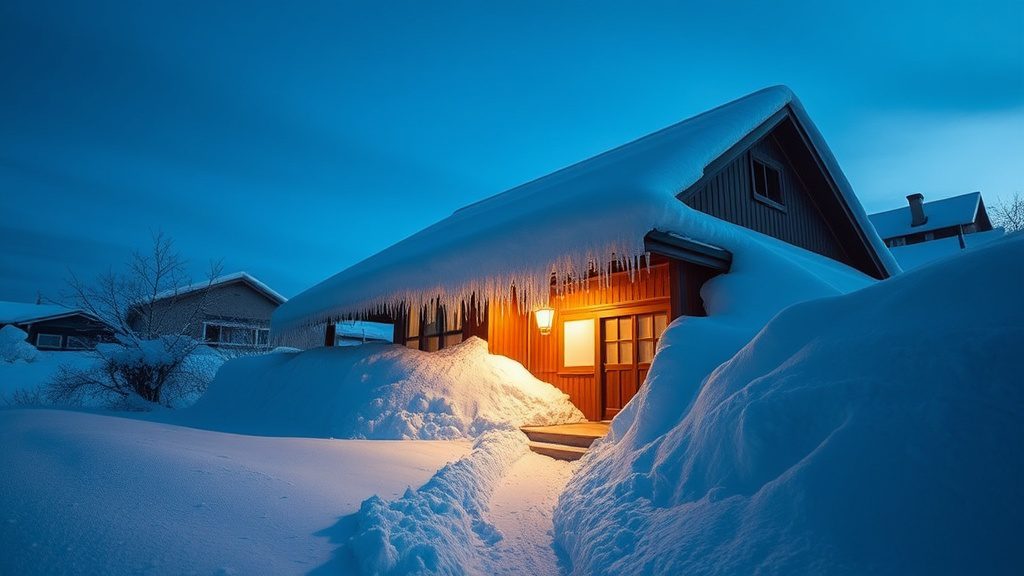
Otaru gets five to six meters of cumulative snowfall per winter. I want to make sure that number registers. That’s not a dusting. That’s not a white Christmas. Five to six meters is sixteen to twenty feet of snow falling on your house, your yard, your street, and every surface that faces the sky, accumulating and melting and accumulating again from November through April.
The snow doesn’t stick around at full height — it compresses, melts partially, gets cleared, then gets buried again by the next storm. But at peak accumulation in January or February, you’ll see two meters of snow on the ground, banks higher than your head along the roads, and a weight on your roof that your house was designed to hold. If your house was designed to hold it.
This is the thing about buying property in Hokkaido that warm-climate buyers underestimate most consistently. The cold isn’t the problem. The snow is. Snow is heavy. Snow is persistent. Snow gets into every crack and seam and then melts and refreezes and pries those cracks wider. A Hokkaido house is in a structural fight with winter for five months of every year.
Here’s what that fight looks like, what it costs, and what happens when you lose it.
Snow Load on Roofs
Hokkaido houses are built for snow. The framing is heavier than what you’d see in Kansai or Kanto. Rafters are bigger. Roof pitches are steeper — not for aesthetics but to encourage snow to slide off before it accumulates too much weight. The steel roofing common in Hokkaido helps with this. Snow slides off metal faster than it slides off tile.
But “built for snow” has limits. A well-maintained house with a properly pitched steel roof can handle a normal Hokkaido winter without intervention. An older house with a low-pitch roof, deferred maintenance, and compromised framing cannot. Houses collapse under snow load in Hokkaido every winter. Not many, but it happens, and it almost always happens to vacant houses where nobody was clearing the roof.
If your house has a low-pitch or flat roof section — common on additions and extensions — you need to clear it during heavy snow periods. The structural load limit for residential roofs in Hokkaido is typically calculated at 150-200 kg per square meter. A meter of compacted snow weighs roughly 300-500 kg per square meter depending on density. You can see why this matters.
Professional roof snow removal runs ¥50,000-150,000 per season, depending on the size of the house and how many times they come out. A typical arrangement is three to five visits during winter, each time clearing enough to keep the load safe. Some homeowners negotiate a seasonal contract; others call for service after major storms.
Many homeowners do it themselves. The tool of choice is a long-handled roof rake — you stand on the ground and pull snow off the lower edges of the roof, working your way up. For higher sections, you get on the roof itself with a shovel. This is real physical labor, and it’s not without danger. Falls from snow-covered roofs are a leading cause of winter injury in Hokkaido, especially among elderly homeowners. If you’re going to do it yourself, take it seriously — proper footwear, a harness on steep sections, and never work alone.
Frozen Pipes
Here’s where an empty house becomes a liability.
Otaru’s winter temperatures regularly drop to -10°C and occasionally hit -20°C. At those temperatures, any water sitting in an unheated pipe will freeze. When water freezes, it expands. When it expands inside a pipe, the pipe splits. When the pipe thaws in spring, water pours out of the split and into your walls, floors, and ceilings.
I’ve seen the aftermath in houses that were left vacant over winter without being properly winterized. It’s ugly. Water damage from a burst pipe can destroy drywall, warp floors, soak insulation, and invite mold — all of which cost more to fix than preventing the freeze would have.
Prevention has three approaches:
Keep the heat on. Set the heating to a minimum level — even 5-10°C is enough to prevent most pipe freezes. This works, but it costs money. Running a kerosene heater on low all winter when nobody’s home is both expensive and a fire risk. Some owners install electric panel heaters on thermostats specifically for freeze prevention — lower fire risk, but still a monthly electricity cost.
Drain the system. Turn off the water supply, open all faucets, flush toilets, and drain the water heater. Some houses have drain valves at low points in the plumbing specifically for winterization. This requires knowledge of your specific plumbing layout — where the low points are, where water can pool in traps, which fixtures hold water that needs to be manually cleared. Miss a section and that section freezes. Antifreeze solution goes into toilet bowls and drain traps to prevent the remaining water from freezing.
Heat tape. Electric heating cable wrapped around exposed pipes and connected to a thermostat. The tape turns on when the temperature drops below a set point and keeps the pipe above freezing. Effective for exposed runs in unheated spaces — crawlspaces, exterior walls, uninsulated areas. Installation runs ¥30,000-100,000 depending on how much pipe needs to be wrapped.
If you’re buying an akiya that’s been vacant through multiple winters, check the plumbing carefully before turning the water on. Have someone pressurize the system and watch for leaks before you assume everything works.
Insulation and Windows
Pre-1990s Hokkaido houses are often insulated the way someone in Osaka might insulate — meaning barely. This sounds absurd for a place that routinely hits -15°C, but building practices evolved slower than you’d expect, and a lot of Hokkaido housing stock was built with insulation that was considered adequate at the time and isn’t considered adequate by anyone now.
Single-pane windows are the most visible symptom. In a Hokkaido winter, single-pane glass conducts cold so efficiently that ice forms on the inside surface of the window. You wake up and there’s frost on the interior of your bedroom window. The glass isn’t just letting cold air in — it’s radiating cold into the room like a refrigerator panel.
Double-pane windows are the minimum for Hokkaido. Triple-pane is better. The difference in heating costs is immediate and measurable — some owners report 30-40% reductions in kerosene consumption after upgrading windows alone.
Wall insulation matters too, but it’s less visible and harder to assess without opening up a wall or using an infrared camera. If you’re evaluating an akiya, bring an infrared thermometer. Point it at interior walls on a cold day. If the wall surface temperature is significantly lower than the room air temperature, you have an insulation problem. It’s not a precise diagnostic, but it tells you a lot for a ¥2,000 tool.
Heating
Central heating in the American or European sense — a furnace or boiler distributing heat through ducts or radiators to every room — is rare in Hokkaido residential construction. Most houses heat room by room with standalone units.
The standard is the kerosene stove (灯油ストーブ, touyu sutoobu). Kerosene is delivered by truck to a tank outside your house — the same way propane works in rural America. You fill the tank, the stove draws from it, and you stay warm. A typical Otaru winter burns through 1,000-1,500 liters of kerosene. At current prices, that’s ¥80,000-150,000 per winter ($550-$1,000) depending on how warm you keep the house, how well it’s insulated, and how many rooms you heat.
Modern kerosene stoves are efficient and safe, with automatic shutoffs, electronic ignition, and programmable timers. They’re also the single warmest heat source available for the price. Nothing heats a room faster than a kerosene stove.
Alternatives:
Heat pumps (エアコン). Efficient down to about -15°C, where they start struggling. A modern cold-climate heat pump (寒冷地エアコン) can operate down to -25°C, but efficiency drops significantly below -15°C. In Otaru, where -10°C is a normal January night and -15°C happens regularly, heat pumps work most of the time but can’t be your only heat source. Many owners use heat pumps as the primary system and switch to kerosene for the coldest stretches.
Pellet stoves. Growing in popularity in Hokkaido. Use compressed wood pellets. More sustainable than kerosene, roughly comparable in operating cost. Require a chimney or flue, which adds installation cost (¥200,000-500,000). The pellets themselves are ¥40,000-80,000 per ton, and you’ll burn two to four tons per winter.
Electric space heaters. Expensive to operate at the wattage needed for Hokkaido cold. Fine for supplemental heat in a bathroom or bedroom. Not viable as a primary heat source unless you enjoy ¥50,000+ monthly electricity bills.
The Melt Cycle
Winter gets all the attention, but spring is when the damage often reveals itself.
When five months of accumulated snow starts melting, all that water has to go somewhere. If your gutters are clogged, it goes down the exterior walls and into the foundation. If your roof drainage is compromised, it pools on the roof surface. If ice dams have formed at the roof edges — ridges of ice created by heat escaping through the roof, melting snow that then refreezes at the cold eaves — water backs up under the roofing material and drips into your ceiling.
Ice dams are a particular problem in houses with poor attic insulation. Warm air from the living space rises into the attic, warms the roof deck, melts the snow above it. The meltwater runs down to the eaves, which are cold because they extend past the building envelope, and refreezes. The resulting ice ridge traps more meltwater behind it, which has nowhere to go but through the roof.
Prevention: adequate attic insulation (keeps heat from reaching the roof deck), proper soffit ventilation (keeps the attic cold and uniform), and clean gutters (gives meltwater a clear path down).
Spring is also when you discover what the freeze-thaw cycle did to your foundation, your concrete walkways, and your exterior surfaces. Cracks that were hairline in October are finger-width in April. Water got in, froze, expanded, and pried things apart over dozens of cycles. This is normal Hokkaido wear and you budget for it in your annual maintenance.
Summer
After all that, summer feels like a reward.
Hokkaido summers are genuinely pleasant. Daytime temperatures in July and August range from 25-30°C (77-86°F). Nights cool down. The humidity is real but nothing compared to Tokyo or Osaka in August — Hokkaido is the only major region of Japan that does not have a traditional rainy season (梅雨, tsuyu). June and July, which are muggy misery in Honshu, are dry and comfortable in Hokkaido.
No typhoons. Honshu gets hammered by typhoons every September and October. Hokkaido sits too far north. The occasional remnant tropical system reaches the island with heavy rain, but full-strength typhoon landfalls on Hokkaido are extremely rare.
The summer concern for houses is ventilation and mold. If rooms stay closed up and unventilated during humid periods, moisture condenses on surfaces and mold establishes itself. This is less critical than in southern Japan but still matters in houses with poor air circulation. Running a dehumidifier or simply opening windows on dry days handles it.
Why People Come Anyway
Reading the last two thousand words, you might wonder why anyone buys property in a place that buries it under snow for five months and tries to freeze the pipes every night from December through March.
The answer is that all those conditions are manageable. Hokkaido has been inhabited for a long time. The building practices exist. The tools exist. The infrastructure exists. The city of Otaru plows its roads, maintains its sewer system, and operates train service through the worst blizzards. This isn’t frontier survival — it’s well-established cold-climate living with a functioning municipal government backing it up.
And the upside of the climate is real. The skiing is world-class. The summers are the best in Japan. The dramatic shift of seasons — cherry blossoms in May, green mountains in July, red leaves in October, white everything in December — is part of why people fall in love with the place.
The snow keeps prices low. If Otaru had Okinawa’s weather, those ¥3 million houses would cost ten times as much. The climate is both the challenge and the reason the opportunity exists.
You just have to respect what winter does to a house and plan for it. That’s not optional up here. That’s the deal.