
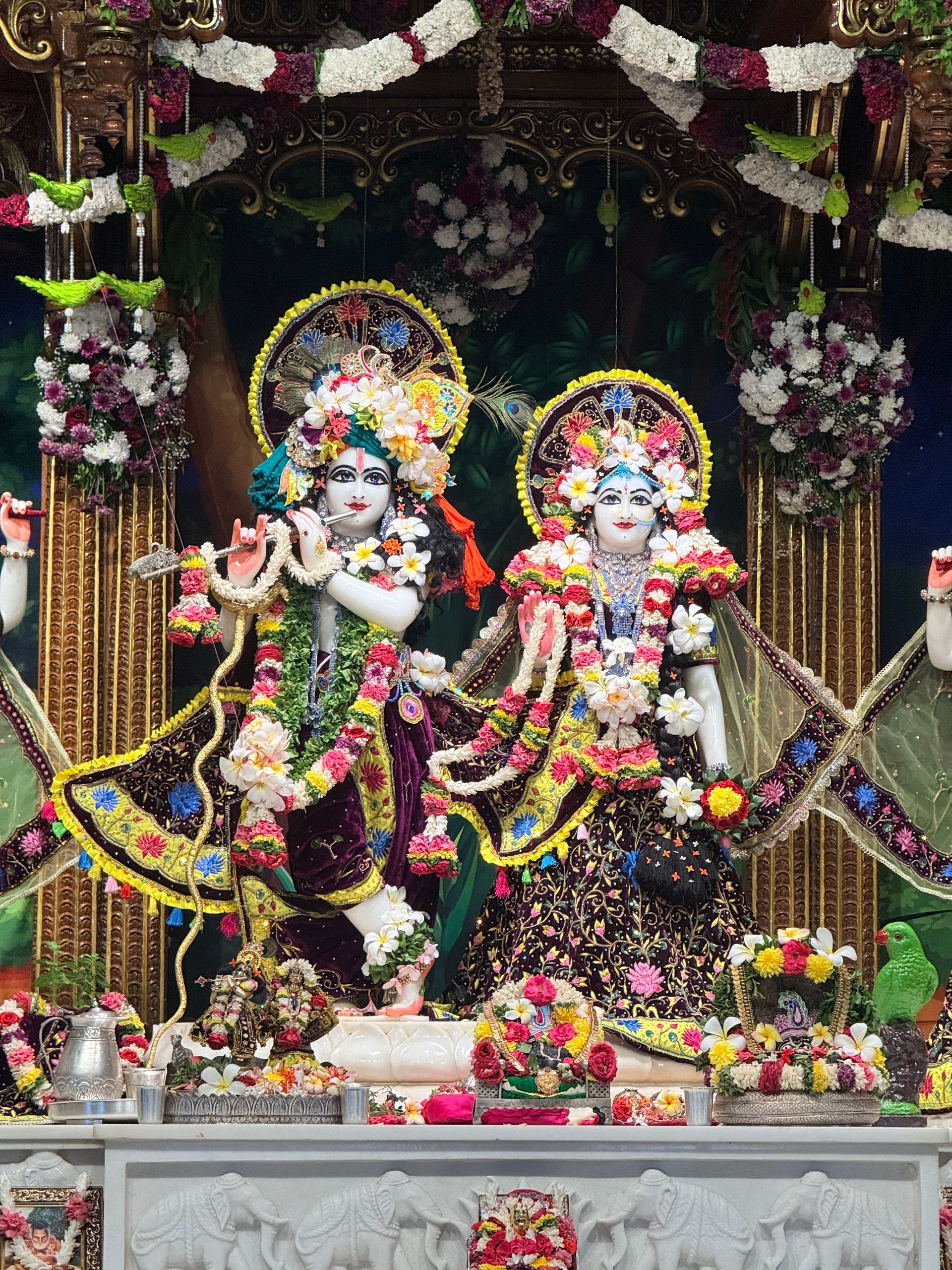
My visit to Shri Radha Krishna Mandir, Greater Kailash.
I didn’t plan this. It’s not the kind of thing I like to plan. I just waited for it to happen naturally. I was walking and it was there. No maps required.I wasn’t planning to go in. That’s usually how it works.
The temple sits in Kailash Colony, the kind of place you’d walk past a hundred times before noticing it’s actually three shrines in one. Shri Radha Krishna Mandir, Greater Kailash. It seems to have been recently renovated, the gods dressed in matching colors, the marble underfoot cool even in the heat, the carpets laid out, only a handful of men there. The whole place scrubbed to a shine that almost felt like it was trying too hard, except it wasn’t, because nobody here was performing for me or anyone else. This isn’t a tourist stop. It’s a neighborhood temple. I just happened to wander in while they were doing what they do every day.
The layout took a second to understand. It’s not one room with one god in it, the way I’d half-expected, it’s three chambers. The small one to the left the most important seeming. The small one to the right equally important. The big one with Ganesha and Hanuman in it, seeming the least important. Each its own sanctum, each housing different deitys or pairs of deities behind its own threshold. Radha and Krishna anchor the main one, front and center, draped and garlanded and lit just slightly brighter than the rest of the rooms.

Walk through the center carpet and go to either end and you’re in front of Hanuman on the left, then Ganesha on the right. In between status I think were Radha and Krishna, Shiva and Parvati – but I don’t know. I’m just guessing. Each one in their own alcove like a separate small temple inside the same big temple building. Nobody told me the order to do it in. One man gave me a few friendly instructions when I arrived with pantomime – wish first, then get water, then pour it. Other than that I just followed the room the best I could.
A man in ochre pants and blouse handed me a small vessel of water before I understood what it was for, and pointed me toward the main shrine. I poured it over the four statues. Abhishekam, a ritual bathing of the deity’s image, an offering of purification. Then I poured it over a lingnam. Then I poured it in a chalice that dripped. Then only after that, only after I’d done that, did he point me to the priest/monk/holy man in the corner who had me step forward. He tied a the thread on my wrist. Too tight for my liking, but I’m leaving it there. Red and yellow, twisted together, a mauli, tied with the unhurried confidence of someone who’s done it ten thousand times and isn’t in a rush for the ten-thousand-and-first. The thread came after the water offering, like a small acknowledgment that I’d actually participated rather than just watched. I’d assumed I would be asked to give money before or after. I wasn’t.
He poured a tiny bit of water in my palm. This was charanamrit, water that’s bathed the deity and carries the blessing back out to whoever drinks it. Sometimes it has Ganges River water in it. I realized it probably wasn’t clean, but what can you do? I drank it. He took a bit of orange clay rubbed off of the statue and rubbed it on my head. I almost didn’t notice that.I forgot about it right away. Next he gave me a sweet, prasad, food offered first to the gods and only afterward to the rest of us. I drank the water. I ate the sweet. Neither felt optional, exactly, but neither felt forced either. It was just the shape of the thing, and I was already inside it by the time I understood the shape. There was a natural width that required drinking the water and eating the sweet. I’d agreed to it by taking off my shoes and stepping inside. That is the way of things.
I bowed at the main shrine, then moved through to Ganesha, then Hanuman repeating the gesture each time. Hands together, head down, a beat of stillness before moving to the next statue. Nobody rushed me. Nobody told me if I did it right or wrong. I looked all of this up afterward. I still don’t know. Nobody hovered either, past the priest at the main shrine. The whole visit had the unbothered rhythm of a place that doesn’t need to convince anyone of anything. It felt sacred without feeling performed.
I didn’t want to leave without leaving some donation. I asked the man who had helped me with the water. He pointed to the holy man. Later, I looked up what happens to donations and found out that this temple (most of them actually) runs its own langar, a free community meal program, and from what I gathered, money offered goes toward the langar, the upkeep of the building itself, and the priests who run the daily rituals. The same rotation I’d just been part of, multiplied by however many people walk through in a day. It’s not abstract charity. It’s the building staying clean, the food getting cooked, the next person’s thread getting tied.
I had 200 rupees folded in my pocket and handed it directly to the priest rather than dropping it in the box. I wasn’t sure if it was too much, too little, the wrong gesture entirely. I hadn’t done any research. There’s no posted rate card for this kind of thing, no menu above the boxes or next to the priest. This wasn’t a tourist shrine. But it felt like the right number for what I’d just been given, and he took it the way he’d tied the thread: unbothered, unhurried, like the amount was the least important part of the exchange.
I don’t know what I felt, exactly, walking out of a place like that. But I know the thread is still on my wrist, and I haven’t taken it off, and I’m not entirely sure why that feels like it matters. I went about my day, had coffee, and didn’t think much about it. I figured people might see the string on my wrist.
In all of my interactions, no one said a word until I got back to the hotel. Then, the chef of the restaurant smiled bigly at me. He pointed to his forehead. “You went to a temple?” I said yes. He kept smiling.
It was only when I got back to my room that I saw the orange dot. I haven’t wiped that off either. This is starting to feel like India.
Temples dedicated to Shri Radha Krishna center around the dual worship of Radha and Lord Krishna. Together, they represent the absolute truth and the highest form of divine love in Hindu philosophy.
Lord Krishna: He is worshipped as the Supreme Swayam Bhagavan (God Himself) or the eighth avatar of Lord Vishnu. He represents absolute cosmic joy, supreme wisdom, protection, and the ultimate source of creation.
Radha: She is Krishna’s eternal consort and the embodiment of the Hladini Shakti (the divine pleasure potency). She represents total selflessness, supreme devotion, and the human soul’s intense longing for the divine.
The Divine Union: Together, they represent Radha-Krishna, a single entity split into two for the sake of divine play (Lila). They symbolize the perfect, inseparable union between the individual human soul (Jivatma) and the Supreme Cosmic Soul (Paramatma).