
The Chimneys on the Horizon
Drive far enough past the edge of any major Indian city and the skyline changes. Apartment towers and temple spires give way to something stranger: rows of tall, tapering brick chimneys, some smoking, some standing silent and abandoned. Near Delhi, this isn’t a rare sight.. it’s a whole industrial landscape hiding in plain view, one most visitors never think to ask about.
What They Actually Are
These aren’t factory stacks or power plant exhausts. They’re brick kilns. Specifically, most are built on a design called the Fixed Chimney Bull’s Trench Kiln, or FCBTK, a technology that’s been in continuous use across the subcontinent for well over a century. The “trench” is a long oval or circular pit where raw clay bricks are stacked and fired in a moving zone of heat that travels slowly around the loop. The chimney at the center isn’t decorative.It’s the engine of the whole process, creating the natural draft that pulls hot air and combustion gases through the kiln continuously, keeping the fire zone moving and the bricks curing evenly.
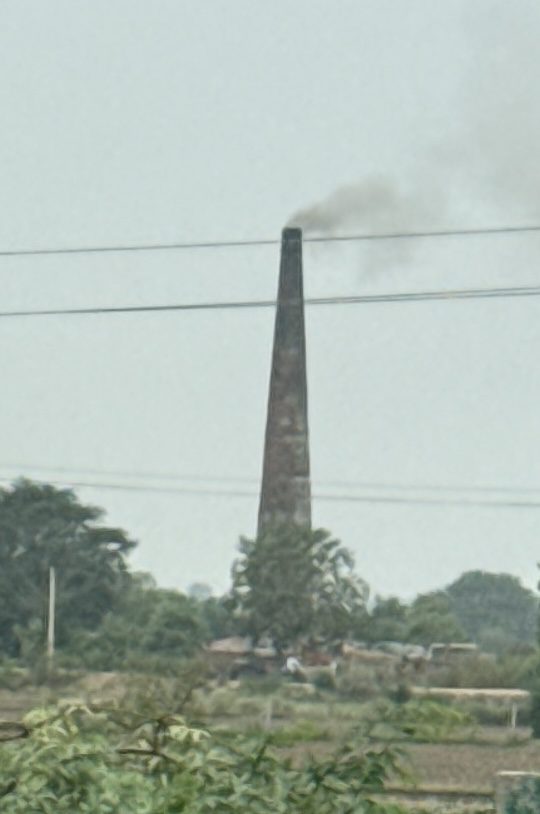
The height matters. A taller chimney generates stronger draft through simple physics. Hot air rises faster and pulls harder through a longer vertical column, the same principle behind a fireplace flue, just scaled up to industrial size. Without sufficient height, the kiln doesn’t fire properly.
Why There Are So Many Near Delhi
This isn’t a coincidence of geography. The districts ringing India’s capital spanning both Delhi proper and adjoining states form one of the densest brick-manufacturing clusters in the country. Uttar Pradesh’s neighboring districts alone, particularly around Ghaziabad, have historically held over two thousand kilns. The reason is straightforward: Delhi and its satellite cities have been in a near-constant state of construction for decades, and bricks are heavy, low-value-per-unit goods that are expensive to transport long distances. It makes economic sense to fire them as close to the point of use as possible, which pushed the industry to cluster on the capital’s outskirts, where cheap land and river-adjacent clay deposits were both available.
The work itself is seasonal, typically running from October through June, timed around the dry months when firing conditions are best and monsoon rains won’t interfere with production or drying the raw bricks beforehand.
The Environmental Reckoning
These kilns have become a major target of Delhi’s air pollution crackdown in recent years, and for good reason. Brick manufacturing is estimated to contribute a meaningful share of particulate pollution across the wider National Capital Region, alongside vehicle emissions and crop burning. The smoke pouring from an FCBTK-style chimney is loaded with fine particulates, and for decades there was little regulation over what could be burned as fuel, with some kilns historically using cheap and dirty sources like scrap rubber alongside coal.
That’s changed substantially. Regulators have pushed the industry toward a cleaner alternative called zigzag kiln technology, which routes the airflow through the kiln in a winding path rather than a straight line, extracting more heat per unit of fuel and cutting emissions significantly in the process while also producing more bricks per unit of coal burned. The transition hasn’t been cheap or painless. Retrofitting an old-style kiln costs a serious sum, and many smaller operators simply couldn’t afford it. Hundreds of kilns around Delhi’s periphery have shut down entirely over the past several years as emission norms tightened, leaving their chimneys standing as industrial relics until the land underneath is eventually cleared and repurposed.
What You’re Actually Seeing
So if you’ve spotted a cluster of tall brick chimneys near Delhi, some smoking still. Then you’re looking at a slice of the informal economy that has quite literally built the city around it, one firing season at a time. It’s an industry now caught between an old, effective, and highly polluting technology and a cleaner one it can’t always afford to adopt, playing out in real time on the capital’s edges, largely unnoticed by everyone rushing past on the highway.