
You buy a house for practical reasons. You stay for other ones.
I bought my house in Otaru because the price was right and the train to Sapporo takes thirty-five minutes. I stay because of the uni bowl at Sankaku Market, the gas lamps along the canal at dusk, and the particular silence of a Hokkaido morning when fresh snow has buried every sound the city makes.
This article is about the staying part.
The Seafood
Otaru is a fishing port. I keep saying this because it matters for understanding what the food is and why it tastes the way it does.
The fishing boats go out of Otaru harbor in the dark and come back with the day’s catch. Squid, crab, herring, scallops, salmon, whatever the Sea of Japan is giving up that season. By the time Sankaku Market opens at the train station, the fish has been dead for hours, not days. The supply chain between ocean and plate is measured in city blocks.
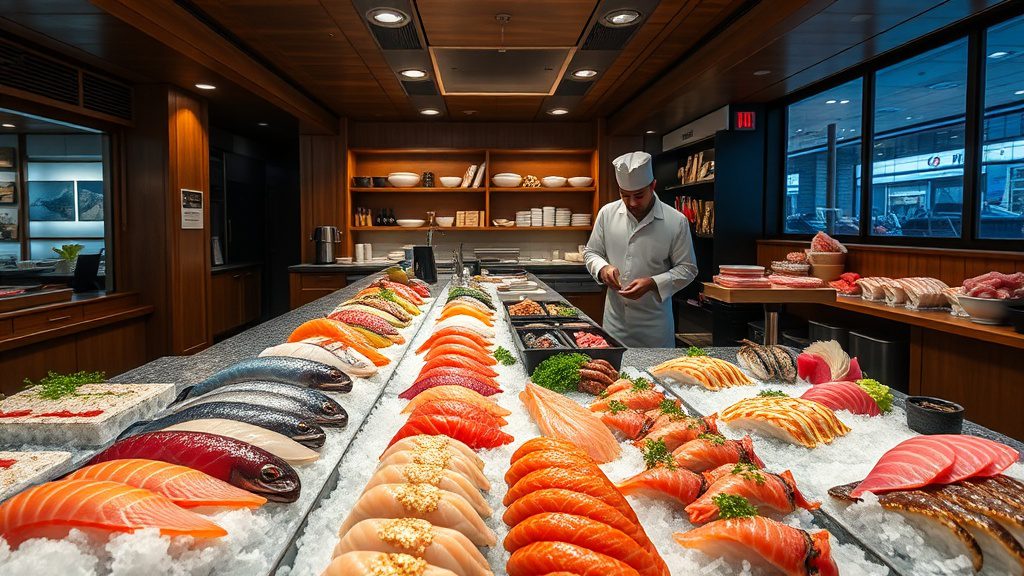
Sankaku Market (三角市場) sits directly adjacent to JR Otaru Station. A narrow, covered alley of fish vendors and small restaurants crammed together at angles that give the market its name (sankaku means triangle). You can buy raw ingredients to take home or sit down at one of the tiny restaurants and eat a kaisendon — a bowl of rice buried under sliced raw fish.
The uni (sea urchin) here is Hokkaido uni, which is widely considered the best in Japan. Otaru uni comes in two varieties — murasaki (purple sea urchin, lighter flavor) and bafun (short-spined, richer, more expensive). A uni-ikura don — sea urchin and salmon roe over rice — runs about 3,000 to 4,500 yen at Sankaku Market. That’s $20 to $30 for a bowl of food that would cost $80 or more at any comparable quality level in New York or Los Angeles, assuming you could find comparable quality at all.
Sushi Street (寿司屋通り) is Otaru’s other food landmark — a stretch of sushi restaurants along a single road that has become a destination in itself. The name is literal: it’s a street of sushi restaurants. Some have been operating for decades. The fish comes from the same harbor, the same morning boats. A solid sushi meal here runs 2,000 to 5,000 yen. For omakase (chef’s choice, multiple courses), maybe 8,000 to 12,000 yen at the higher-end places.
I eat sushi at least twice a week. Sometimes at the well-known spots on Sushi Street, sometimes at a neighborhood place up the hill from my house where the owner knows I like hirame (flounder) and saves pieces for me when he gets good ones. The quality floor in Otaru is higher than the ceiling in most American cities. I’ve eaten sushi in Honolulu, Portland, Istanbul, and a few places in Southeast Asia. Otaru is a different category.
Beyond the showcase spots, daily food shopping in Otaru means access to fish and seafood at supermarket prices that don’t make sense to anyone from North America. Whole squid for a few hundred yen. Scallops — the big Hokkaido hotate — at prices that would make a New England fishmonger uncomfortable. Salmon in every form: raw, smoked, salted, dried. Crab in season. The Hokkaido food supply chain is relentlessly good and, compared to Western prices, absurdly cheap.
The Canal District
The Otaru canal is the image most people have seen, whether they know it or not. Stone warehouses reflected in still water, gas lamps glowing at dusk, snow accumulating on the stone walls in winter. It’s on every Hokkaido tourism poster for a reason.
But I live here, so I should tell you what it actually is on a Tuesday afternoon in October.
The canal runs roughly 1,140 meters through the old commercial district. The stone warehouses along its banks have been converted — restaurants occupy the ground floors, craft shops fill the upper levels, a few buildings house small museums or galleries. The walking path along the canal is flat, well-maintained, and open year-round.
On a quiet weekday, you can walk the canal path and see maybe a dozen other people. Tour buses and cruise ship passengers hit on weekends and during peak season (summer and the February Snow Light Path festival), but the canal isn’t Shibuya Crossing. It absorbs crowds without losing its character, partly because the stone warehouses have the mass and gravity to hold their own against any number of tourists with selfie sticks.
The converted warehouses house some genuinely good spots. Otaru Beer (小樽ビール) brews German-style beer in a stone warehouse and serves it in a beer hall that feels like someone relocated a Bavarian pub to the Hokkaido coast. Otaru Wine also has a tasting room nearby. Several of the canal-district restaurants serve the day’s catch in converted warehouse dining rooms where the stone walls are the original Meiji-era construction.
The glass workshops are a real draw. Otaru’s glass-blowing tradition goes back to the herring fishing era — glass floats were used to hold fishing nets, and the workshops that made them survived the herring industry’s collapse by shifting to decorative and artistic glass. Kitaichi Glass (北一硝子) is the largest, spread across multiple buildings on Sakaimachi Street, but smaller independent studios operate throughout the district. You can watch glass-blowers work. You can blow your own glass in hands-on workshops. The glass shops range from tourist-trinket to genuinely beautiful art pieces.
The Otaru Music Box Museum (小樽オルゴール堂) is one of the largest music box collections in Asia. The building is a converted Victorian-era warehouse. Out front, a steam clock — built by a Canadian clockmaker, the same model as the one in Vancouver’s Gastown — marks the hours. Inside, thousands of music boxes from antique to modern, and a workshop where you can build your own. It sounds like it should be kitschy. It isn’t, somehow.
The Festivals
Otaru’s festival calendar gives the city a seasonal rhythm that keeps the place from ever feeling static.
Otaru Snow Light Path (小樽雪あかりの路) runs for about ten days in February, overlapping with the Sapporo Snow Festival. Hundreds of snow lanterns and ice candles line the canal, the streets, the hillsides. Volunteers carve snow sculptures and ice holders. The candles are real — actual flames inside carved ice and snow — and the effect at dusk when several hundred of them are lit along the canal is something I can’t adequately describe in text. It’s smaller and more intimate than the Sapporo Snow Festival, which runs on corporate sponsorship and massive ice sculptures. The Snow Light Path runs on candles and volunteer labor. I prefer it.
Otaru Ushio Festival (おたる潮まつり) is the city’s biggest summer event, running three days in late July. Ushio means tide — it’s a port festival. Fireworks over the harbor, traditional dance parades through the streets, food stalls along the waterfront serving grilled squid and yakitori and corn on the cob (Hokkaido corn, which is sweet enough to eat raw). The city fills up. People dance. The fireworks reflect off the harbor water. It feels like a city remembering that it used to be the most important port in Hokkaido and celebrating that memory.
Smaller seasonal markets and events run throughout the year — craft fairs, food festivals, autumn harvest events, New Year shrine visits at Suitengu and Sumiyoshi shrines. None of them individually would justify moving here. Collectively, they create a texture of lived time — you know where you are in the year by what’s happening in the streets.
The Daily Rhythm
Here’s what I don’t see in most articles about Otaru, which tend to focus on the canal and the sushi and move on.
Otaru is a walking city. The topography forces it — the city rises from the harbor up into hills, with residential neighborhoods climbing the slopes behind the commercial district. My daily route takes me downhill from my neighborhood, past the canal, through the commercial streets, and back up again. I know the route by the way the incline changes under my feet.
Morning starts at the fish market or, on lazier days, at a coffee shop in a converted warehouse near the canal. The Lawson convenience store near my house sells 100-yen coffee that is, against all reasonable expectations, pretty good.
Afternoons vary. I write at home or walk to the library. If I need something from Sapporo, I’m on the 2:15 train and back by dinner. Groceries happen at the Aeon or the local co-op, both within walking distance.
Evenings are when the canal earns its reputation. The gas lamps come on. The water goes still. The stone warehouses glow warm yellow against whatever the sky is doing — salmon pink in summer, deep purple in winter, white-gray during snow. I walk through on my way home and it never looks the same twice.
This is the life you’re buying into when you buy property in Otaru. The financial case is about train connections and property prices and Sapporo proximity. The staying case is about walking through a lit canal district on a Tuesday evening in November with fresh snow on the stone walls and the smell of grilled scallops drifting from a warehouse restaurant and nobody rushing anywhere.
I’ve lived in a lot of places. I’ve liked most of them. This is the one where I bought a house.