
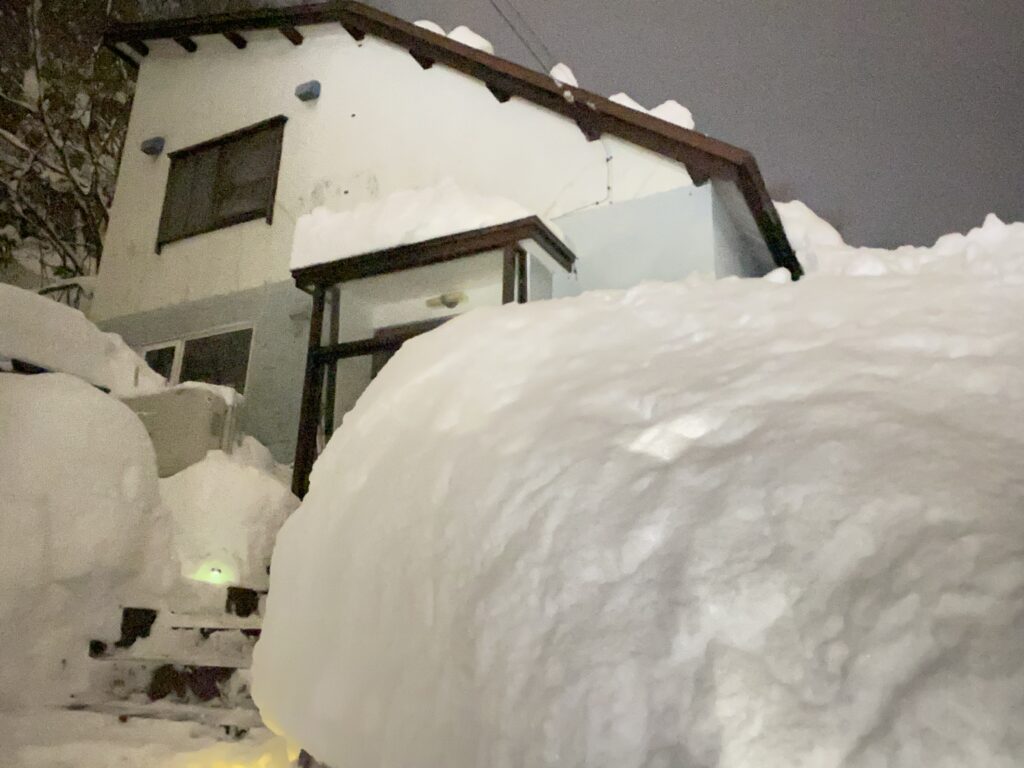
Satoshi Manor is my house in Otaru, Hokkaido. I named it after the smallest unit of Bitcoin because I bought it with small Bitcoin profits, and because it’s a pretty small house, so calling it a manor felt about right. I bought it in the spring of 2024 after a single walk-through in the snow, no inspection, and a consultant who told me, a few minutes into our first call, “This is a terrible idea and you shouldn’t do it.”
I moved in that August, committed to living in it for a year, and filmed the whole thing. A year later I wrote: “This is my home. It will always be my home.”
How I ended up here
I had been trying to buy a house for years. In Hawaii I was outbid by cash offers over the asking price, approved for a mortgage and then unapproved, and once watched a seller nearly double his price just as I had my offer together. I looked at burned-out brick houses in Detroit. I looked at Italy. I wanted to stay within a day’s travel of my daughter in Hawaii, which left the Pacific Rim, which left Japan.
I picked Hokkaido, then Otaru, and shopped the cheapest listings on an akiya site run by an American and a Canadian who had bought one themselves. The house I liked best sat at the low end of my budget. Their consultant called it a terrible idea and then, without charging me, introduced me to a Tokyo agent who spoke good English and was building a business around foreign buyers. I flew to Tokyo, took the train north, and walked through the house in the snow.
I knew exactly what I was doing in one sense and had no idea in every other. I don’t speak much Japanese and I’m not a carpenter. I thought of it as a $10,000 education in buying a house in Japan. Owning a house in Japan doesn’t give you the right to live in it, so I also took a one-year job teaching English.
What the paperwork says
All of this comes from the sale contract and the Important Matters Statement (重要事項説明書) the seller’s broker gave me in March 2024.
| Purchase price | ¥1,000,000: land ¥700,000, building ¥300,000 (about $6,500 at the time) |
| Asking price | ¥1,500,000 when first listed; ¥1,200,000 on the contract paperwork, reduced by ¥200,000 because of the building’s age and condition |
| Contract | Important Matters explained 25 March 2024; ownership transfer and registration scheduled for 25 April 2024 |
| Buyer’s agent fee | ¥220,000 (tax included) |
| Built | July 1969. Building permit issued 2 May 1969. It never had a completion inspection. |
| Structure | Wooden frame, galvanized steel roof, two storeys, with attic storage |
| Floor area | 112.61 m²: 71.21 m² downstairs, 41.40 m² upstairs |
| Land | 494.21 m² over three lots. Two are in Mogami: the larger (277 m²) is still registered as genya (原野), “wild land,” though it’s used as a house lot, and the smaller (75.21 m²) is registered residential. The third (142 m², also genya) sits just over the district line in Matsugae 2-chōme and was on the title but not in the contract’s land table. |
| The stream | 28.80 m² of the property is officially riverbed and is exempt from property tax. |
| Zoning | Category 1 low-rise exclusive residential; 60% building coverage, 100% floor-area ratio, 10 m height limit. Inside Otaru’s landscape district and a land-development regulation zone. |
| Road | Faces a private road on the north side whose width and legal road category have never been settled |
| Utilities | City water and sewer, individual propane, Hokkaido Electric. The water pipe runs across the neighbour’s land to reach the house. |
| Hazards | Inside a landslide warning zone and a landslide special warning zone. Outside the tsunami zone. Covered by the city flood hazard map but outside its projected flood area. |
| Terms | Sold as-is: no seller liability for defects, no fixtures list, and no boundary survey. Anything the seller didn’t take became mine. |
That last line meant the house came full. Clearing it was the first several months of my life here.
What the inspector found
I skipped the inspection before buying. In September 2024, after I’d moved in, I hired a home inspector out of Sapporo to look at it properly. The report said the house leans to the east, more than the standard allows in places, and that the ground on that side may have settled unevenly. It found signs of a roof leak, cracks in the foundation and walls that let water in, and insulation the inspector described as very low. Its summary was that this is normal deterioration for a 55-year-old house: fix where the water gets in first, then improve it bit by bit.
By then I’d already replaced the furnace, the water heater and the stove, caulked the exterior cracks before the first freeze, and had the kerosene tank cleaned.
The land and the neighbourhood
The neighbourhood is Mogami (最上), which means “the uppermost.” It’s one of only a few residential areas in Otaru above 150 metres. The house sits at the end of a small cul-de-sac on the side of the mountain, with three or four neighbours and a high school next door, looking up at Tengu-yama.
The government’s benchmark land price for a residential plot in Mogami is ¥15,700 per m² in 2026, down from ¥51,000 in 1983. I paid about ¥2,000 per m² for my land.
The first family to live here left their mark. On a joist between the kitchen and the bedroom they measured their children’s growth in the 1970s, and those marks are still there. [CHECK: the land registry would show whether the family I bought from were those original owners; see research notes.]
[PHOTO: the growth marks on the joist]
The house as an art project
The kitchen cabinets were dented and broken, so I spray-painted them and started writing a stream-of-consciousness novel on them. That turned into the whole house. The doors between the kitchen, the bathroom and the stairs became Tokyo subway doors. The door from the living room to the entry is a Tardis. The toilet room has a wall each of paper money, coins, credit cards and crypto. The philosophy of Baoism and the Indignified Manifesto are written on the kitchen doors. Guests sign the inside of the guest-room closet.
I’ve done some version of this in almost every house I’ve lived in since I was a kid: writing on the back of a mirror, inside a closet, under a coat of paint. This time I’m doing it in the open.
[PHOTO: the cabinets] [PHOTO: the Tardis door] [PHOTO: the garden and the shed]
The videos
I filmed the first year as a series of chapters, from the day I left Hawaii to the end of my first year in the house. Despite my numbering, there are 21 of them. Every chapter plays on Substack, where I first posted them, except Chapter 15, which is on YouTube only. On YouTube, Chapters 2 through 11 are audio only.
Chapter 1: A Fool in Japan: watch on Substack · watch on YouTube
Chapter 2: Unboxing Satoshi Manor: watch on Substack · YouTube (audio only)
Chapter 3: Creating Order from Chaos: watch on Substack · YouTube (audio only)
Chapter 4: Transformation: watch on Substack · YouTube (audio only)
Chapter 4.5: The Grounds: watch on Substack · YouTube (audio only)
Chapter 5: Non-stop Work: watch on Substack · YouTube (audio only)
Chapter 6: Otaru Revealed: watch on Substack · YouTube (audio only)
Chapter 7: Summer Becomes Autumn: watch on Substack · YouTube (audio only)
Chapter 7.5: Trust Your Gut: watch on Substack · YouTube (audio only)
Chapter 8: On Being a Foreigner in Japan: watch on Substack · watch on YouTube
Chapter 9: Bright Colors in Life: watch on Substack · YouTube (audio only)
Chapter 10: Life as an Art Installation: watch on Substack · YouTube (audio only)
Chapter 11: Autumn to Winter, plus Vietnam: watch on Substack · YouTube (audio only)
Chapter 12: Winter Challenges: watch on Substack · watch on YouTube
Chapter 13: Gratitude: watch on Substack · watch on YouTube
Chapter 14: The Loneliness Epidemic: watch on Substack · watch on YouTube
Chapter 15: The Missing Chapter: watch on YouTube
Chapter 16: Satoshi Manor in Winter: watch on Substack · watch on YouTube
Chapter 17: The Grounds and the House in Spring: watch on Substack · watch on YouTube
Chapter 18: Summer Vibes at Satoshi Manor: watch on Substack · watch on YouTube
Chapter 19: Third Verse Same as the First: One Year Reflective: watch on Substack · watch on YouTube
The whole run is also collected in one post: Satoshi Manor: 20 Videos, 1 Year in Japan. The second house has its own page: BaoHouse.
A year later
At no point that first year was I sure I’d be able to stay. The visa system, the house, the weather, my own head and living apart from my daughter were all out of my control. By the end, the house had become itself and so had I. I’d always carried a fantasy about buying back my childhood homes. That went away. I wasn’t a vagabond because I didn’t want to settle. I was a vagabond because I needed to find the place to settle. My hat is hung here.