
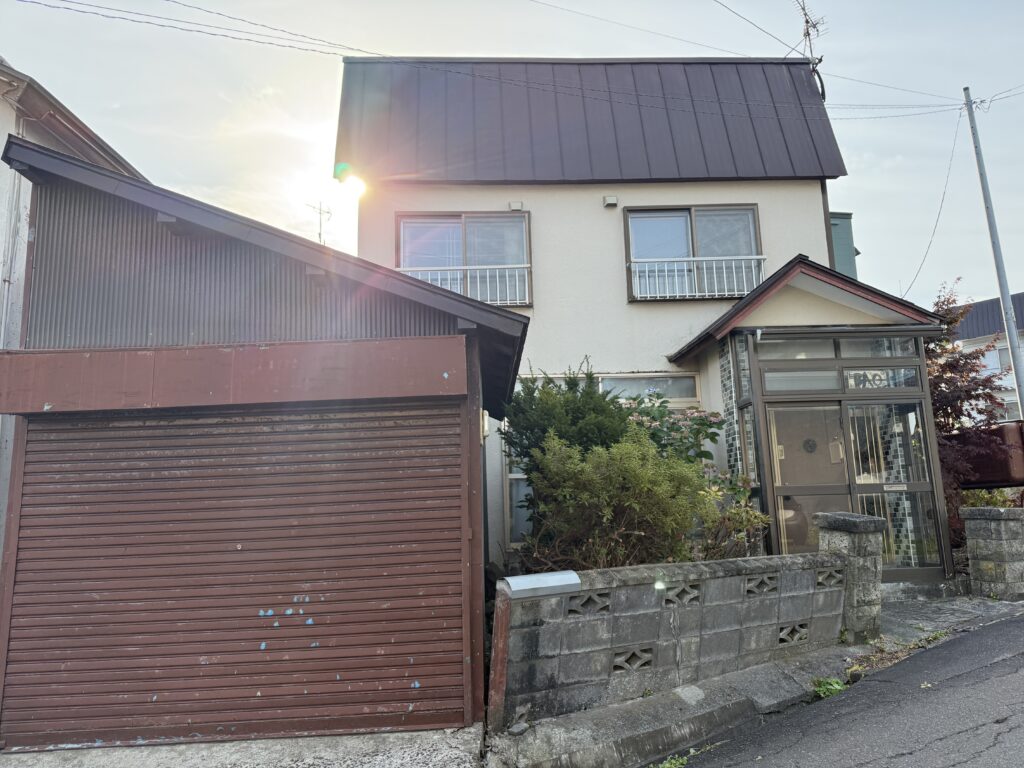
BaoHouse is my second house in Otaru, about a fifteen-minute walk down the mountain from Satoshi Manor in the old Matsugae neighborhood. I bought it in early 2026 for ¥800,000 without ever seeing the inside.
 Why a second house
The joke is that there wasn’t enough shoveling the winter before, so I bought another house to keep me busy. The real reason is that I could see more foreigners starting to buy in Hokkaido. If Satoshi Manor’s value shot up I’d be tempted to sell it, and I never want to sell it. A second house solves that: if prices ever take off, I can sell BaoHouse without the regret of having been early and walked away with nothing, which has happened to me before.
I found it on a long winter walk down streets I hadn’t been down before: a house piled high with snow, overgrown, obviously empty, with a big garage. Satoshi Manor has no parking, which matters a lot in Japan. There was a sign on the door. My Japanese isn’t great, but I was fairly sure it said “for sale,” so I sent it to the agent in Tokyo who’d helped with my first house and asked if they could get it for me.
What the paperwork says
| Purchase price | ¥800,000, with a ¥100,000 deposit credited toward it |
| Buyer’s agent fee | ¥330,000 (tax included) |
| All in | ¥1,222,552 wired on 24 February 2026, covering the price, the agent’s fee, registration and the property-tax settlement [CHECK: you’ve been saying “about $7,000 all-in” on camera; at February 2026 rates this wire may come to more] |
| Settlement deadline | 28 February 2026 |
| Built | Showa era, per the disclosure statement [CHECK: a since-removed listing for an ¥800,000 house in Matsugae 1-chōme gave June 1977 and 127.20 m² of land; I haven’t confirmed it’s this one] |
| Structure | Wooden, zinc-coated steel roof, two storeys on paper |
| Floor area | About 108.76 m² (registry figure, not measured) |
| Basement | Not in the paperwork. I found it under a floor panel. More on that below. |
| Land | Freehold, two registered lots, no mortgages or tenants |
| Zoning | Category 1 medium-rise residential; 60% building coverage, 200% floor-area ratio (may be limited by road width); fire-regulation district (Building Standards Act Art. 22) |
| Road | Public road of variable width; the exact width was never measured |
| Hazard maps | The disclosure lists flood, tsunami and landslide maps as applying |
| Inspections | None. No seismic certificate, no building confirmation records. Sold effectively as-is. |
Inside
The first time I got the key in the door, the house was full. Every cupboard, every room, and the garage. Kimono in the closet cabinets, sixteen futon, six clocks upstairs alone, more baskets than one person should own, lacquerware, vintage dishes, tools, skis. A broken water line had flooded the back rooms, and the tatami, walls and everything stored there were covered in mould. I froze my fingertips working in a house with no heat, power or water, and the toilet bowl cracked because I’d poured water into it in winter.
Whoever cleared it before the sale knew what they were doing. I found exactly one yen in cash. What they missed included a Louis Vuitton wallet, vintage Burberry and YSL, a beaded purse, a fountain pen with a gold nib, a commemorative boxed set of Hiroshige’s Fifty-Three Stations of the Tōkaidō that Nissan put out for the Laurel’s tenth anniversary, and an old photo album with pictures going back to the 1920s and the war years.
Then, in June, I lifted a floor panel and found a basement nobody had mentioned. It was Granny’s home-brewing cellar, as I’ve taken to calling it, still lined with old sake bottles.
The neighbourhood: Matsugae
The roads around BaoHouse are strangely wide for a quiet residential neighbourhood, and there’s a big community hall up the street that sits empty most of the time. There’s a reason for both.
On the night of 27 April 1896, a fire broke out in Otaru’s licensed pleasure quarter at Suminoe and spread into a major blaze. Afterwards the quarter was moved up the hill to Matsugae, at the foot of Tengu-yama. It became known as the Nankaku (南郭), the South Quarter, to tell it apart from the North Quarter that opened at Umegae in 1907. You entered through a great gate, and the streets inside were named after Edo’s Yoshiwara district: Yanagi-machi, Kyō-machi, Naka-machi, Benten-machi, Hagoromo-machi. One account counts eighteen houses. The streets were laid out extra wide as a firebreak, which is why they’re still that wide today.
The quarter was shut down not long after the war. In 1967 the old South Quarter streets were folded into Matsugae, which slowly turned into the quiet neighbourhood it is now. When I walk to BaoHouse I pass one little shop that’s sometimes open and about three restaurants. It used to be full of shops and izakaya and festivals. The name is meant to bring good luck. It probably comes from the larches planted at the base of Tengu-yama.
For comparison, in October 2026 houses of a similar age in Matsugae 1-chōme were listed at around ¥2.4–2.5 million, and empty lots at anywhere from ¥300,000 to ¥1.8 million.
What BaoHouse is for
Houses in Hokkaido need people in them or they fall down; the winters see to that. I’ve been a couchsurfer and a host for decades, but Satoshi Manor is small with one bathroom. So BaoHouse is where travellers coming through Otaru can apply to stay for free, and where I hold small meetups to get people in town to know each other. In the long run I want it to be a retreat for artists and writers, and a way to bring the right kind of people to Otaru: people who invest in the place instead of using it as a cheap base for skiing.
The videos
More episodes of The ¥800,000 House are on the way. [CHECK: add episodes 2–7 as they go up]
Neighbourhood history sources: Shimamura Takanori lab, Kwansei Gakuin University, “小樽遊廓史,” citing Kimura Satoshi, 『赤線跡を歩く 完結編』 (2007); 小樽銭函地名歴史研究会, “小樽の町名の由来”; Koume Taro, 「小樽日記」 (2013). Comparable listings from the Otaru Fudōsan Rengōtai listings site, October 2026.