
New Chitose International Airport’s Case Against Rushing to the Gate
By CD Damitio | Indignified.com
Most airports are something to survive. You show up, you wait, you board, you leave. New Chitose Airport — 新千歳空港, Shin-Chitose Kūkō — doesn’t work that way. If you’ve spent any time passing through it, you know what I mean. If you haven’t, you need to know that showing up two or three hours early is not a sacrifice here. It’s a strategy.
I’ve been through New Chitose more times than I can easily count — flying in and out of Hokkaido from Otaru, coming back from the States via Tokyo, watching the JASDF F-15s ghost across the sky as you taxi. It’s the airport I use the most in Japan. And every time I’m in there, I find something I’d either forgotten or hadn’t noticed before. That’s genuinely unusual for any piece of infrastructure, let alone one with runways.
A quick orientation: New Chitose sits about 50 kilometers southeast of Sapporo, connected to the city by the JR Rapid Airport train in about 37 minutes. It’s the largest airport in Hokkaido, Japan’s northernmost major island, and runs one of the world’s busiest domestic routes — the Tokyo–Sapporo corridor. The airport became Japan’s first 24-hour facility back in 1994, and Skytrax named it the world’s most improved airport in 2024, jumping from 102nd to 49th in their global rankings. That’s not a fluke. The place has been quietly building a case for itself.
Here’s what’s actually in there.
The Ground Floor Reality: Food, Seafood, and Omiyage
Before you even think about entertainment, the second floor of the domestic terminal hits you with shopping and the third with food. The concept driving the whole commercial layout is “Hokkaido showroom” — over 170 shops and restaurants, most of them selling things you actually want to buy rather than the desperate last-minute trinkets you find at lesser airports.
The seafood situation alone is worth noting. The market area recreates the feel of a proper Hokkaido fish market — urchin, crab, fresh salmon, things that you’d have to go out of your way to find in Tokyo. Sapporo Seafoods sources from the city’s central wholesale market. Kushiro Port Market brings in eastern Hokkaido’s catch. You can have things shipped frozen, which is useful if you’re heading somewhere with a kitchen.
For hot food, the third floor’s Hokkaido Ramen Dojo is the genuine article. Ten carefully selected ramen shops from around the prefecture, gathered in one spot with the kind of rotating quality that means you can’t really go wrong regardless of which line you join. The miso ramen with corn and butter is the obvious Hokkaido choice. Ebisoba Ichigen draws the longest queues. The whole zone is legitimately good ramen, not airport-good ramen, which are very different things.
Beyond ramen, the Gourmet World zone on the third floor has soup curry, kaisendon, wagyu, and a spread of Hokkaido-forward options. There are also Starbucks and convenience store options for when you just want coffee and a seat.
Smile Road: The Corridor That Contains Multitudes
Between the domestic and international terminals runs a connector on the third floor called Smile Road. This is where the airport gets genuinely strange, in the best possible way. What should be an ordinary transitional passage is instead packed with things you’d make a special trip to see.
Royce’ Chocolate World anchors the whole thing. Royce’ is Hokkaido’s signature chocolate brand — those pink boxes of raw chocolate you see everywhere in the gift shops are their most famous product — and this is their only factory-museum anywhere, making it the first chocolate factory ever installed inside an airport in Japan. The setup: a glass-enclosed production floor where you can watch the machines running (operating 8:30 AM to 5:30 PM), a mini-museum covering the history of chocolate from cacao cultivation through to the modern confectionery industry, panels showing chocolate labels from around the world, cocoa can collections, and a two-meter-tall chocolate bear who greets you at the entrance.
The shop carries close to 200 products, including items exclusive to this location — airport-specific flavors, limited editions, things the regular Royce’ stores don’t carry. There’s also a bakery running separately, selling chocolate-laced breads: the Gouter, a bar of chocolate baked inside the loaf, is the one people come back for specifically. The bakery is one of only seven Royce’-affiliated bakeries in all of Hokkaido. Admission to the museum and factory viewing is free. The shop and museum run 8 AM to 8 PM.
Also on Smile Road: the Hello Kitty Happy Flight shop and café on the second floor of the connector. It’s exactly what it sounds like — Sanrio merchandise, themed food, pink everywhere — and it works. Further in, there’s a Crayon Shin-chan pavilion that’s been added to the roster.
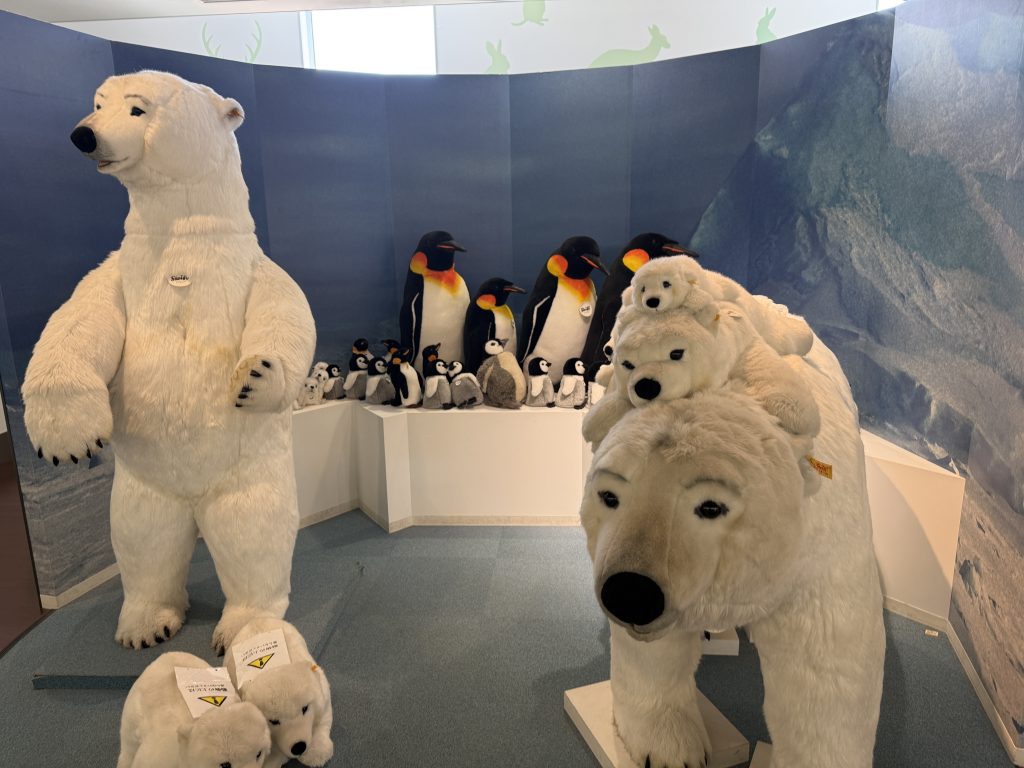
And running the length of the second-floor connecting path, the Steiff Discovery Walk is one of the stranger and more wonderful things you’ll find in any airport on earth. Steiff, the German toy company that invented the modern teddy bear, has installed a kind of open-air museum along both sides of the wide aisle. Life-sized plush animals — elephants, bears, buffalos, giraffes — are displayed in themed arrangements representing natural habitats and German street scenes. There are “motion displays” where the animals move. There are photo spots against backdrops of white bears in arctic settings and penguins doing their thing. It sounds like a gimmick but it lands as something more: a genuinely enchanting oddity, the kind of thing that makes you stop and wonder how it got here. Open 10:00 to 18:00, free to walk through.
The Fourth Floor: Where Airports Stop Being Airports
The fourth floor of the domestic terminal is where New Chitose fully commits to being somewhere else.
New Chitose Airport Onsen is Japan’s first in-terminal hot spring — natural sodium chloride mineral water, weakly alkaline, the kind that leaves your skin soft and your body temperature running warm for hours afterward. There are indoor baths, outdoor baths, three types of stone sauna (six varieties of rock), a relaxation room with 180-degree reclining seats, a restaurant, and overnight accommodation (from around ¥5,000 for the relaxation room; private rooms available). The facility runs essentially 24 hours, with a late-night surcharge after 1 AM. Admission for the baths is around ¥2,600 including towels and a bathrobe. For anyone doing an early morning departure or a late-night arrival, this changes the calculation entirely. You don’t need a hotel. You soak, you sleep in a reclined seat, you shower, you board.
The New Chitose Airport Theater is Japan’s first cinema inside an airport terminal. General admission around ¥1,700, open 9 AM to midnight. It runs current films, mostly family-oriented, with proper reclining seats. If your flight is delayed, this is where you go.
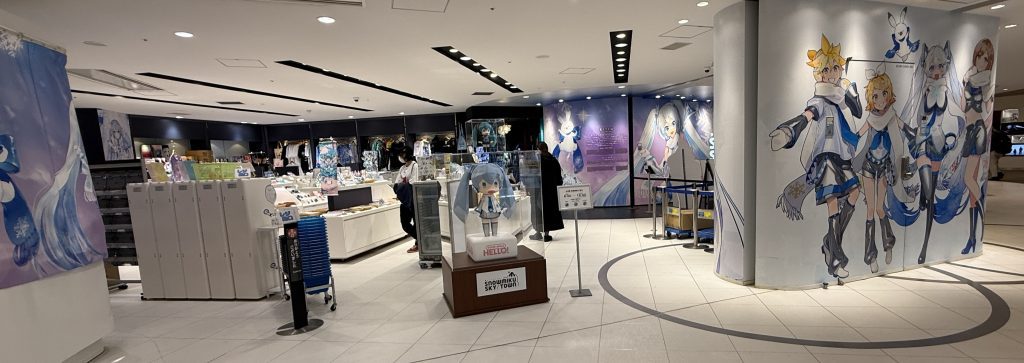
Snow Miku Sky Town occupies a dedicated corner on the fourth floor, and it’s worth lingering in even if you’re not deep into Vocaloid culture. Hatsune Miku — the singing synthesizer character created by Sapporo’s Crypton Future Media — has a home region connection that makes this Hokkaido airport a natural home. The Snow Miku variant is specifically Hokkaido’s local celebration of the character, with an annual winter design. The museum is compact but thoughtful: original Crypton software packaging, a chronological history of the Vocaloid phenomenon, documentation of landmark live performances, coverage of the character’s evolution across the Piapro Character series. At the end, a big whiteboard for visitor messages is always completely covered with drawings and notes from fans. The gift shop carries Snow Miku merchandise, seasonal items, and things you won’t find in standard Miku shops. Free to enter, open during airport hours.
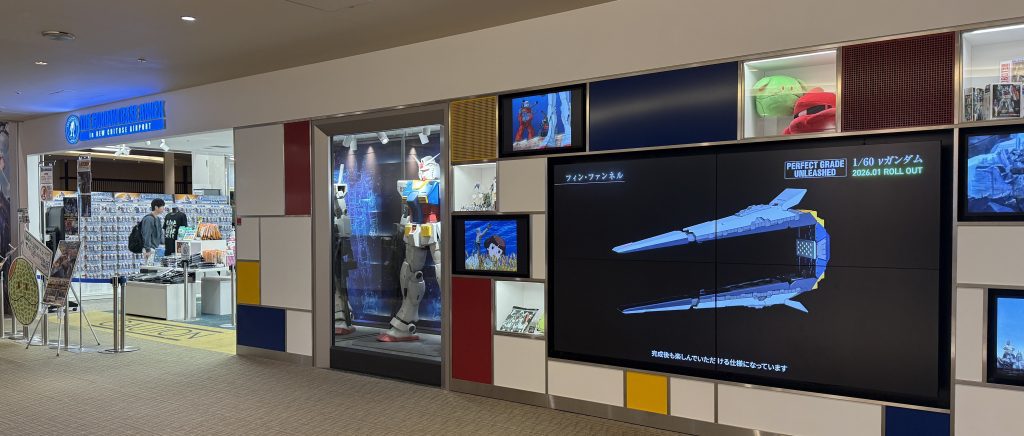
Also on the fourth floor: the Gundam Base Annex, which opened in March 2025 — the first official Gundam merchandise facility in all of Hokkaido. Operated by BANDAI SPIRITS, it stocks Gunpla model kits, apparel, stationery, Hokkaido-exclusive sweets, and limited items not available at other Gundam Base locations. A 1/10 scale RX-78-02 Gundam statue stands in the domestic aisle nearby. Multi-panel monitors run Gundam footage. The walls are printed with artwork from the Gunpla packaging series. Free to enter, 9 AM to 7 PM.
The Sky Museum and Observation Deck
On the third floor of the domestic terminal, adjacent to the food court and free to enter (10 AM to 6 PM), the Sky Museum is a proper aviation history installation. A flight simulator runs two courses (¥100 for 2.5 minutes, ¥200 for 4.5 minutes). There are full-scale displays of aircraft tires, engines, and components. A model airplane collection spans aviation history. There’s a corner where you can try on pilot and flight attendant uniforms for photos. For anyone who finds the mechanics of flight genuinely interesting, or traveling with someone who does, this is a legitimate 30-45 minute stop.
The Observation Deck (Skydeck) sits on the roof of the domestic terminal with open-air views of the runways. Fighter jets from the adjacent JASDF Chitose Air Base share the airspace, so planespotting here has an unusual dual-use quality — you might see an ANA 777 roll past and then have a pair of F-15s cut across the sky behind it. Note that the observation deck closes seasonally in winter, typically December to March, due to Hokkaido’s weather realities. In the warmer months, it’s the best free view in the building.
The Practical Layer
The duty-free shops in the international terminal carry the standard range: cosmetics, spirits, tobacco, Japanese goods. The domestic terminal has Muji, Uniqlo, a Pokémon store, Laox for electronics, drug stores, and an overwhelming selection of Hokkaido omiyage — the individually wrapped, already-boxed gift sets designed for the Japanese tradition of bringing souvenirs back from every trip. These are genuinely good things to buy: Rokkatei cookies, Tokachi corn confections, various Royce’ products, LeTAO cheesecakes from Otaru. Light, packable, designed to be carried on planes.
The Air Terminal Hotel and Portom International Hokkaido both operate inside the terminal. Hotel guests at the Air Terminal get free onsen access and a breakfast buffet included. Portom is in the international terminal, positioned for transit passengers doing early departures.
There’s also a Café Sky Library on the fourth floor of the international terminal, which accepts Priority Pass, DragonPass, and LoungeKey, and extended its hours in April 2026 to 9 PM.
One logistical note for readers heading to or from Otaru specifically: the JR Rapid Airport train from New Chitose takes about 73 minutes to Otaru Station. It’s a long ride but it’s direct and comfortable. Budget accordingly.
The Note on Doraemon
If you’ve read older guides to New Chitose — or if someone told you about the Doraemon Wakuwaku Sky Park — know that it closed in July 2025. The themed park with its park zone, café, library, and workshop ran for years as one of the airport’s signature attractions. It’s gone now. What replaced it and what’s filling that space is still being sorted. The Doraemon café and merchandise may still have some presence in the area, but the full park experience is no longer operating.
What This Place Actually Is
New Chitose is the airport you actually want when your flight is delayed, when you’ve got three hours to kill before boarding, when you’re arriving with family who need somewhere to be for an afternoon. It’s the airport where locals from Sapporo will drive out specifically to eat at the ramen dojo or pick up Royce’ bread, because the airport versions are genuinely that good.
I don’t reach for superlatives about infrastructure — but there’s something worth saying about a place that took the obvious fact that people have to wait in airports and decided to make the waiting worth something. Hot springs and cinema and a working chocolate factory and Hatsune Miku’s hometown museum and life-size Steiff animals and a Gundam base and fresh seafood and ramen from across a whole island. All of it under one roof, attached to a train that gets you to or from Sapporo in 37 minutes and to Otaru in a bit over an hour.
One more note. The policy of the Onsen is “No Tattoos” though I have talked with people who had no issue despite having tattoos. If you can cover the tattoos, you most likely won’t have an issue – but as with most onsen, you might. I learned this the hard way when I planned to overnight in the Onsen for an early flight and made the mistake of specifically asking about the tattoos. In terms of tattoos in onsen in Japan, my personal rule is forgiveness trumps explicit permission.
Arrive early. Stay late. The gate will still be there.
CD Damitio is the author of thirty books and the creator of Indignified.com. He lives in Otaru, Hokkaido, Japan and travels constantly.