
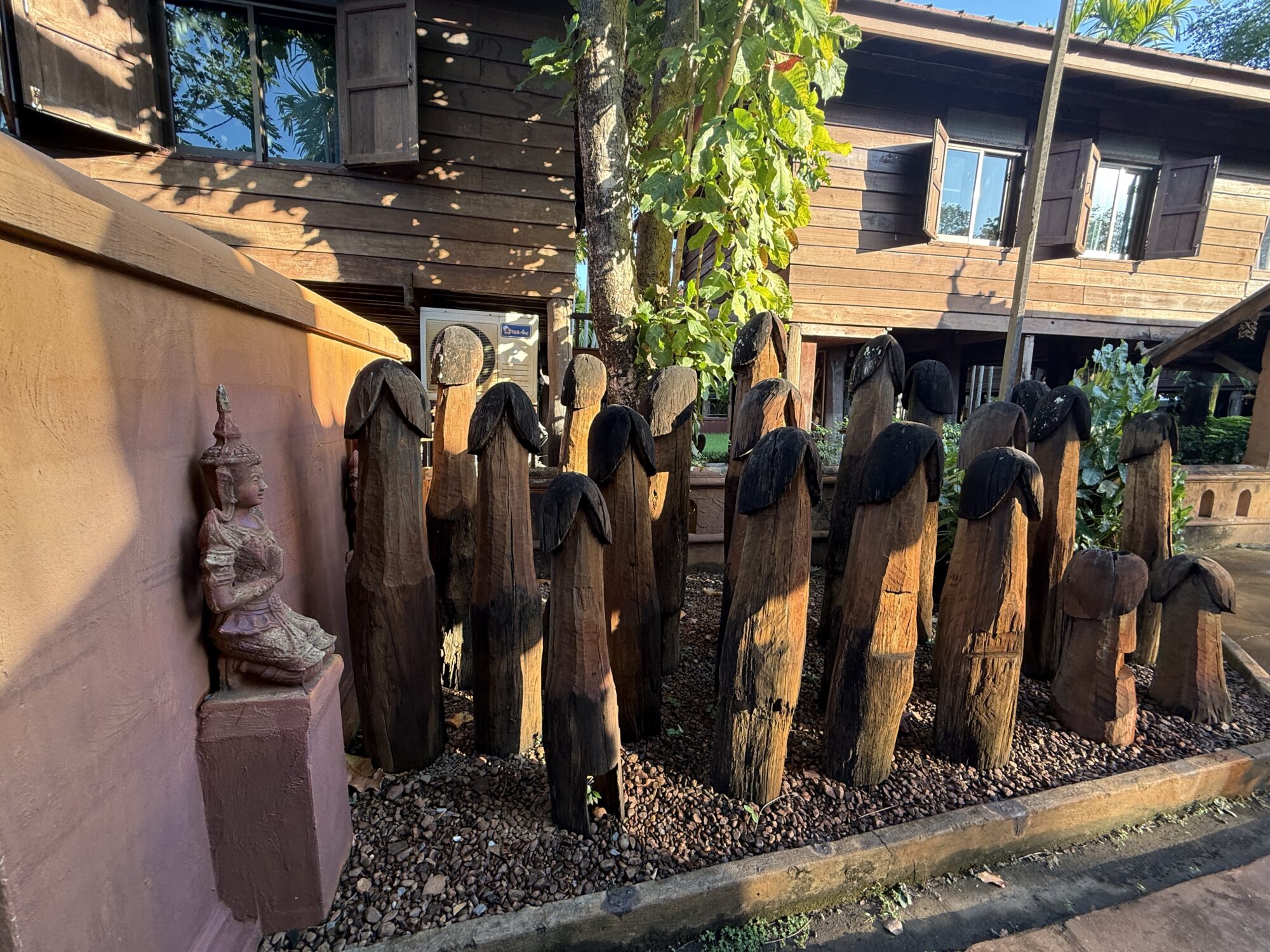
I’m currently staying at a workaway project to the south of Chiang Mai. If you aren’t sure what that is – I’ll write an article about it soon – so stay tuned. One benefit of this kind of thing is it puts you in real neighborhoods and places where you don’t really know what you will find and you usually have some time to explore and dig into the place if you choose to. Yesterday led me to a very interesting man and his very interesting life project. What follows is some of his story. ~CD
In the quiet outskirts of Saraphi, just south of Chiang Mai and near the ancient ruins of Wiang Kum Kam, sits a place that feels less like a restaurant and more like a living museum of Northern Thai life. Lanna Ricebarn (ยุ้งข้าวล้านนา) is a collection of century-old Lanna houses and traditional rice barns carefully relocated and restored across two acres of land. At its heart is a restaurant serving honest Northern Thai food. Behind it all is one man: architect Adul Heranya (อดุลย์ เหรัญญะ).
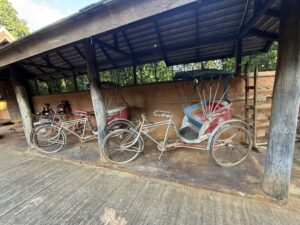
Adul grew up in a farming family and never lost his attachment to the traditional Lanna way of life. While studying architecture, he began collecting old rice barns (yung khao) and wooden houses that were being torn down or left to rot as modern concrete replaced the old timber structures. Over roughly eight years he gathered barns that were 70 to 100 years old and houses more than a century old, along with tools, decorative elements, and artifacts from the Lanna era. He moved them piece by piece to this plot of land and rebuilt them with care. What started as personal preservation became one of the most complete living collections of authentic Lanna vernacular architecture in Thailand.
Today the site functions as both a homestay and a restaurant. Guests stay in the old elevated wooden houses, swim in a pool framed by palm trees and traditional roofs, and walk among the barns and antiques. Architecture students come here as a kind of pilgrimage site to study real Lanna construction rather than drawings or reconstructions. Adul has also created a small on-site museum of Lanna-era objects. He continues to work as an architect, designing residences, hotels, and other buildings while teaching and advocating for the preservation of Northern Thai building traditions. He has received recognition from the Association of Siamese Architects for his conservation work.
The restaurant itself, ยุ้งข้าวล้านนา อาหารพื้นเมือง, is straightforward and rooted. It specializes in traditional Northern Thai dishes that many places in Chiang Mai have softened or abandoned. Expect the strong, distinctive flavors of fermented fish, shrimp paste, dried fish, roasted chili, bamboo shoots, and local greens. The kitchen is open about authenticity: some dishes will taste bold and unfamiliar to those used to milder Central Thai or tourist versions. Staff note that spice levels can be reduced but the fundamental character of the food cannot be removed. Reviews consistently praise the cooking, the quiet garden setting, and the chance to eat among the old wooden structures. It is not a flashy place. Opening hours are daytime only (roughly 10:00–17:00 or 17:30), closed on Tuesdays, and the location is a little hard to find without navigation.
What makes Lanna Ricebarn stand out is the sincerity of the project. Many places in Chiang Mai borrow Lanna aesthetics for decoration. Adul actually saved the buildings. The result is a calm, slightly eccentric compound that rewards people who value the real thing over polished presentations. The food is good, the architecture is the real attraction, and the whole place feels like the work of someone who cared more about keeping something alive than about creating a tourist product.
If you go, give yourself time to walk around the grounds after eating. The barns, the houses, the small museum, and the quiet gardens tell the story better than any description. Adul Heranya did not set out to build a restaurant. He set out to keep a disappearing way of building and living from vanishing. The restaurant is simply the most pleasant way to experience what he managed to save.