
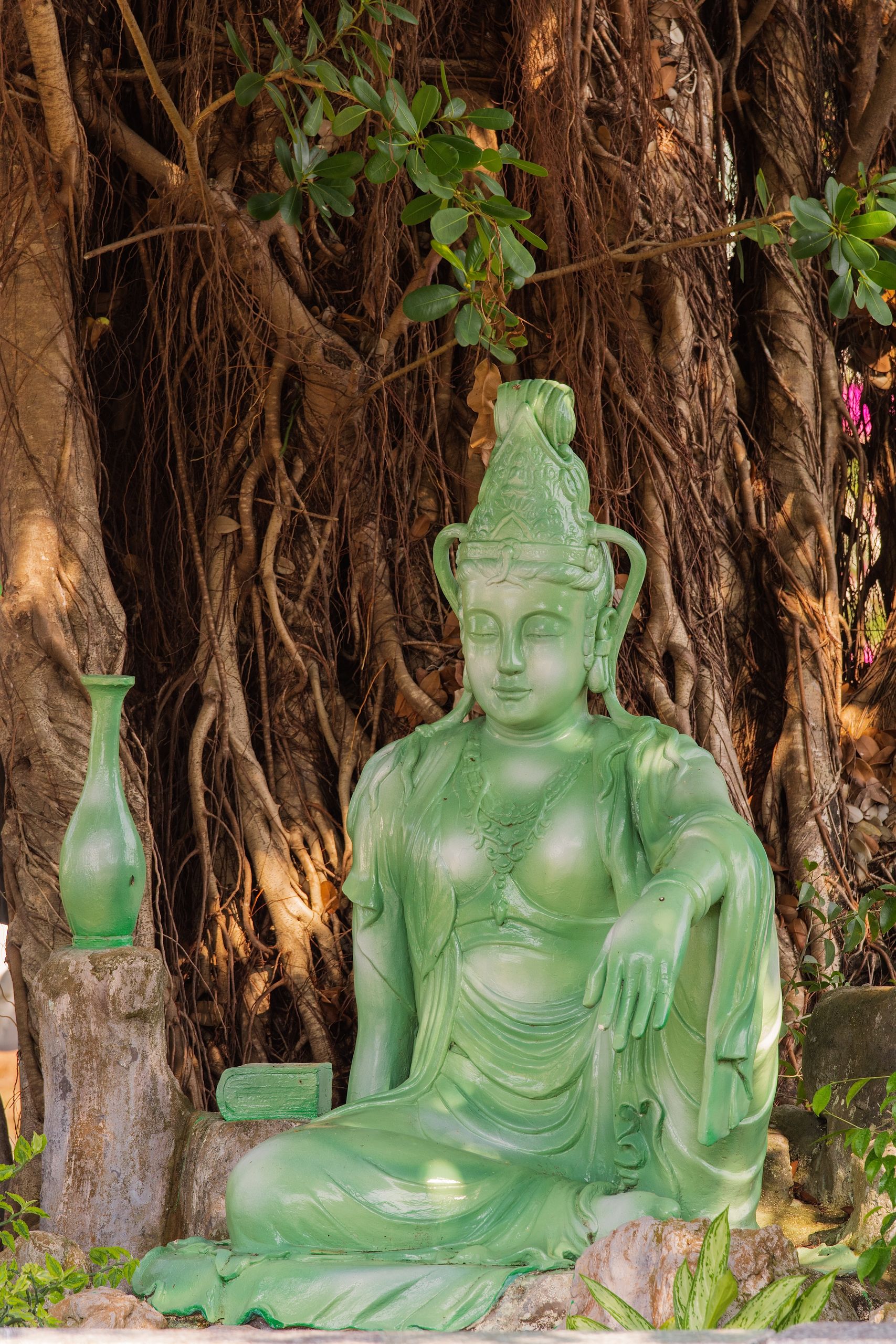
The Green One
There is a shade of green that follows you through Kathmandu. It is on the thangkas hung in the tourist shops of Thamel, on the small resin statues wrapped in newspaper and sold for a few hundred rupees, on the shrines tucked into courtyards where nobody stops to look twice. It is the color of Green Tara, and once you notice her you cannot stop seeing her.
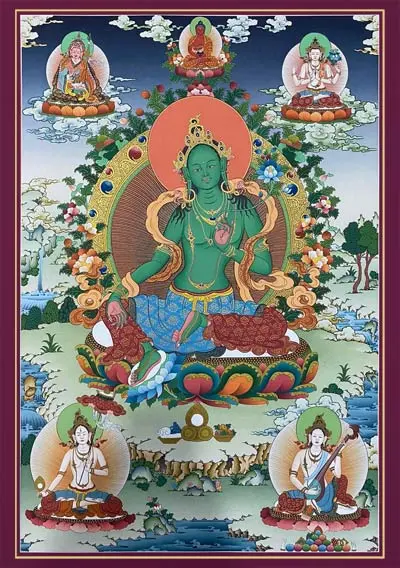
Tara is not a minor figure in the Buddhist pantheon of Nepal and Tibet. She is called the Mother of all Buddhas, the female embodiment of enlightened action, and in her green form she is the one who moves fastest. Her right foot is extended out of her lotus seat, not tucked beneath her in the stillness of formal meditation. She is depicted mid motion, already stepping down, already on her way to whoever has called her name. Compassion, in her iconography, is not a static virtue to be admired from a distance. It is a verb.
A Goddess in a Hurry
The mantra associated with her, om tare tuttare ture soha, is one of the most recited phrases in the Kathmandu Valley, murmured by pilgrims spinning prayer wheels at Boudhanath and Swayambhunath alike. She is understood as a protector against fear and sickness, someone who acts quickly rather than deliberating. Where other deities in the tradition are approached with elaborate ritual and patient devotion, Tara has a reputation for showing up.
That distinction matters more than it might seem. A great deal of religious architecture, in every tradition, is built around waiting: waiting for judgment, waiting for the next life, waiting for a distant authority to notice you. Tara’s mythology runs the other direction. She is the figure who does not make you wait.
Patan’s Living Craft
Walk into Patan, across the river from central Kathmandu, and you are standing in a city that has been casting Tara in copper and bronze for centuries. The lost wax process used by Newar metalworkers there, cire perdue, has barely changed in its essentials. A wax model is built, coated in clay, and the wax is melted out and replaced with molten metal, meaning every statue produced this way is singular. No two Taras from Patan are quite identical, which is a fitting trait for a deity defined by responsiveness rather than fixed form.
This is not showroom Buddhism. It is a trade passed from father to son to apprentice, and the small workshops off Patan Durbar Square still turn out statues bound for altars in Kathmandu, Lhasa, and living rooms on the other side of the world.
Green Among the Five
Tara’s green also connects her to Amoghasiddhi, one of the five Dhyani Buddhas who preside over the cardinal directions in the mandalas of Vajrayana Buddhism. He governs the north and is rendered in the same green, holding a double vajra, associated with dispelling envy. Together the two green figures point at something the tradition takes seriously: color is not decoration in this iconography, it is doctrine. Green marks a register of active, fearless engagement with the world, distinct from the stillness of blue or the radiance of gold.
Where This Meets the Road
I did not come looking for Tara. She showed up the way she is supposed to, in shop windows and shrine corners, insistent and unannounced. Then, I met a Tibetan monk through a Tibetan alcholic and that monk tied a string on my wrist and put a Green Tara medallion over my head. That is, I think, the useful lesson buried in her iconography, and it rhymes with something I have spent years working out under the name Baoism.
Baoism holds that every person already carries the capacity to tell Rox from Tox, good from bad, and that the practice of any sincere tradition is really the practice of polishing a mirror that is already there. Tara does not wait for a supplicant to arrive fully purified. She steps down. She meets people where they already are, mid fear, mid sickness, mid uncertainty, and the encounter itself is the practice. There is no separate institution required, no clergy standing between a frightened traveler and the compassion that is already reaching toward them.
Every tradition that takes this posture seriously, that compassion is something you do rather than something you wait to receive, is in that moment practicing Baoism whether it uses the word or not. Tara, green and already moving before you finish the prayer, is as clean an image of that as I have found on this trip.
She is easy to miss if you are moving too fast yourself. She is also, it turns out, very hard to miss once you slow down. In fact, she will not let you miss her.