
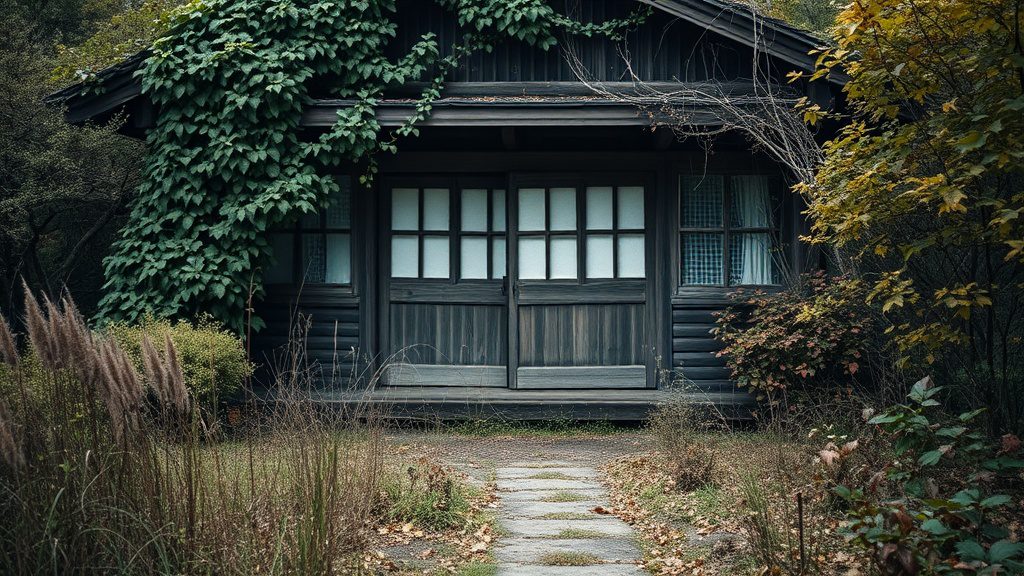
Akiya (空き家) means empty house. That’s the literal translation — 空 (empty/sky) and 家 (house/home). The word itself is mundane. Every language has a term for a vacant property.
What makes the Japanese version different is the scale. As of the 2023 Housing and Land Survey, Japan has approximately 9 million akiya. Nine million empty houses in a country the size of California. That number has been climbing for decades and shows no sign of reversing. The 2018 survey counted 8.49 million. The 2013 survey counted 8.20 million. The trajectory is one direction only.
To put 9 million in perspective: that’s roughly one in seven residential properties in the entire country sitting empty. It’s more vacant houses than the total housing stock of many countries. It’s enough empty houses to give one to every resident of New York City.
This is the context in which a foreigner can buy a house in a first-world country for the price of a used car. The akiya phenomenon isn’t a bug in the Japanese property market — it’s the defining feature. Understanding why it exists is essential to understanding what you’re buying, what it’s worth, and why nobody else wants it.
The Demographic Engine
Japan’s population peaked in 2008 at approximately 128 million. Today it’s around 123 million. By 2050, government projections put it below 100 million. By 2100, some estimates go as low as 63 million — roughly half of the peak.
The raw numbers: deaths currently exceed births by around 700,000 per year. Japan’s total fertility rate sits at approximately 1.2 children per woman, well below the 2.1 replacement rate. Immigration exists but remains modest by global standards — Japan accepted about 36,000 permanent residents in 2023, a number that barely registers against the annual population decline.
Every year, 700,000 more people die than are born. Every year, the demand for housing drops. Every year, more houses empty out.
But the population decline doesn’t distribute evenly. Tokyo, Osaka, and a handful of major metros continue to grow — or at least hold steady — by absorbing internal migrants from everywhere else. Young people leave smaller cities for jobs, education, and the simple gravitational pull of the metropolis. The places they leave behind lose population faster than the national average.
Otaru is a textbook case. Population peaked around 190,000 in the 1960s when the city’s port and fishing industries were at full strength. Today it’s roughly 105,000. That’s a 45% decline over sixty years, and the rate accelerated after 2000. The people who left were disproportionately young. The people who remained grew old. When they die, their houses empty.
This pattern plays out across hundreds of Japanese cities and towns. The countryside depopulates. The cities fill with elderly residents on a one-way timeline. The houses accumulate.
The Cultural Equation
Demographic decline creates vacant houses everywhere populations shrink — rural America has them, Eastern Europe has them, parts of Southern Italy have them. But Japan produces disproportionately more akiya than population decline alone would predict. The reason is cultural, and it inverts an assumption that Western property buyers carry without even knowing they carry it.
In the United States, the UK, Australia, or most of Europe, a house is expected to last. A well-maintained Victorian can be 150 years old and sell for more than a new build. Age adds character. “Good bones” is a selling point. The structure appreciates or at least holds value while the land beneath it does the same.
In Japan, the opposite. A wooden house is expected to last about 30 years. After that, conventional wisdom says it’s reached end-of-life. Banks won’t lend against it. Assessors value the structure at zero — only the land retains monetary worth. Buyers in the market for a home overwhelmingly prefer new construction. An older house isn’t just “used” — it carries a stigma of obsolescence.
This isn’t irrational, exactly. It has historical roots. Japan’s traditional wooden architecture wasn’t built for permanence in the Western sense. Earthquakes, typhoons, humidity, and termites all shorten the effective lifespan of wood-frame construction. The 1981 revision of Japan’s Building Standards Act created a meaningful divide — pre-1981 houses were built to weaker seismic standards, and post-1981 construction is demonstrably safer. The cultural instinct to tear down and rebuild every generation has a practical basis.
But the result is economically bizarre by Western standards. A perfectly functional 35-year-old house — solid roof, good foundation, maintained plumbing — is worth nothing. Less than nothing, because the owner faces demolition costs of ¥1-3 million to clear the land for sale. The structure is a liability, not an asset.
This creates the gap that foreign buyers walk through. A Japanese buyer looks at a 40-year-old house and sees a teardown. A foreign buyer looks at the same house and sees a three-bedroom home that needs some work. Same house, different cultural math, wildly different price.
The Inheritance Problem
When a property owner dies in Japan, their heirs inherit the property along with all its associated obligations — property tax, maintenance costs, liability if the structure collapses onto a neighbor’s property, and eventual demolition expense. For a house in Tokyo or Osaka, the inherited land value easily justifies these costs. For a house in Otaru or Yubari or a village in Shimane Prefecture, the math goes the other way.
Japanese law allows heirs to formally refuse an inheritance. The refusal is all-or-nothing — you can’t take the bank account and refuse the house — but for heirs whose parents’ primary asset was a rural house they’ll never live in, refusing everything can be the rational choice. Especially when the house has been vacant for years, the maintenance is deferred, and the demolition bill would exceed the land value.
The result: orphaned properties with no legal owner. The house sits. The roof leaks. The garden grows wild. The neighbors complain to city hall. City hall adds it to the akiya registry. Nobody buys it because Japanese buyers don’t want a used house in a shrinking town, and the cycle continues.
The Japanese government estimated that in 2024, approximately 1.5 million properties had unclear or untraceable ownership due to inheritance refusal, incomplete registration, or multiple generations of undocumented succession. Some of these properties are effectively impossible to buy because there’s nobody with legal standing to sell them.
Reforms are underway. A 2024 law made inheritance registration mandatory within three years of inheritance, with fines for non-compliance. This should slow the creation of new orphaned properties, but the existing backlog is enormous and will take decades to unwind.
The Government Response
Japanese municipalities are well aware of the akiya problem. Vacant houses aren’t just an economic issue — they’re a safety and nuisance issue. Abandoned buildings collapse. They attract pests. They become fire hazards. They depress surrounding property values and accelerate neighborhood decline.
The primary response has been the municipal akiya bank (akiya banku) system. Cities and towns maintain free online listing platforms where owners of vacant properties can post them for sale, often at nominal prices. Some municipalities offer houses for literally ¥0 — free — on the condition that the buyer renovates and occupies within a set period.
Renovation subsidies also exist. Depending on the municipality, buyers of akiya may qualify for grants covering a portion of renovation costs, especially if the buyer commits to permanent residence. These programs vary wildly by location and change frequently, so verifying current availability with the specific city hall is essential.
The national government has taken steps too. The 2015 Akiya Taisaku Tokubetsu Sochi Ho (Act on Special Measures Concerning Vacant Houses) gave municipalities the power to designate dangerous akiya as “tokutei akiya” (specified vacant houses) and order owners to demolish them. If owners don’t comply, the municipality can demolish the structure and bill the owner. It can also remove the tax benefit that makes keeping a vacant house on land cheaper than demolishing it — previously, having any structure on land reduced the property tax by up to 1/6, creating a perverse incentive to leave derelict buildings standing.
These measures are making a dent, but the fundamental math hasn’t changed. Japan is still producing new akiya faster than the policy apparatus can address old ones.
Hokkaido: The Cold Multiplier
Hokkaido has one of the highest akiya rates among Japan’s prefectures. The cold climate factor is significant.
A vacant house in Okinawa or Kyushu can sit empty for years with minimal degradation. A vacant house in Hokkaido faces sub-zero temperatures from November through March. Water in pipes freezes. Ice expands in concrete cracks. Snow accumulates on roofs — Otaru gets 5-6 meters of snowfall in a typical winter, and a house without someone to clear the roof can suffer structural damage from snow load alone. The freeze-thaw cycle accelerates decay in ways that don’t apply in warmer regions.
A house occupied for 30 years and then vacant for 5 years in Hokkaido deteriorates more than the same house vacant for 10 years in Kansai. This means Hokkaido akiya tend to be in worse condition than equivalent-aged vacant houses further south, which further depresses their market value, which further discourages buyers, which means they sit vacant longer and deteriorate further. The cycle feeds itself.
The upside: Hokkaido akiya are priced to reflect this reality. What would be a ¥5 million house in Tochigi might be ¥2 million in Otaru because the market has already discounted the climate penalty. For a buyer who understands cold-climate renovation and goes in with eyes open, the discount is real.
The Opportunity Behind the Numbers
Nine million empty houses. A population declining by 700,000 per year. A culture that treats used housing as worthless. Heirs walking away from inherited property. Municipalities offering houses for free.
Described one way, this is a story about national decline — depopulation, abandoned towns, a social contract fraying at the edges. And that description isn’t wrong. The demographic trajectory is real and serious, and the communities losing population are losing vitality along with it.
But described another way, it’s a structural opportunity of a kind that almost never exists in developed-world real estate. A functional house in a functioning city in a first-world country, available for a price that wouldn’t rent an apartment in most world capitals for six months.
The opportunity exists because of a mismatch between Japanese cultural assumptions and foreign ones. Japanese buyers don’t want these houses. The stigma against used construction, the preference for new builds, the zero-value assessment of aging structures — these are deeply embedded cultural preferences that aren’t going away. For a Japanese buyer, a 40-year-old house in a shrinking city represents everything to avoid.
For a foreign buyer who doesn’t share those assumptions — who comes from a culture where old houses are normal, where renovation is expected, where a low purchase price is an advantage rather than a warning sign — the same property represents something else entirely.
That gap between cultural valuations is where the price lives. And as long as Japan’s population keeps declining, as long as the cultural preference for new construction persists, and as long as heirs keep refusing inherited properties in rural and mid-sized cities, that gap isn’t closing.
Otaru has roughly 105,000 people and thousands of akiya. It has a train to Sapporo, a port, a tourist district, and an infrastructure built for nearly twice its current population. It’s not a dying village on a mountainside — it’s a functioning mid-sized city with more houses than it knows what to do with.
Whether that sounds like a problem or a proposition depends on which side of the cultural equation you stand on.